Adobe Experience Manager is a combined web content management system and digital asset management system. The combined applications of Adobe Experience Manager Sites and Adobe Experience Manager Assets is offered by the vendor as an end-to-end solution for managing and delivering marketing content.
N/A
Ion, by Rock Content
Score 8.0 out of 10
Enterprise companies (1,001+ employees)
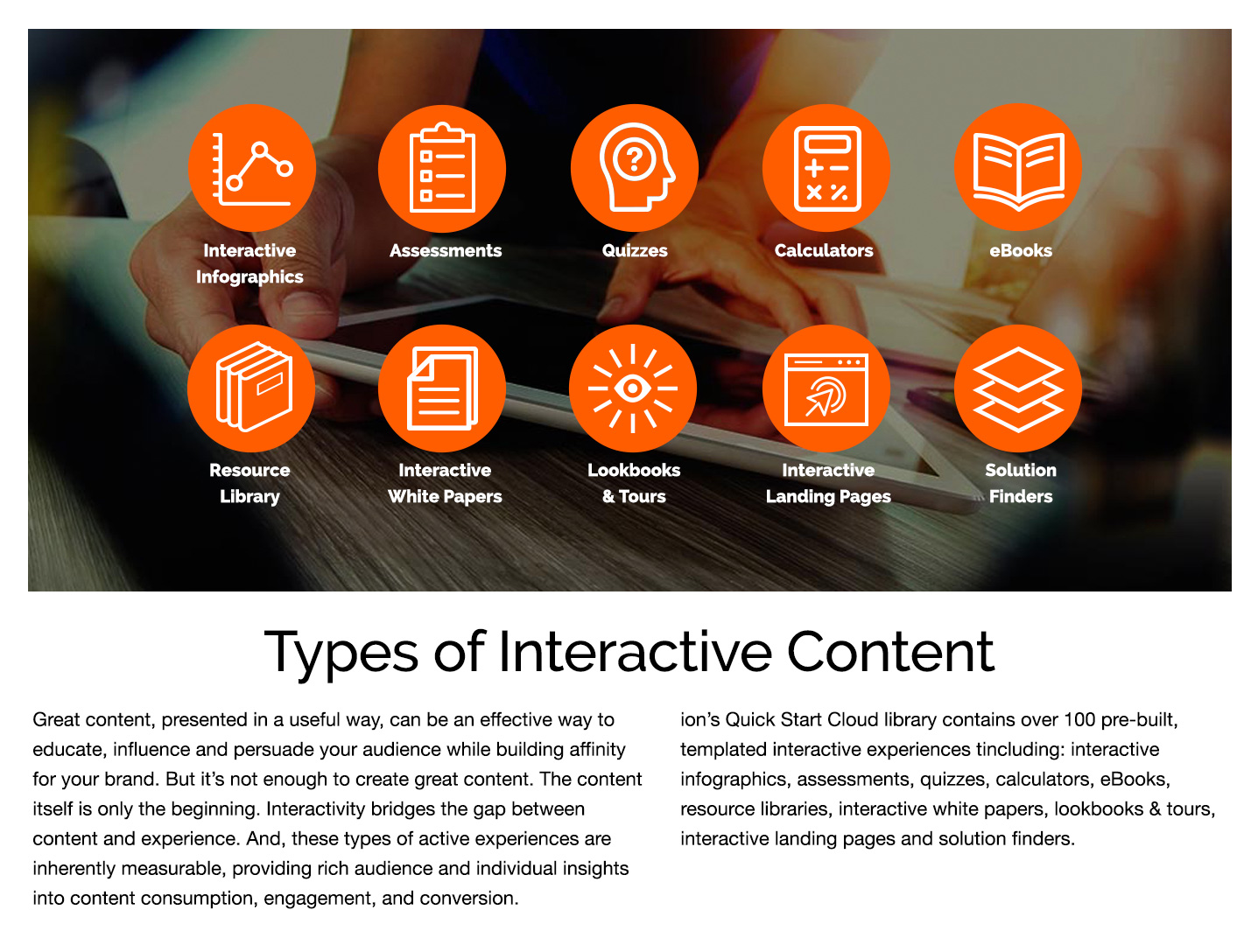
Ion is an enterprise-grade content experience platform that empowers modern marketers and designers to create no-code interactive content experiences integrated with their CRM or marketing automation tools. Ion helps enterprises to build brand awareness and increase conversions and lead generation enriching their contact database with declared, high intent data. Ion helps brands launch quizzes, ROI calculators, assessments, interactive infographics, and other interactive formats in…
N/A
Pricing
Adobe Experience Manager
Ion, by Rock Content
Editions & Modules
No answers on this topic
Managed Services + SaaS
Custom
per year
Offerings
Pricing Offerings
Adobe Experience Manager
Ion, by Rock Content
Free Trial
No
No
Free/Freemium Version
No
No
Premium Consulting/Integration Services
No
Yes
Entry-level Setup Fee
No setup fee
$5,500 per customer
Additional Details
—
ion’s Build Anything SaaS platform provides organizations with an entirely new and agile interactive content marketing capability. It enables non-technical marketers and designers to create, test and measure an unlimited number of all types of interactive content marketing experiences. It includes unlimited seats, experiences, tests, customization, phone and email support, analytics and more.
Compared to Adobe's products, I prefer ion. However, Optimizely is slightly more intuitive to use than ion, but the value comes in big savings over Optimizely's prices.
Currently our business uses both ION and Adobe CQ. I much, MUCH prefer ION. ION is far more intuitive. It is much easier to navigate. The learning curve is much shorter in ION.
So one of the primary focuses in the company has been SEO, and it does not seem well suited to SEO. For instance, how we set up the alt image tags. It's pretty tricky and there are multiple steps to do that. So I would like to see an Adobe Experience Manager that is more focused on out-of-the-box solutions for SEO, schema coding, alt image tags, and other sorts of SEO functionality to have that more built into the vanilla version of the product. Well suited? It's very good at scalability. And because we're managing such a large number of hotel properties, it works well for an enterprise.
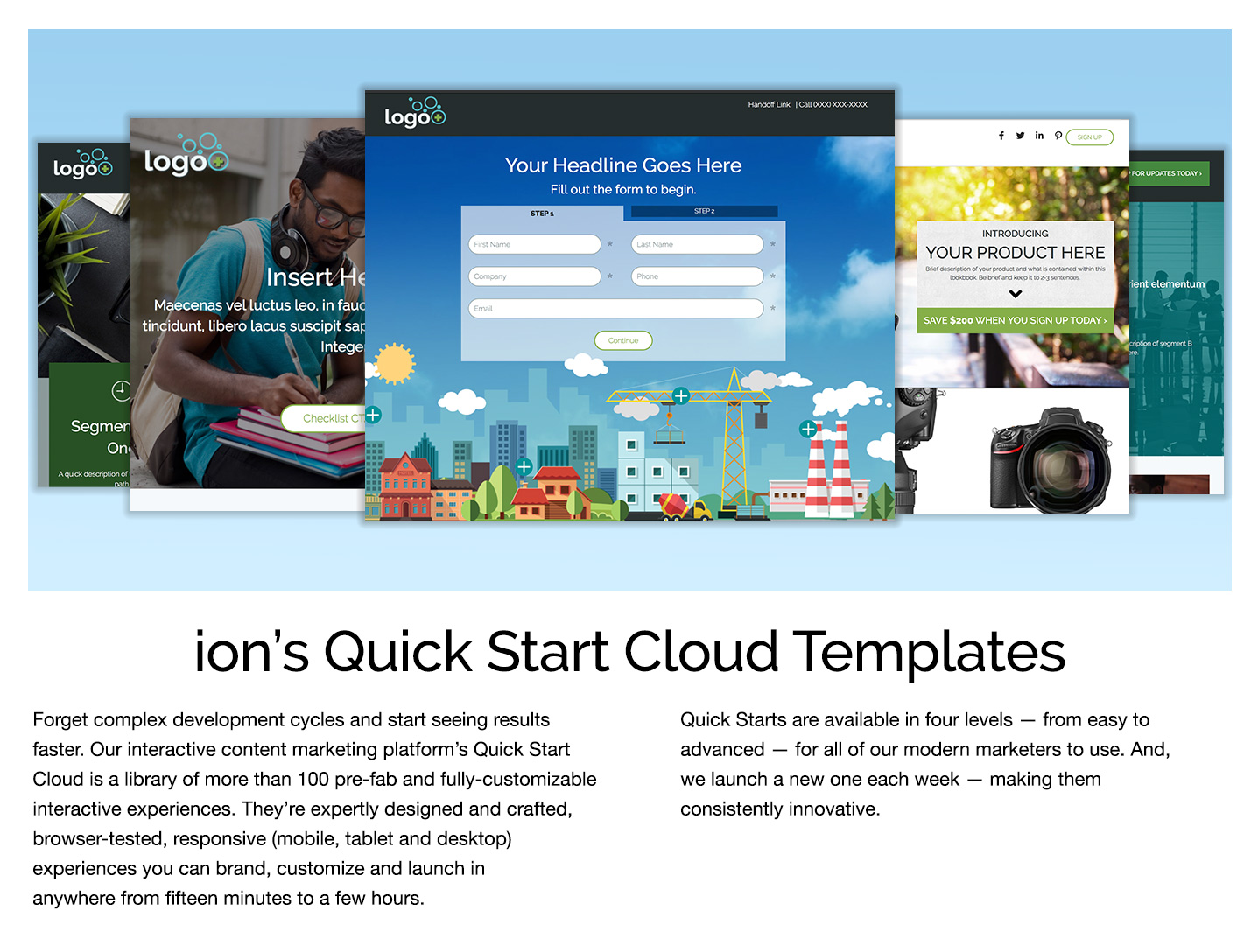
If you want to choose a quick start template and fill in the fields with your content, Ion will be fantastic for you. We've done this with whitepapers and quizzes and it's been great and extremely easy to use. If you have an exact idea of what you want, and a background in web development, you may get frustrated. Ion has some quirks that make it tricky to fully customize - everyone once in a while I really just want to go into the HTML and make some changes, but can't. If you are looking to reuse a piece of content for specific targeting (industry or account-specific), Ion is great. The dynamic substitutions are great and very helpful.
It is able to support our incoming volume. We're one of the largest in what we do in the country, and we've not had any issues in terms of how it performs, or how it scales our customers coming in. It's a fairly stable platform. It is also a very intuitive platform in us being able to give our business users the ability to come make changes and request additions without going through a huge lift in getting those requests implemented. It has also been a very developer-friendly platform for my team to be able to develop, adapt, and build. We're also expanding on being able to use AEM both as a pure content management solution and also as a headless content solution. So that way we are trying to build a unified content platform that would allow us to create, publish, and manage content across channels from one place. So it's fairly intuitive that way. It's fairly scalable. Obviously, the modern tooling helps, but overall I think it's been a good experience.
I think some of the key things that can be done better is today we have more point solutions for different things like personalization. We have Adobe Target and for email marketing, we have Adobe Campaign Marketer and all that kind of stuff. But truly I have worked both as an implementation partner for Adobe as well as now I'm a client of Adobe. Being in both those shoes, I can say that we can do a lot better in terms of beefing up the capabilities of AEM, bringing personalization and search and content search experience closer together. It would definitely put Adobe Experience Manager in a different league if we can bring all those personalization capabilities together. I think initially the content management systems, the market was mostly meant to serve static sites. It never matured into that full-scale content personalization being married together. I think that's one area where if those integrations rather than being point solutions, if those capabilities can be made more native to AEM, I think it would definitely be a big sell for a lot of customers.
Ion University, while stacked with a wealth of information, is difficult to navigate from a troubleshooting perspective. The tutorial videos are all very helpful, but they are also very long. Sometimes I would want to search for how to address a particular issue I was struggling with and it would be a two-minute segment buried in a 45-minute video.
Again, getting back the self-guidance side of things. I think a lot of the tutorials are set up in a way that makes sense to Ion, but not as much to the end user.
I think the controls admins use when creating new users could be a bit more straightforward.
We had and still have a fantastic experience using Adobe CQ. Lots of flexibility, great integration with other Adobe products we already use and a powerful technology make it a great fit for our corporate environment. Also as the community grows, it makes it easier to network with other developers and users to get new ideas on how to continue to get the best out of the software.
We use it for every landing page and we plan on only doing more dynamic content creation. We dont see that option coming in-house any time ever in the future. ION has a very robust platform for us to work with that really allows us to do more for our customers in regards to having the one-to-one conversation.
From our learning curve until we got better. I'd say as we're moving forward and we're making more customizations and we're getting used to it, I'd say it's about a seven or an eight. But as more innovations and more information comes out from Adobe as they make more changes and they make improvements, I'd say they're getting probably about an eight right now.
Usability is straightforward, with extensive documentation and tutorials provided to ensure landing pages are built to specifications and can be optimized for performance. Built-in platform funnels give insight into customer dropoff, success/failures, and conversions (at a glance). Setting up a landing page can be done quickly and easily, with numerous integrations (CRMs like SalesForce, for instance) supported
Being part of Adobe Suite means you are already notified when the tool has any outages. However, I have never faced unplanned outages. Whenever you face any issue with the site, it is clearly stated if there were any planned outages and how quickly you will be back to normal. So, I will say that even the outages are planned and managed in a great way like their other services.
With respect to performance, Adobe experience manager is one of the best in the CMS space. We didn't observe frequent slowness on platform, however the systems which are accessing experience manager should be of good specifications without which slowness would be observed. Adobe experience manager works well in integration with other solutions, unless the destination application is designed to trigger frequent calls to AEM.
Adobe Experience Manager, in all its capacity, is a great alternative to any other CMS you are using. It helps in rapid development and makes life easier for maintaining the website for multi-language sites. Technical know-how is eliminated at content authoring. Better documentation in terms of live examples with videos would be appreciated.
The ION support team is amazing. There has not been a single issue they they could not solve for me. If there is a feature or request that they do not have, they have even, on occasion, created custom scripts for our team. *Update 6/5/17 - ION has continued to delight on multiple occasions. I appreciate their attention to detail and ability to solve whatever issue I have. After 3+ years of use and support, ION still has my full endorsement.
They offer a great amount of online training, videos, articles, etc. There is usually an answer available if you run into an issue. I would recommend taking advantage of the online training they offer. I wish I would have done it sooner.
Depending on your individual needs, It is really quite simple to create an authoring experience for a website that looks really good. I have been part of many implementations and many teams and have seen many projects that were super successful and others that were not implemented well. AEM has room for a lot of flexibility in the implementation process compared to other CMS like SharePoint
There were a lot of things we learned about the tool once we really got in and got our hands dirty. Being hands-on was essential for our team to be able to utilize ION in the most effective manner.
At Canadian Tire Financial, in the time I've been there, we've always used AEM, but in past places I've used WordPress, I've used Squarespace. Things that are more general user-friendly where you're like building your own blog or you're creating a small business website where it's basically just text, you're not intaking information or something like that. I think the customization options in AEM are huge. My experiences with WordPress were pretty straightforward. Again, it was like, I don't know, like college newspaper website or something like that where you're just like putting content up for people to look at. You're not necessarily taking in any other information. Maybe you might allow people to log in or something and save articles or something pretty straightforward, but then even then I remember that stuff taking me forever to do, to figure out and scroll through tons and tons and tons of documentation. It's just not fun. No one enjoys doing that and then even then you might not have the answer available to you. And that's so frustrating. Hey, it's super user-friendly, figuring out the content editor is pretty straightforward. You're not clicking around and being, "what the heck am I looking at?" Or you're not looking at a bazillion menus to be like, "maybe the thing I want is in here." I can't stand that. I want to be able to look at a page, see what I'm going to be getting in production, and then publish it. I don't want to look around in menus to figure out how to add something to a page.
I was not the decision maker to choose this over Uberflip, but the UI is much more appealing to me. It's incredibly easy to use, clean, and from a backend standpoint, it requires little to no tech savvy'ness. Our team has really enjoyed using it and has required no training what-so-ever.
Instead of being directly involved in the tool purchase, I am involved in analysis or what we can use to maximize the tool. Small organizations may find it expensive. However, if the team or organization focuses more on your ROI or the features you will get, then it will definitely be worth it. Pricing is based on a number of factors, including team size or the use of the tool. The user can select the pricing option that best fits their needs based on the number of form submissions they make or the number of pages they wish to publish on their global/multisite sites.
Separate client portfolios enable scalability, however, some elements are still grouped for all accounts so it's difficult to scale for an ad agency with multiple clients. Would prefer totally separate sections of the platform for all clients with each element housed separately.
The professional services team within adobe is one of the best in terms of technical and solutioning knowledge. However, considering the billing charges of adobe professional services team, it is always recommended to involve them during platform initial setup or when a complex solution is to be built with platform customizations.
This actually has been great for our websites. In the time that I've been with the company, we've seen at least the profitability of our websites because we are measuring that through analytics. We've seen it double since using it. We were using it when I first started with the company, but we've gotten better at how we're using it and really optimizing the use as well as the design. I think that that's made a huge difference. We've seen a huge jump in the performance of our websites with maintaining users and the e-commerce side of it.
Though we have not had the service long enough to see any measurable outcomes, we've been able to create interactive web content faster than ever before
The speed with which we can build interactive pages and re-use assets has been critical as projects we've done with Ion have made their way around and more and more internal clients have said "me too" for their own projects
It is very pricey at $28K for the base annual subscription (dropping to $24k after the first year), so depending on your budgetary situation, that may make no sense for your team--but we had contract money set aside for a company to build us a microsite for around the amount, so we just used it for Ion instead and will now be building the microsite ourselves using it