TrustRadius: an HG Insights company

DbVisualizer

Score9.7 out of 10

106 Reviews and Ratings

What is DbVisualizer?

DbVisualizer is a database client and SQL tool used by developers, DBAs, analysts, and data engineers to work with relational and NoSQL databases.

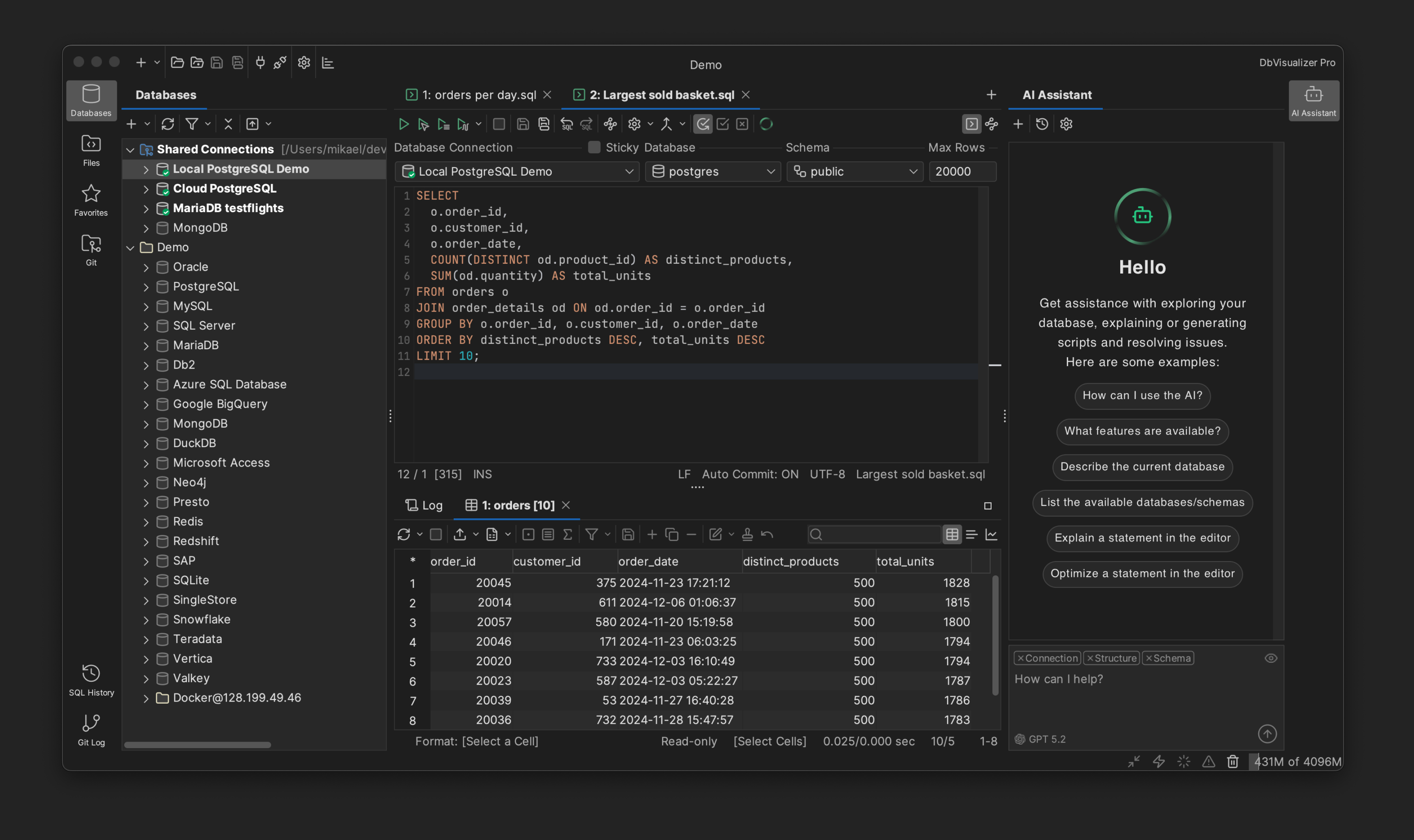
It provides a graphical interface for exploring database structures, managing schemas and database objects, and running SQL queries across multiple database systems through JDBC drivers, including MySQL, PostgreSQL, SQL Server, Oracle, Snowflake, SQLite, Cassandra, and BigQuery. The tool also includes an AI assistant for generating and explaining SQL queries, and built-in Git integration for version control of SQL scripts.

The platform includes a feature-rich SQL editor with autocomplete, formatting tools, and visual query building to support SQL development and database analysis. Users can browse tables and views, edit table data, inspect indexes and constraints, and customize their workspace with configurable layouts, themes, and shortcuts.

DbVisualizer runs on Windows, macOS, and Linux and is used worldwide, with nearly 7 million downloads and Pro users in over 150 countries.

Media

SQL formatting
ERD diagram
Auto complete
Database connection
Database connection
Integrated AI Assistant

1 / 7

Top Performing Features

  • Schema maintenance

    Maintaining schema integrity via regular maintenance

    Category average: 8.6

  • User management

    Tools to help manage user and role administration

    Category average: 8.4

  • Performance optimization tools

    Performance optimization tools measure and maintain overall responsiveness and efficiency of queries, database structures, etc.

    Category average: 8.1

Areas for Improvement

  • Database status reporting

    Detailed reports on database performance, configuration, security, vulnerabilities, etc.

    Category average: 8.2

  • Database security

    Security maintenance such as authorization management, log analysis, database auditing

    Category average: 8.2

Our go-to database tool.

Use Cases and Deployment Scope

We’re a digital marketing agency with a large data warehouse that uses multiple databases, and we interact with many database types and integrations for our own needs as well as those of our clients. DbVisualizer makes this very simple with easy integrations to every type of database we’ve needed to connect to, with a fantastic UI that makes working across databases easy and all in one spot.

Pros

  • Out-of-the-box support for many different databases.
  • Intuitive UI for interacting with data.
  • Flexibility of SQL Commander for writing scripts.
  • Great support for working with JSON data in recent updates.
  • Database connections over SSH.
  • Table relationship visualization is very helpful.
  • The tree view is well organized in how it splits out schemas.

Cons

  • Would be great if we could update individual JSONB properties directly in the JSON viewer window.
  • Sometimes, when a table structure is changed (e.g., adding columns), the changes are not reflected when viewing the table because the old structure is still cached.

Return on Investment

  • Faster access to more typically “web-based” data, like BigQuery, for more rapid prototyping and exploration.
  • Parameterized queries in SQL Commander have become our go-to for getting fast answers to common questions about our data.

Usability

Alternatives Considered

SQL Server Management Studio (SSMS)

Other Software Used

Google BigQuery, PostgreSQL, Apache Hadoop, MySQL, Db2

A great software product

Use Cases and Deployment Scope

As a software developer I build and support products with many different types of database connections. DbVisualizer gives me one coherent workspace to work with a wide variety of data sources that support SQL. And it runs in exactly the same way across different operating systems.

Pros

  • SQL intellisense
  • Exports to spreadsheets
  • Data editing in tables
  • Graphical table altering
  • Remote connections via SSH

Cons

  • Nothing

Return on Investment

  • Saves me time every day
  • Presents complex data tasks in a way the give me certainty that I am handling it in the correct way, not missing essential details.

Usability

Alternatives Considered

Oracle SQL Developer, MySQL Workbench and DBeaver

Other Software Used

Eclipse, LibreOffice, Fedora Linux

DbVisualizer is a great IDE

Use Cases and Deployment Scope

I perform Data Engineering with DbVisualizer to power our the analytics of our entire company. The product is great for not only that, but also writing ad hoc queries and doing deep analytics. Its easy to export data into Excel and also add/update rows or values within the tool without needing to write the UPDATE statement yourself. Its easy to use and I recommend it to anyone looking for a nice IDE.

Pros

  • Export to Excel
  • Object navigation
  • DDL viewing

Cons

  • The Excel export sometimes bugs out

Return on Investment

  • Faster analytics
  • Faster data engineering development

Usability

Dbvi going strong since 20 years.

Use Cases and Deployment Scope

We use dbvis to test database connections during the installation of our product on customers' servers. This lets us verify that a connection is not 'lost' on the way to the database. As we use JDBC as our primary connection method, DBIS provides an easy, additional, and independent way to test the connection. We use dbvis to check stored data, review table structures and metadata (e.g., when selects or inserts fail), and verify table permissions for the user who is having connection issues. We love the in-cell data editing feature, which is much easier than building SQL queries for every entry. This also allows a quick manual review of the stored data, even with large tables, and fixes the most obvious errors instantly. We test, build, and also 'deconstruct' SQL queries when there is a need to check on long-running queries. This helps us identify, for example, misused indices and other issues. We use it to easily export complete tables and data for a wide variety of DBMS for our customers and ourselves. It helps us visualize relationships and identify faults that are often not obvious within our codebase.

Pros

  • Easy visualize Db-data.
  • Connect to a wide range of Dbms.
  • Ease of data manipulation.
  • Managing a great number of different Db-connections.
  • Work with big queries.

Cons

  • Support for troubleshooting on a Dbms level.
  • Automatically suggest syntax differences with different Dbms.
  • Sharing of Db connections.
  • Startup time.

Return on Investment

  • It allows us to query databases without paying extra for proprietary tools or worrying about licensing.
  • It is one tool that replaced several others.
  • We need to build know-how for only one tool, not several, so developers can spend their time working rather than figuring out other tools.
  • We need more licenses than we have developers. A 'per person' licence or a 'per install' licence would be great.

Usability

Alternatives Considered

DBeaver and Toad Database Developer Tools

Other Software Used

pgAdmin, IntelliJ IDEA, Eclipse, Apache Tomcat

My standard way of querying databases for over a decade

Use Cases and Deployment Scope

I need to routintely check data in Oracle, DB2, Cassandra databases

Pros

  • love the ability to edit data in cells like a spreadsheet
  • organising all my connections in to folders and marking them as prod with yellow and black stripes
  • the filters so I can hide database objects that I am not interested in

Cons

  • I would like to see the "References" tab and its functionality expanded to allow it become even more powerful to support documentation requirements

Return on Investment

  • I am a developer so cannot really comment on specific ROI. But my general consensus is that the licence is worth the money I pay for as a freelancer to provide a more efficient and useful service to my clients

Usability

Alternatives Considered

Oracle SQL Developer

Other Software Used

IDEA, Postman, Docker