TrustRadius: an HG Insights company

Flowgear

Score9 out of 10

5 Reviews and Ratings

What is Flowgear?

Flowgear is an integration platform that enables organizations to build and manage application, data, and API integrations across cloud and on-premise environments from a single interface.

The platform supports both technical and non-technical users, allowing teams to create, edit, and maintain enterprise-grade integrations for internal systems, customers, and partners. Flowgear provides a code-free, drag-and-drop visual designer with a library of prebuilt connectors and templates, enabling reusable workflows that automate repetitive processes and reduce integration complexity.

Media

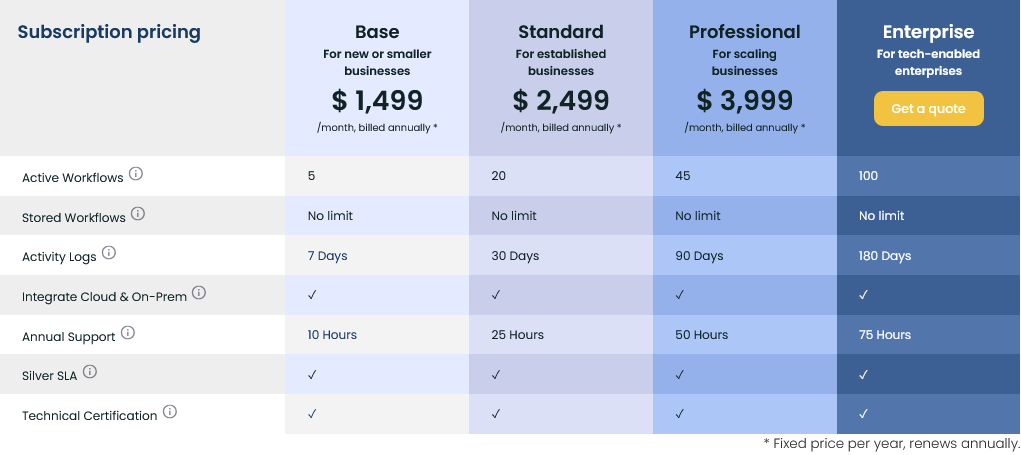
Pricing Model
Flowgear Key Features
High Cadence Value Propositions
No Code
Design Canvas and Activity Logs
Sample workflow - Import Sales and Purchase Order

1 / 6

Top Performing Features

  • Data security features

    Data security features include rights management, LDAP integration, password encryption, etc.

    Category average: 8

  • Support for real-time and batch integration

    Software supports both real-time and batch integrations

    Category average: 7.7

  • Pre-built connectors

    Pre-built, tested connectors to a wide variety of applications such as ERP, CRM, HCM, Marketing Automation, etc.

    Category average: 8.4

Areas for Improvement

  • Data quality services

    Software includes capability to perform data profiling, deduplication, cleansing etc.

    Category average: 8

  • Connector modification

    Provision for modification of pre-built connectors to suit specific environments

    Category average: 7.8

  • Monitoring console

    Central console for monitoring resource utilization, system health, ability to start and stop processes, etc.

    Category average: 7.7

Integration the Easy Way

Use Cases and Deployment Scope

We use the product to do mapping and transformation of data for a product that we've developed. Flowgear has given us the ability to address our business use case. The various sources to integrate into Flowgear has also allowed us to easily make use of them whether they were by connecting via drop points or just directly to our resources.

Pros

  • various integration nodes to choose from
  • ease of mapping
  • quick drop point updates and installations and automatic updates

Cons

  • Learning should be easy for even a beginner
  • Users may find the platform a bit overwhelming if they do not understand it

Return on Investment

  • deploy product faster to market
  • easy to onboard various integrations
  • costly support hours
  • Competitive pricing packages suited to what one chooses
  • Assists with getting the job done in-house so you don’t have to hire expensive consultants.

Other Software Used

Azure Logic Apps

Pro services!

Use Cases and Deployment Scope

We use flow gear to build processes to simplify our work and increase productivity and efficiency. Time has been a key factor in resolving problems and flow gear provides quick solutions to complex tasks. Training is provided when needed with easy to learn and follow guides that makes learning fun.

Pros

  • efficiency
  • increase productivity
  • cut costs

Cons

  • Easier way of opening support requests
  • On screen pop ups
  • One click videos

Return on Investment

  • increased productivity
  • efficiency
  • and reduced time and costs

Alternatives Considered

Gartner Peer Insights

Other Software Used

LastPass for Business, Microsoft 365, Canvas X Draw (Windows)

Cloud-Based iPaaS Removes Barriers to Integration

Use Cases and Deployment Scope

Making use of FlowGear removes barriers to the market when it comes to integrating Operational Systems with Record Systems. Their extensive pre-build nodes allow for integration from our Supply Chain solutions to a wide range of ERPs and record systems. Benefits of FlowGear when doing integration: 1.) Ease of use - Any resource that is trained can manage to maintain, build and manage the integration layer 2.) Re-usable - an effort made for one integration can easily be replicated especially when using the extensive pre-built nodes 3.) Excellent customer service from FlowGear allows for in-process learning and training. They are readily available to assist when you get stuck in your solution building.

Pros

  • Easy node code front end
  • Excellent Customer Service
  • Adding new pre-built integrations on a regular basis

Cons

  • More detailed examples on some of the uses of the Nodes
  • Upgrade and improve some of the samples in pre-built nodes

Return on Investment

  • Ease of Integration
  • Shareable Costs
  • Range of Customers

Other Software Used

Snagit, Microsoft 365, Notepad++

Simple Yet Powerful Integration Platform

Use Cases and Deployment Scope

Flowgear provided the most complete, simplistic yet powerful middleware tool in order to integrate and connect our systems. It provided automation in areas that were solely lacking. Having the capability to develop, test and deploy a solution within minutes further extends and shows how quick and easy the platform is to use.

Pros

  • Point to point integration
  • Automation
  • ETL
  • Data Engineering

Cons

  • User interface can be confusing at first
  • Better API management - API Gateway
  • Use roles and segregation

Return on Investment

  • Decreased time to market
  • Empowered users
  • Upskilled employees

Flowgear

Use Cases and Deployment Scope

The product has enabled my team to design automation workflows and integrate with various systems seamlessly saving my team extensive development time. Without Flowgear, my team would have spent additional time designing and developing solutions trying to interface with various systems and networks in a secure manner that Flowgear manages natively.

Pros

  • Workflow version control and deployment through development, UAT and Production environments.
  • Numerous prebuilt connectors available for quick workflow design and development.
  • Enables reliable workflow automation with detailed logging aiding in troubleshooting.
  • Allows for multiple environment workflows

Cons

  • Enabling the Always On functionality in multiple environments instead of only the production environment.
  • Easier means of navigating larger or complex workflows.
  • Increasing the existing timeout functionality or allowing for this to be configured at a user level.

Return on Investment

  • Positive impact by saving my team the development effort for automating various tasks.
  • Positive impact on the team due to the ease of use and built in capabilities of the product.
  • Positive impact with the logging features allowing my team to efficiently troubleshoot and resolve issues when something fails.