TrustRadius: an HG Insights company

HubSpot Marketing Hub

Score8.5 out of 10

2,281 Reviews and Ratings

What is HubSpot Marketing Hub?

HubSpot's Marketing Hub is an all-in-one inbound marketing engine that includes tools for email marketing, landing page creation, social media marketing, content management, reporting & analytics, search engine optimization (SEO), and more.

Media

Screenshot of Marketing Automation with HubSpot. Here, marketers can define workflows for highly targeted and personalized nurturing campaigns that send leads and prospects the right targeted content at the right point in their decision-making process.
Screenshot of HubSpot Analytics. These help track engagement with the entire funnel through real-time reporting on website performance, traffic and marketing effectiveness.
Screenshot of HubSpot Social Media. HubSpot’s social media publishing helps improve scheduling and publishing social media content.
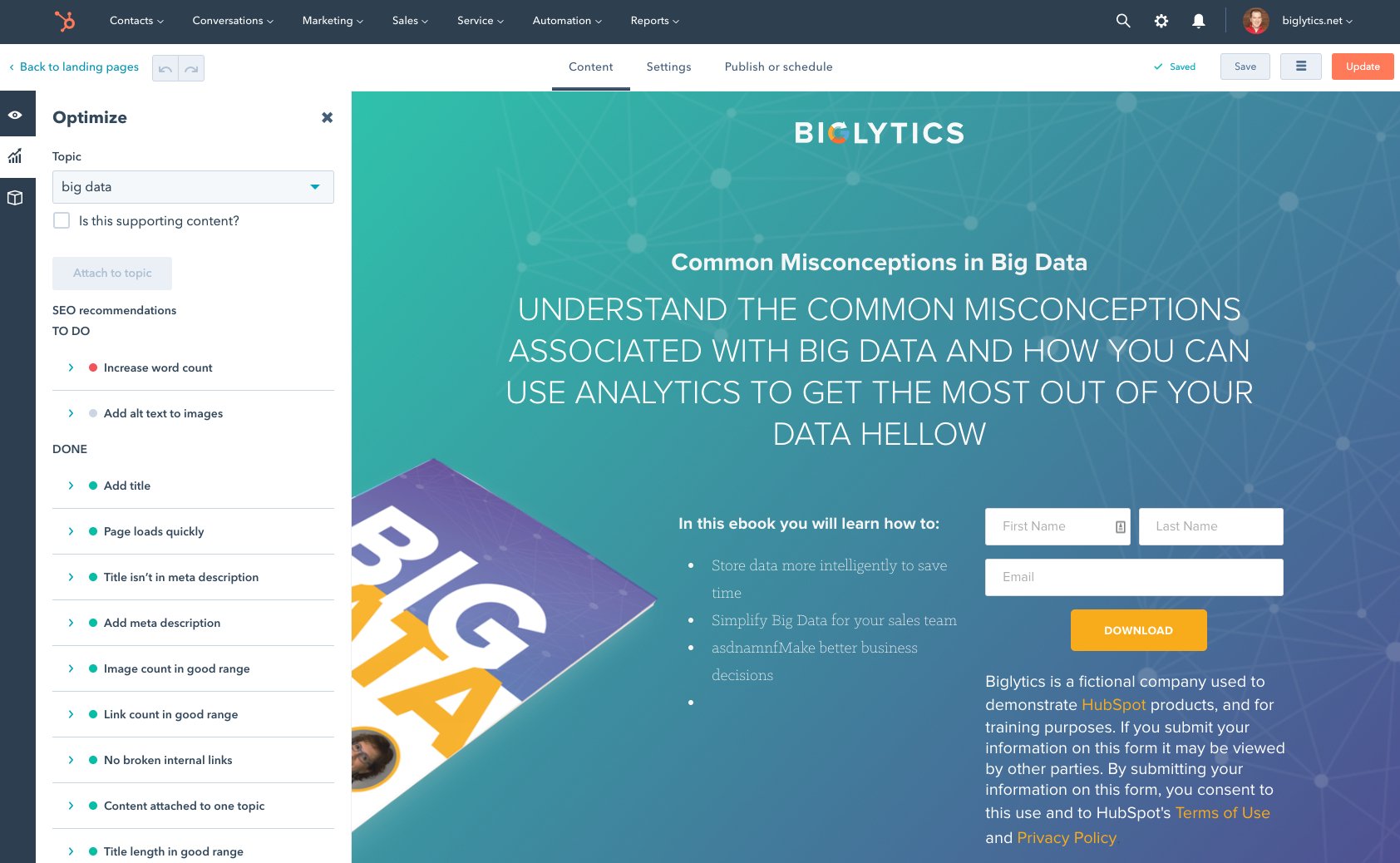
Screenshot of HubSpot Blogging and SEO. HubSpot provides an integrated set of tools for Search Engine Optimization (SEO) which makes getting found online a natural part of the inbound marketing mix. More than a simple CMS, HubSpot provides an integrated authoring view with SEO-oriented suggestions as blog posts are written.
Screenshot of Marketing Automation with HubSpot. Here, marketers can define workflows for highly targeted and personalized nurturing campaigns that send leads and prospects the right targeted content at the right point in their decision-making process.
Screenshot of HubSpot Contacts. Integrating with most common CRMs, HubSpot provides a view of view contacts, and allows for customized and personalized email communications.

1 / 6

Screenshot of Marketing Automation with HubSpot. Here, marketers can define workflows for highly targeted and personalized nurturing campaigns that send leads and prospects the right targeted content at the right point in their decision-making process.

Top Performing Features

  • Automated sales alerts and tasks

    The software helps ensure that a sales person is notified of lead activity and can act on the information in a timely fashion.

    Category average: 8.1

  • List management

    This involves creating, filtering, editing, merging and de-duping lists of contacts.

    Category average: 8.5

  • Triggered drip sequences

    The software allows users to set up automatic / drip email campaigns triggered by certain events.

    Category average: 8.7

Areas for Improvement

  • Integration with SugarCRM

    The software can integrate with SugarCRM bi-directionally, allowing for data syncs, activity alerts, campaign triggers, enhanced reporting, and lead assigning.

    Category average: 7.5

  • Social sharing and campaigns

    Users can incorporate social share buttons into campaigns to allow recipients to easily share content. Users can track shares as well.

    Category average: 7

  • A/B testing

    Users can experiment with different variations of a campaign and measure results. Testable aspects might include subject lines, header images, or landing page copy.

    Category average: 7.9

HubSpot Review

Pros

  • HubSpot makes it easy to ensure that all our Blog content is optimized for SEO - it helps us with keywords, meta descriptions, CTAs, images, and more. With every blog that goes up, I'm confident it is as strong as it can be.
  • HubSpot has helped us organize leads and contacts into lists so we can provide helpful and relatable information to nurture them along on the buying process and also see each client as a trustworthy, knowledgeable source.
  • With HubSpot, we can track the success and shortcomings of eNewsletters. HubSpot helps with the setup process, gives sending guidelines (time, subject line, etc), and gives us a depth of information about who opens the emails, when, what they click, and more.

Cons

  • It would be nice to be able to select a date range when checking the rank and success of keywords in the keyword reporting tool
  • HubSpot sends great, thorough monthly reports for each of our client, but it'd be nice if we had the option to get the reports quarterly instead.
  • Right now HubSpot Ads Add-On/Integration only works with LinkedIn and Google Adwords - so we're still using other resources for things like Facebook, Twitter, etc.
  • We'd love to see HubSpot find a way to use Instagram and be able to schedules posts like we can on other social channels.

Return on Investment

  • More qualified leads
  • Better Developed Lead Nurturing Process
  • Stronger, well-placed content has helped build awareness and brand identity
  • Increased revenue for several clients

The honest review of HubSpot Marketing Hub

Use Cases and Deployment Scope

I use for marketing purpose specifically, where i run campaigns under HubSpot Marketing Hub. Its advanced features has automated many manual tasks in my day to day professional life. Its CRM tool gives notifications, groups customers as per their profile to target at granular level. I can check each emails rate of conversion by looking at the open rate, click rate etc which is really helpful in deciding to take this email to lower funnel or not. The UI is also simple to understand

Pros

  • Email Anaytics
  • A/B testing
  • social media inegration

Cons

  • While multiple price options are available, the best options are available with the expensive packages which is difficult for a small organisation to bear.
  • Although the UI is simple, it doesnt provide much customisation. You can only see limited view of your campaign performance.
  • AI integration is required as lot of manual work is there

Return on Investment

  • Its our go to tool for email marketing
  • It is a great tool for email marketing considering you are using the costlier packages
  • It is not a great tool for social marketing

Usability

Alternatives Considered

ACTIVE Camp

Other Software Used

Salesforce Agentforce Marketing

Robust but maybe too much

Use Cases and Deployment Scope

Using HubSpot as a CRM and email marketing system, I was in charge of automations, email marketing, database management and client management. We needed an extended database for our custom fields but also automations to segment and email different groups according to their interaction with the brand. Our main need was to keep everything centralized and at the same time in a robust platform that could grow with us.

Pros

  • Extended CRM
  • Automations
  • Attribution

Cons

  • UI/UX is complex
  • It is robust but maybe too robust for most cases
  • Expensive

Return on Investment

  • Extremely expensive
  • We eventually moved away

Usability

Alternatives Considered

ActiveCampaign

HubSpot Marketing Hub - only martech Id die on a hill to keep

Use Cases and Deployment Scope

It's our classic CRM system. We use it to track all prospects and deals. Build dashboards and pipeline reports. On the marketing side, we use it to run email campaigns, post on social, and build target account lists. We also leverage it for events, web forms, and landing pages. It's our wholistic system for aligning sales and marketing.

Pros

  • Running email campaigns is really easy. Using segments, email templates, it's turnkey.
  • It's a great way to build target account lists and track progress with sales
  • It's a great tool for building reports and dashboards for senior leadership

Cons

  • The AI suggestions have improved, but I think it could be more custom
  • I wish there was better reporting for social. It's not as robust as other platforms.

Return on Investment

  • We are a low volume, long sales process but it's easy to track pipeline numbers
  • It's the only tool in our tech stack I would die on a hill to keep

Usability

The best Marketing CRM

Use Cases and Deployment Scope

We use HubSpot Marketing Hub to facilitate the majority of our Marketing activities. We use it for our CRM, for emails, landing pages, as a content hub, for automated workflows, and for our reporting. It is connected to our SalesForce instance for more in-depth Marketing reporting. We were looking for a one-stop shop tool that was intuitive and easy to use. By having all of our Marketing data in one place, we are better able to track our impact and ROI.

Pros

  • Reporting / Dashboards: It is easy to set up different reports to track impact. The platform surfaces relevant way that is easy to understand and actionable.
  • Workflows: Workflows are easy to set up and edit on the fly. A specific use case we love is that you can create email nurture programs, set them live, and then edit the workflow without pausing it (i.e. if all of your content is not ready at the same time).
  • Email and Landing Page Creation: Editing and creating emails and landing pages with drag and drop functionality.

Cons

  • Influenced and Sourced Pipeline reports could be easier to set up
  • Creation of "calculators" for landing pages (i.e. showing a prospect the ROI of using our product after then input information into a few fields)

Return on Investment

  • We went from not being able to track Marketing impact to being able to attribute 40% of our pipeline to Marketing sourced activities
  • We went from primarily using events as our main source of new pipeline to being able to track engagement from email marketing, content downloads, and social media

Usability

Alternatives Considered

Salesforce Marketing Cloud

Other Software Used

Figma, Canva, monday.com