TrustRadius: an HG Insights company

Save this comparison

Save this comparison

Add Product

Recommended Comparisons

    Overview
    ProductRatingMost Used ByProduct SummaryStarting Price

    IBM Terraform

    Score8.7 out of 10
    N/AIBM Terraform (formerly Hashicorp Terraform) is a cloud infrastructure automation tool used to create, change, and improve production infrastructure, and it allows infrastructure to be expressed as code. It is available Open Source, and via Cloud and Self-Hosted editions.

    $0

    Radar by Skyhook

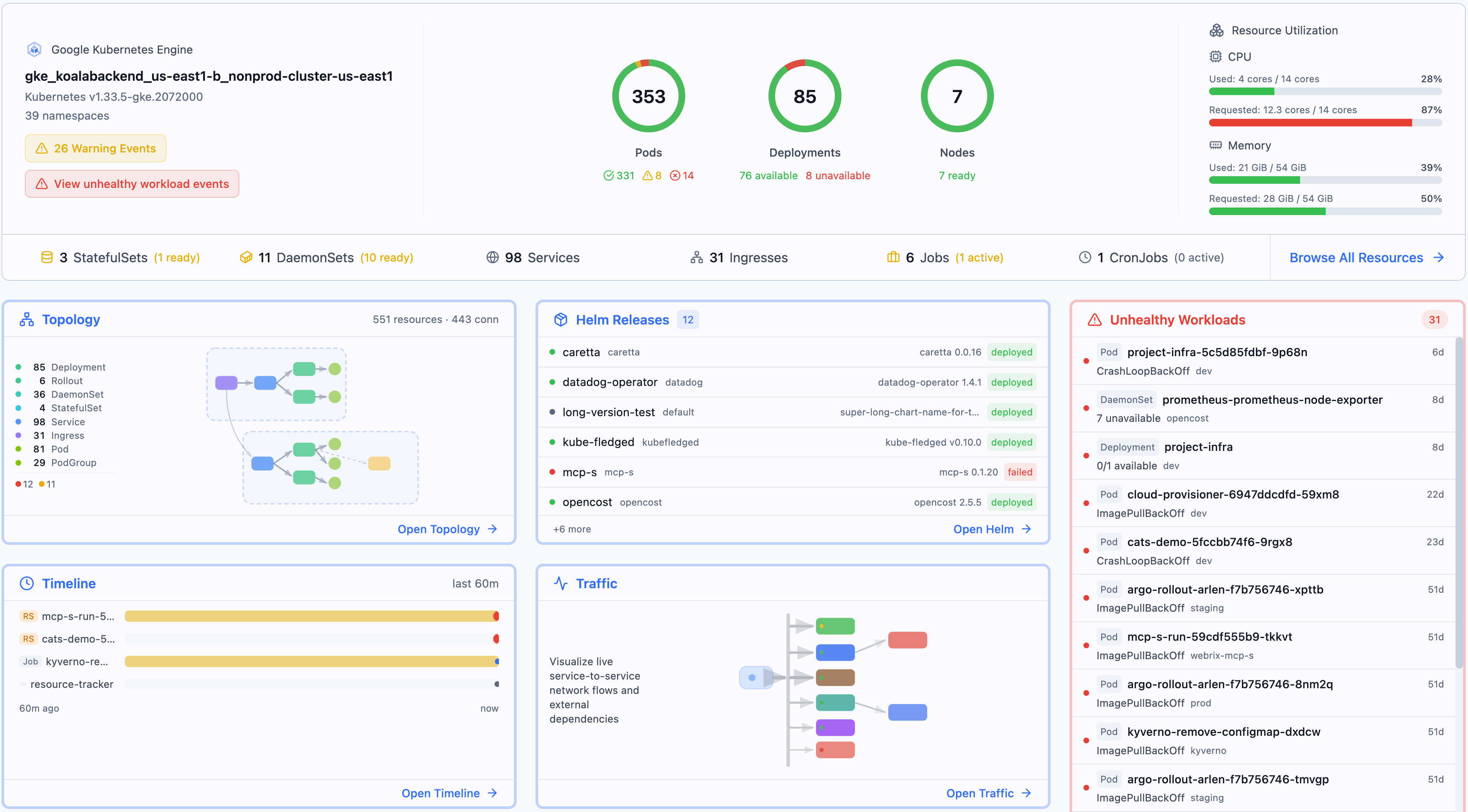
    N/AN/ARadar is an open-source Kubernetes interface designed for the humans and AI agents that operate clusters. It addresses a common gap in Kubernetes workflows: clusters are easy to query with kubectl, but hard to understand. Radar presents a live cluster over two surfaces, a graphical UI for engineers and a built-in MCP server for AI assistants, so both can make sense of what is actually running. Deployment Radar runs as a single Go binary that talks to the…

    $0

    per month per installation

    Pricing
    IBM TerraformRadar by Skyhook
    Editions & Modules
    Open Source
    $0
    Team & Governance
    $20/user
    per user/per month
    Enterprise
    Contact sales team
    Radar OSS
    $0
    Cloud Free
    $0
    Up to three connected clusters
    Team
    $149
    per month per cluster
    Enterprise
    $299
    per month per cluster
    Custom
    Contact Sales
    Offerings
    Pricing Offerings
    IBM TerraformRadar by Skyhook
    Free Trial
    NoYes
    Free/Freemium Version
    YesYes
    Premium Consulting/Integration Services
    NoNo
    Entry-level Setup FeeNo setup feeNo setup fee
    Additional Details—Discount of 20% for commercial plans.
    More Pricing Information
    Community Pulse
    IBM TerraformRadar by Skyhook
    Considered Both Products
    IBM
    No answer on this topic
    Skyhook Radar
    No answer on this topic
    Key User Insights
    Would buy again
    95%
    Would buy again
    21 Answers
    No answers on this topic
    Delivers good value for the price
    100%
    Delivers good value for the price
    20 Answers
    No answers on this topic
    Happy with the feature set
    95%
    Happy with the feature set
    21 Answers
    No answers on this topic
    Lived up to sales and marketing promises
    100%
    Lived up to sales and marketing promises
    14 Answers
    No answers on this topic
    Implementation went as expected
    95%
    Implementation went as expected
    18 Answers
    No answers on this topic
    Best Alternatives
    IBM TerraformRadar by Skyhook
    Small Businesses
    HashiCorp Vagrant
    Score9 out of 10
    No answers on this topic
    Medium-sized Companies
    HashiCorp Vagrant
    Score9 out of 10
    Azure DevOps
    Score8.1 out of 10
    Enterprises
    AWS CloudFormation
    Score8.2 out of 10
    Azure DevOps Server
    Score8.5 out of 10
    All AlternativesView all alternativesView all alternatives
    User Ratings
    IBM TerraformRadar by Skyhook
    Likelihood to Recommend
    7.8
    (33 ratings)
    -
    (0 ratings)
    Likelihood to Renew
    9.0
    (2 ratings)
    -
    (0 ratings)
    Usability
    8.8
    (8 ratings)
    -
    (0 ratings)
    Performance
    9.4
    (3 ratings)
    -
    (0 ratings)
    Support Rating
    8.0
    (6 ratings)
    -
    (0 ratings)
    Implementation Rating
    8.0
    (1 ratings)
    -
    (0 ratings)
    Ease of integration
    9.2
    (3 ratings)
    -
    (0 ratings)
    User Testimonials
    IBM TerraformRadar by Skyhook
    Likelihood to Recommend
    IBM
    Anything that needs to be repeated en masse. Terraform is great at taking a template and have it be repeated across your estate. You can dynamically change the assets they're generating depending on certain variables. Which means though templated assets will all be similar, they're allowed to have unique properties about them. For example flattening JSON into tabular data and ensuring the flattening code is unique to the file's schema.
    Incentivized
    Read full review
    Skyhook Radar
    No answers on this topic
    Pros
    IBM
    • Terraform is cloud agnostic. Just select the suitable provider for the cloud and it will do the job.
    • Templating is possible to make the Terraform templates reusable.
    • Variables can be created to make the templates generic so that it can be reused for different environments or resources.
    Incentivized
    Read full review
    Skyhook Radar
    No answers on this topic
    Cons
    IBM
    • The language itself is a bit unusual and this makes it hard for new users to get onboarded into the codebase. While it's improving with later releases, basic concepts like "map an array of options into a set of configurations" or "apply this logic if a variable is specified" are possible but unnecessarily cumbersome.
    • The 'Terraform Plan' operation could be substantially more sophisticated. There are many situations where a Terraform file could never work but successfully passes the 'plan' phase only to fail during the 'apply' phase.
    • Environment migrations could be smoother. Renaming/refactoring files is a challenge because of the need to use 'Terraform mv' commands, etc.
    Incentivized
    Read full review
    Skyhook Radar
    No answers on this topic
    Likelihood to Renew
    IBM
    Still the best provisioning tool out there and good support from the community as well in terms of shared knowledge
    Incentivized
    Read full review
    Skyhook Radar
    No answers on this topic
    Usability
    IBM
    The syntax itself is pretty straightforward. The documentation is well-maintained & easy to follow. Most cloud providers, even smaller ones, maintain official provider libraries, making discovery & learning a breeze. Some, like GCP, even provide high-level libraries on top of their own more primitive provider, making building complex infra much more manageable. The language itself is cloud-agnostic, so you can literally manage resources from multiple providers in a single Terraform repo.
    Read full review
    Skyhook Radar
    No answers on this topic
    Performance
    IBM
    Terraform's performance is quite amazing when it comes to deployment of resources in AWS. Of course, the deployment times depend on various parameters like the number of resources to deploy and different regions to deploy. Terraform cannot control that. The only minor drawback probably shows up when a terraform job is terminated mid way. Then in many cases, time-consuming manual cleanup is required.
    Incentivized
    Read full review
    Skyhook Radar
    No answers on this topic
    Support Rating
    IBM
    I have yet to have an opportunity to reach out directly to HashiCorp for support on Terraform. However, I have spent a great deal of time considering their documentation as I use the tool. This opinion is based solely on that. I find the Terraform documentation to have great breadth but lacking in depth in many areas. I appreciate that all of the tool's resources have an entry in the docs but often the examples are lacking. Often, the examples provided are very basic and prompt additional exploration. Also, the links in the documentation often link back to the same page where one might expect to be linked to a different source with additional information.
    Incentivized
    Read full review
    Skyhook Radar
    No answers on this topic
    Implementation Rating
    IBM
    Implementation is straight forward. Never had issues as the team is already very familiar with Terraform installation from previous projects and roles
    Incentivized
    Read full review
    Skyhook Radar
    No answers on this topic
    Alternatives Considered
    IBM
    Terraform is the solid leader in the space. It allows you to do more then just provisioning within a pre-existing servers. It is more extensible and has more providers available than it competitors. It is also open source and more adopted by the community then some of the other solutions that are available in the market place.
    Incentivized
    Read full review
    Skyhook Radar
    No answers on this topic
    Return on Investment
    IBM
    • we are able to deploy our infrastructure in a couple of ours in an automated and repeatable way, before this could take weeks if the work was done manually and was a lot of error prone.
    • having the state file, you can see a diff of what things have changed manually out side of Terraform which is a huge plus
    • if state file gets corrupted, it is very hard to debug or restore it without an impact or spending hours ..
    • writing big scale code can be very challenging and hard to be efficient so it's usable by the whole team
    Read full review
    Skyhook Radar
    No answers on this topic
    ScreenShots

    IBM Terraform Screenshots

    Screenshot of Terraform StateScreenshot of Terraform RunsScreenshot of Terraform VariablesScreenshot of Terraform WorkspacesScreenshot of Terraform Cost Estimation

    Radar by Skyhook Screenshots

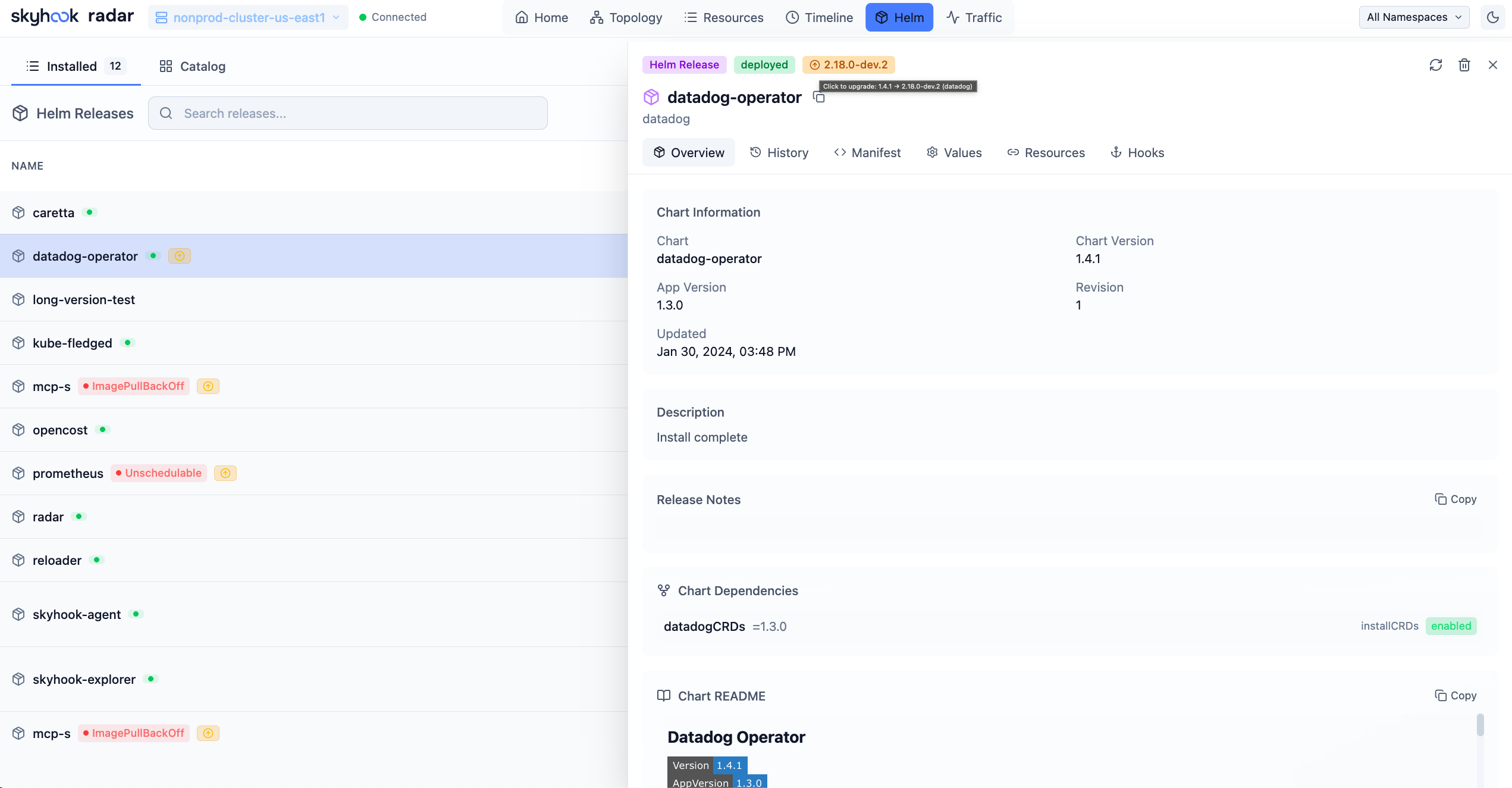
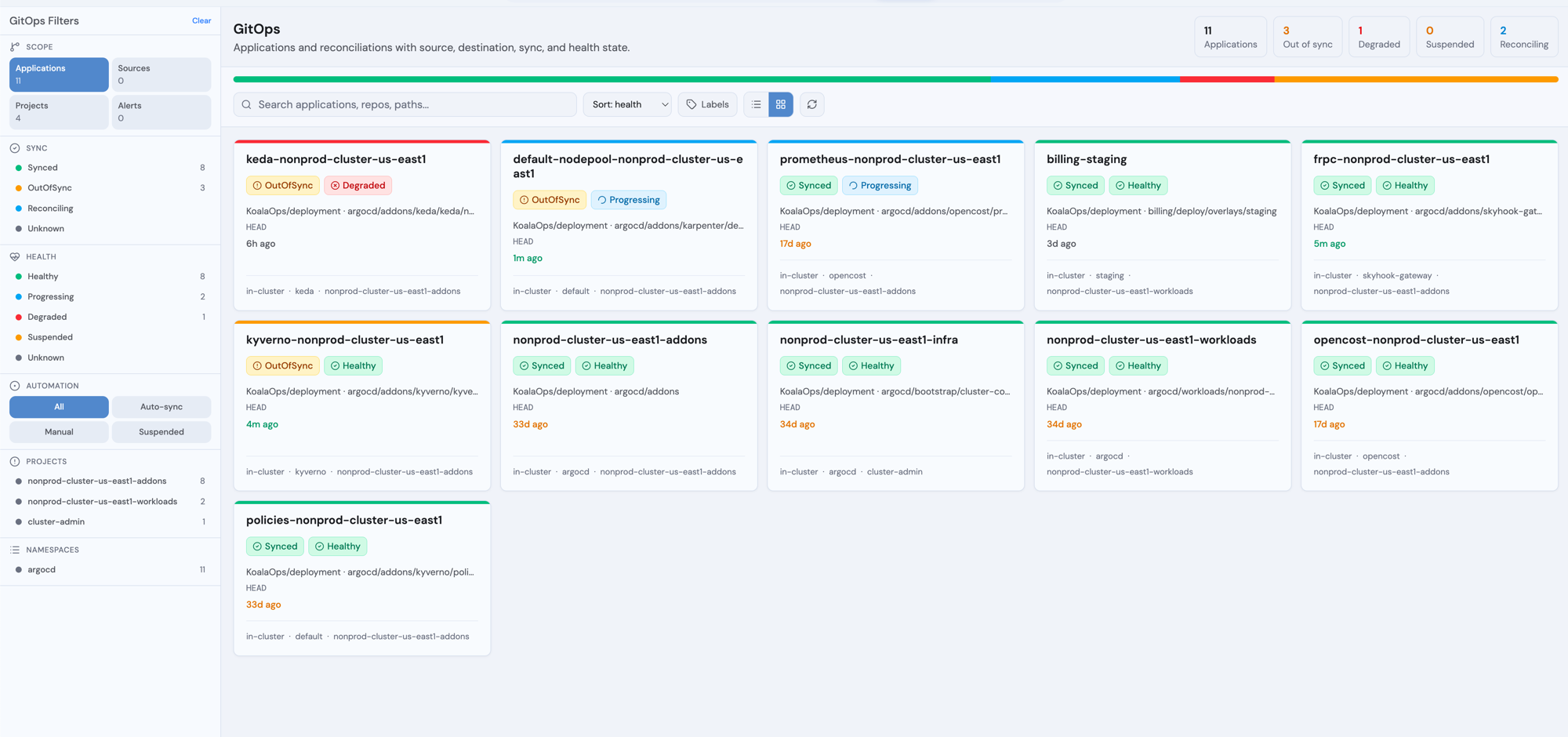
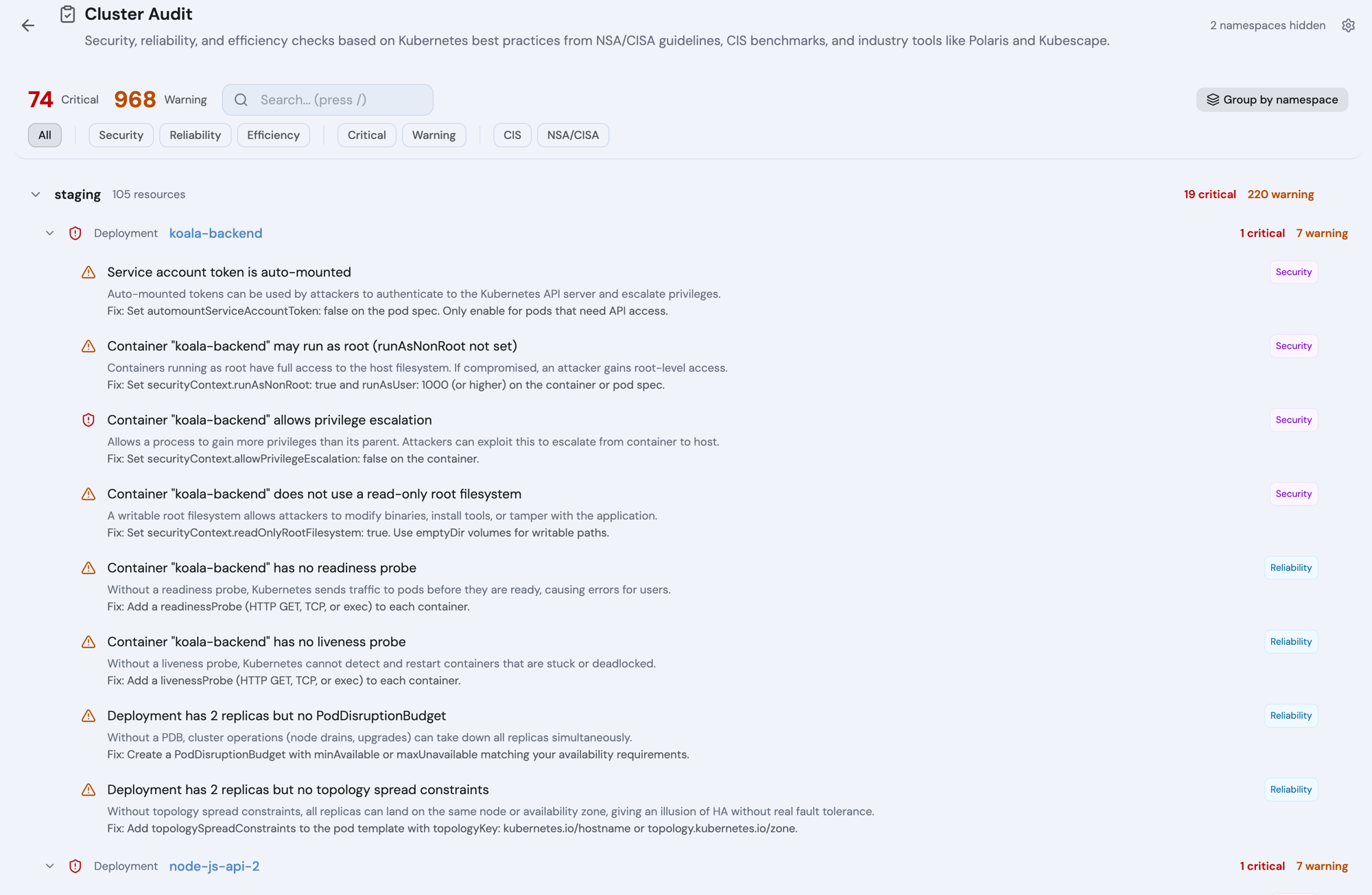
    Screenshot of Radar opens a real-time web UI in about 30 seconds - no agents, no CRDs, no account required. See cluster health, resources, and activity from a single binary running on your laptop or in-cluster.Screenshot of An interactive, auto-laid-out graph of how your Kubernetes resources connect, with grouping by namespace or app label and instant detail on any node. Updates stream live as the cluster changes.Screenshot of Kubernetes events and resource-change diffs in one real-time feed. See exactly what changed - replicas, images, config - and when, retained well past the default one-hour event TTL.Screenshot of Manage Helm releases without leaving the UI: inspect values, compare revisions, and upgrade, roll back, or uninstall.Screenshot of First-class FluxCD and ArgoCD support with sync status, health, and reconciliation controls, so you can see and fix drift from the same place you see the cluster.Screenshot of A 31-check audit across security, reliability, and efficiency, with findings labeled to frameworks including NSA/CISA and CIS and paired with remediation guidance.