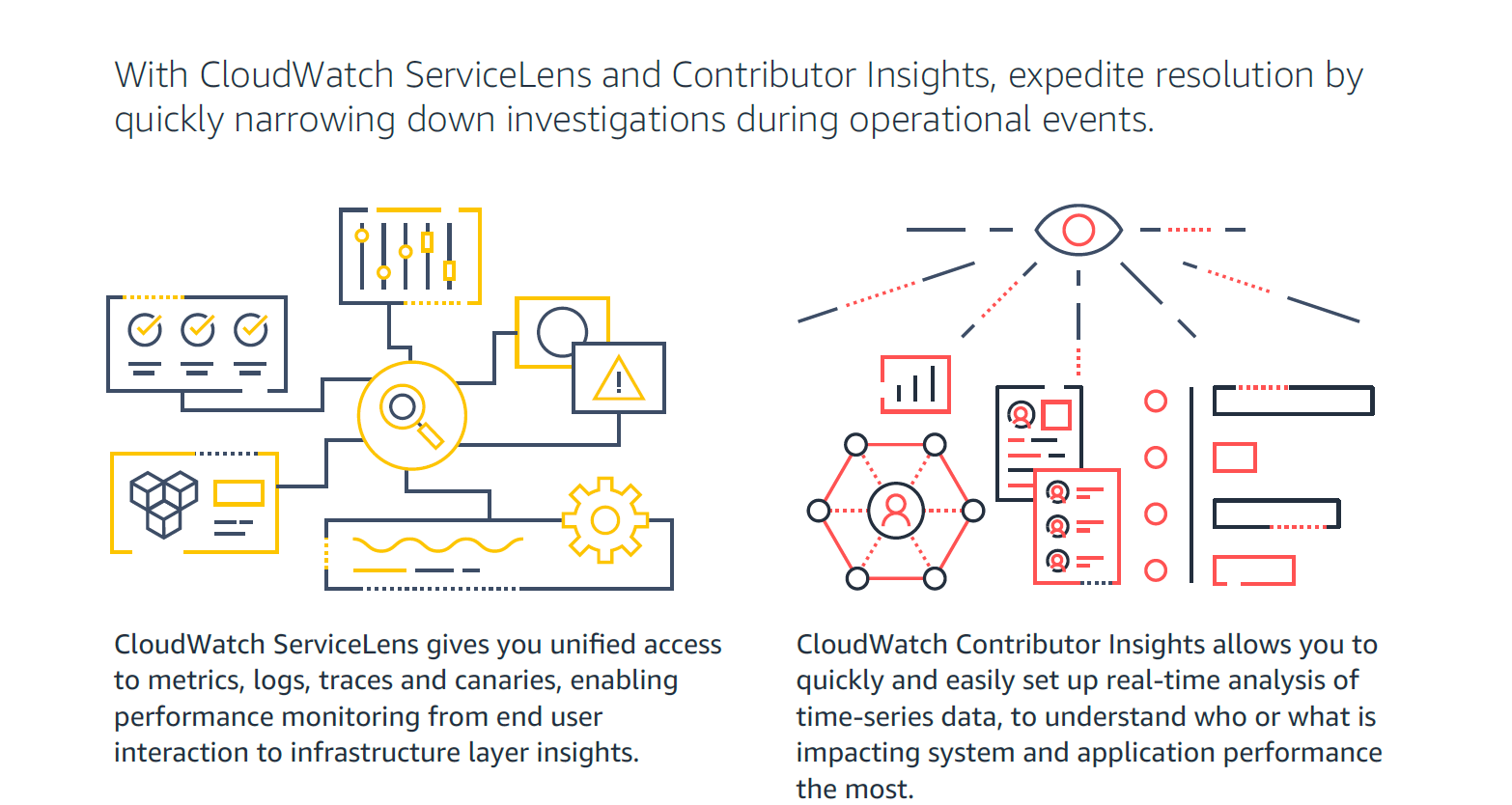
Amazon CloudWatch is a native AWS monitoring tool for AWS programs. It provides data collection and resource monitoring capabilities.
$0
per canary run
VMware Cloud Foundation
Score 9.0 out of 10
N/A
VMware Cloud Foundation is a hybrid cloud platform for managing VMs and orchestrating containers, built on full-stack hyperconverged infrastructure (HCI) technology. With a single architecture that is desribed by the vendor as easy to deploy, VMware Cloud Foundation aims to enable consistent, secure infrastructure and operations across private and public cloud.
N/A
Pricing
Amazon CloudWatch
VMware Cloud Foundation
Editions & Modules
Canaries
$0.0012
per canary run
Logs - Analyze (Logs Insights queries)
$0.005
per GB of data scanned
Over 1,000,000 Metrics
$0.02
per month
Contributor Insights - Matched Log Events
$0.02
per month per one million log events that match the rule
Logs - Store (Archival)
$0.03
per GB
Next 750,000 Metrics
$0.05
per month
Next 240,000 Metrics
$0.10
per month
Alarm - Standard Resolution (60 Sec)
$0.10
per month per alarm metric
First 10,000 Metrics
$0.30
per month
Alarm - High Resolution (10 Sec)
$0.30
per month per alarm metric
Alarm - Composite
$0.50
per month per alarm
Logs - Collect (Data Ingestion)
$0.50
per GB
Contributor Insights
$0.50
per month per rule
Events - Custom
$1.00
per million events
Events - Cross-account
$1.00
per million events
CloudWatch RUM
$1
per 100k events
Dashboard
$3.00
per month per dashboard
CloudWatch Evidently - Events
$5
per 1 million events
CloudWatch Evidently - Analysis Units
$7.50
per 1 million analysis units
No answers on this topic
Offerings
Pricing Offerings
Amazon CloudWatch
VMware Cloud Foundation
Free Trial
Yes
No
Free/Freemium Version
Yes
No
Premium Consulting/Integration Services
Yes
No
Entry-level Setup Fee
No setup fee
No setup fee
Additional Details
With Amazon CloudWatch, there is no up-front commitment or minimum fee; you simply pay for what you use. You will be charged at the end of the month for your usage.
For out business we find that AWS Cloudwatch is good at providing real-time metrics for monitoring and analysing the performance and usage of our platform by customers. It is possible to create custom metrics from log events, such people adding items to a basket, checking out or abandoning their orders.
It is best suited for an on-premise cloud solution where customer can shift their entire production environment. Also, the customer has a preference for a Homogenous Infrastructure Environment where budget is not a challenge. It is not at all suited for a Heterogenous Environment, e.g., a Public cloud where integration becomes a huge issue, also in SMB sections where budget is challenging.
It provides lot many out of the box dashboard to observe the health and usage of your cloud deployments. Few examples are CPU usage, Disk read/write, Network in/out etc.
It is possible to stream CloudWatch log data to Amazon Elasticsearch to process them almost real time.
If you have setup your code pipeline and wants to see the status, CloudWatch really helps. It can trigger lambda function when certain cloudWatch event happens and lambda can store the data to S3 or Athena which Quicksight can represent.
Memory metrics on EC2 are not available on CloudWatch. Depending on workloads if we need visibility on memory metrics we use Solarwinds Orion with the agent installed. For scalable workloads, this involves customization of images being used.
Visualization out of the box. But this can easily be addressed with other solutions such as Grafana.
By design, this is only used for AWS workloads so depending on your environment cannot be used as an all in one solution for your monitoring.
It's excellent at collecting logs. It's easy to set up. The viewing & querying part could be much better, though. The query syntax takes some time to get used to, & the examples are not helpful. Also, while being great, Log Insights requires manual picking of log streams to query across every time.
Support is effective, and we were able to get any problems that we couldn't get solved through community discussion forums solved for us by the AWS support team. For example, we were assisted in one instance where we were not sure about the best metrics to use in order to optimize an auto-scaling group on EC2. The support team was able to look at our metrics and give a useful recommendation on which metrics to use.
Grafana is definitely a lot better and flexible in comparison with Amazon CloudWatch for visualisation, as it offers much more options and is versatile. VictoriaMetrics and Prometheus are time-series databases which can do almost everything cloudwatch can do in a better and cheaper way. Integrating Grafana with them will make it more capable Elasticsearch for log retention and querying will surpass cloudwatch log monitoring in both performance and speed
Although the public Cloud Model follows Opex Costing Model, it actually leads to very high costs also, the infra model in my organization is not suited for a Public Cloud Model. Hence We decided on an On-Premise Model, and the best suited was VMware Cloud Foundation, which is a complete Software-Defined Scale-Out Architecture. I also prefer a Homogenous environment; i.e, support and services from a Single OEM, so that I Can get faster resolutions to my tickets raised.
My organization has a size of 1300+ employees, using multiple applications and an exchange mail server that is hosted on On-Premise Cloud, hence scalability has not been a challenge.
Having hosted my Production environment and Mail exchange Server on VCF, there has been optimum resource utilization with very little scope downtime. Hence have been able to save a lot of funds on Hardware resources.
Due to the size of my organization and due the data load, I have been able to save on Resource Utilization and Organization Funds