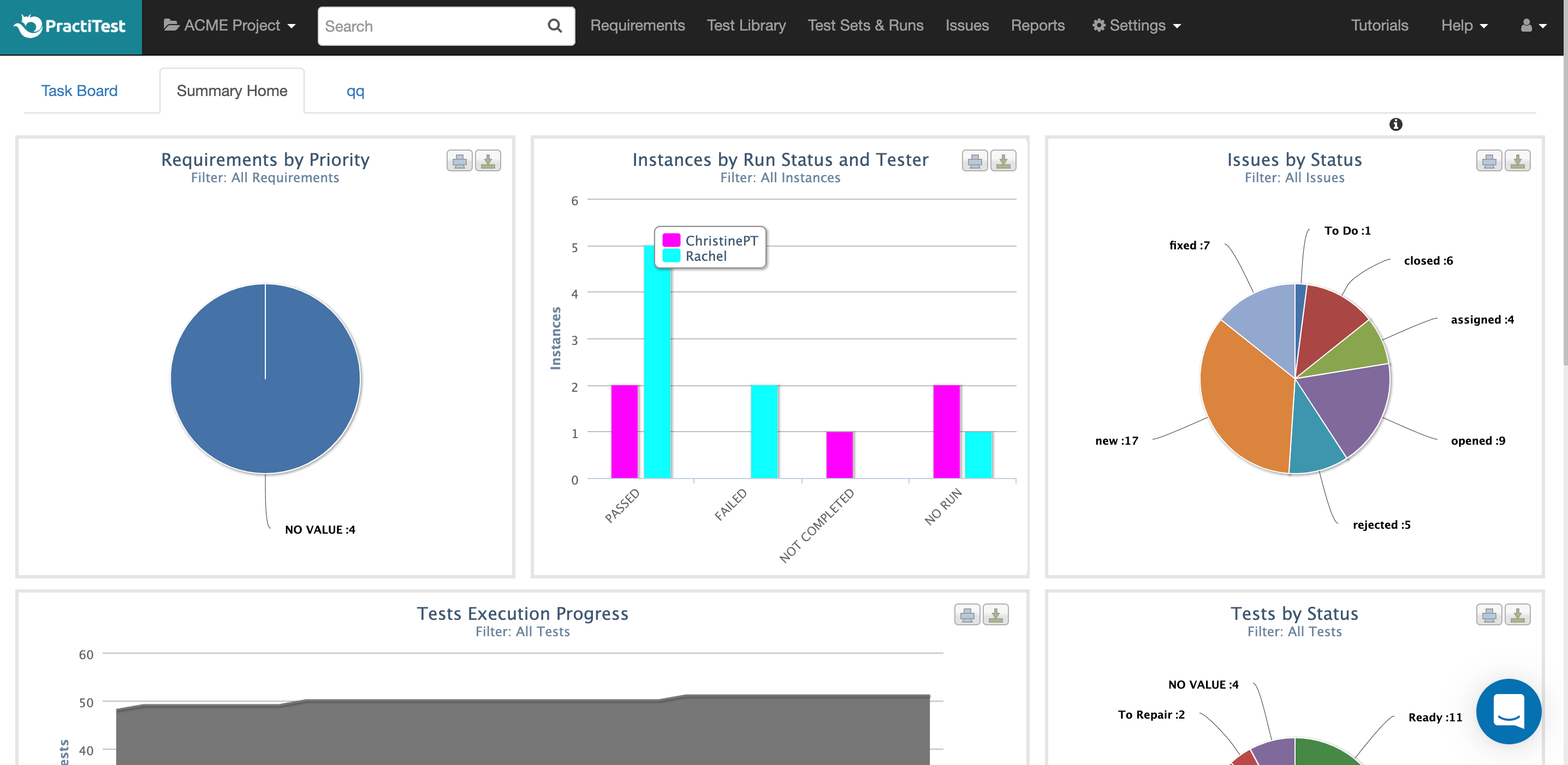
PractiTest is presented as a cloud-based test management tool that provides its customers with an end-to-end system to meet testing and QA needs. It is described by the vendor as flexible but methodological, enabling organizations to ensure visibility and communication at all levels. The solution aims to help users and project development teams streamline and manage their testing processes, while providing management with a clear and simple view of their project status at all times.
$39
user
Pricing
Appium
PractiTest
Editions & Modules
No answers on this topic
Professional
$39.00
user
Enterprise
$49.00
user
Offerings
Pricing Offerings
Appium
PractiTest
Free Trial
No
Yes
Free/Freemium Version
No
No
Premium Consulting/Integration Services
No
No
Entry-level Setup Fee
No setup fee
Optional
Additional Details
—
—
More Pricing Information
Community Pulse
Appium
PractiTest
Features
Appium
PractiTest
Test Management
Comparison of Test Management features of Product A and Product B
1. It's open source which supports range of languages, operating systems and languages. Well suited for Android and IOS mobile automation. Supports all kinds of apps, which makes it flexible and robust mobile testing tool 2. It is less appropriate where we need intercept network call to verify the API calls. Extensive coding experience is required to work Appium
PractiTest works GREAT as a test case repository. It is very easy to gather metrics, filter, and sort based on custom fields. We were able to work with the API to pull our automation results in as well. The support team is always very quick with their responses and monitors the "in-app chat." They are very open to answering questions, providing best practice materials, and looking for additional feedback. If you already have a central location for all of your test cases and testing needs, then I guess you probably wouldn't need to add another. However, PractiTest has high capability and potential, so if it's set up properly you can easily save time managing your tests.
I would like to give 9/10 rating to Appium because of it can easily integrate with popular frameworks and CI/CD tools, as well as it is reliable, flexible and easy to use. The setup can bit complex in initial step, but once on configured it's very easy to use and enables stable and scalable mobile automation for real and cloud devices.
The chat button is available to anyone who logs into PractiTest. In my experience, the support has always been very quick, very friendly, and very thorough. They make sure that your question is answered in a way that you understand it. They also provide documentation of best practices so you are never left hanging on what to do next.
If you're an Apple developer, you use Xcode. It's practically a forced necessity. For system testing though, it doesn't have to be. You can have your development team focus on unit and integration tests in their platform and another team automate acceptance tests with a language they are more familiar with.
I've used many different Test Case Repository tools, and while each of them has its perks, I like the capabilities of PractiTest best. When creating a test in qTest for example, you can only input information into the fields provided, and you have everything set up in a folder tree structure. With PractiTest, we are able to create custom fields and filter our tests based on those fields to provide more accurate information in a readily available format while quickly searching for the filter instead of through a folder tree. TestRail did not appear to meet our needs as a company. It just didn't have the potential that we found with PractiTest. Zephyr for example worked seamlessly with Jira, which is really nice since that is what we use for the most part. However since we cater to many different clients, we needed an external Test Case repository so we could use something that wasn't tied to 1 Jira instance.