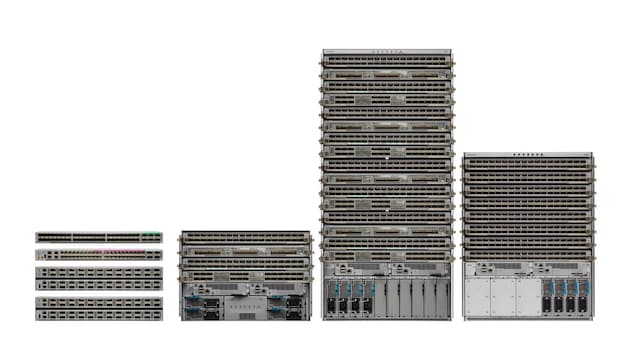
Cisco 1000 Series Aggregation Services Routers (ASR 1000)
Cisco 5500 Series Network Convergence System (NCS 5500)
Considered Both Products
Cisco 1000 Series Aggregation Services Routers (ASR 1000)
Verified User
Contributor
Chose Cisco 1000 Series Aggregation Services Routers (ASR 1000)
The Cisco 1000 series devices in most cases perform vastly different roles in a large network than the ASR 9000s. They take up a lot less physical space, require less cooling and less power consumption at a lower cost. However, they cannot process information at the same …
Cisco 5500 Series Network Convergence System (NCS 5500)
Verified User
Contributor
Chose Cisco 5500 Series Network Convergence System (NCS 5500)
The Cisco NCS 5500 series router continues the evolution of the network router. It can be used in similar parts of a network as the older Cisco 7500 and 12000 series routers, and it can either replace older or work in conjunction with ASR series routers. The smaller form …
Chose Cisco 5500 Series Network Convergence System (NCS 5500)
Ultimately other Arista and Juniper choices were tested but design and testing did not give much detail as to why these are better overall or in comparison. We are already using Cisco in this level of the topology so that was most likely the strongest reason and fit the …
Best Alternatives
Cisco 1000 Series Aggregation Services Routers (ASR 1000)
Cisco 5500 Series Network Convergence System (NCS 5500)
Cisco 1000 Series Aggregation Services Routers (ASR 1000)
Cisco 5500 Series Network Convergence System (NCS 5500)
Likelihood to Recommend
Cisco
Based on my past and current experiences as a network engineer, they serve and run really well and also simplify our setup where we used them as edge or border or internet gateway routers. And also we used them as Data Center Interconnect, terminating dark fibers using LR or ZR SFP+. Even though they are well suited for enterprise network, there may still be some room for improvement with SRv6.
Cloud based solutions, these need the necessary bandwidth going from point A to point B. Automate as much as possible from a WAN Core edge standpoint, take away the always on maintaining of the routers/switches on the network. Automation is extremely important in today's world. The Cisco 5500 Series Network Convergence System would not be a very viable solution for a small company, especially from a budgetary standpoint.
The ASR 1000 series routers can, as with most devices, improve with additional memory capacity and upgraded chip sets for faster processing.
There seems to be limitations on the number of routing sessions the smaller ASR devices can handle, which can be overcome with proper planning and placement within the network.
The device without a doubts performs at the level required and expected, we can renew it and use it as we have been using it for years. The device can be used as DCI, IPN/ISN, or even private cloud for customer circuit handoff, it also supports IPSec properly. The device is well suited in multiple segments of the network.
All our modular contingency service exercises use this equipment, it allows us to perform this type of exercises very easily, in a controlled and effective way. It is used at least once a month for these types of events. It also allows configuration replication in computers that are under the same model.
We have received training on the equipment, which has made us add more networks on our own, we provide first level support, we validate the publication of the equipment and we can satisfy the needs of our internal clients in terms of the prompt recovery of the affected services
Cisco support is always informative and reliable. Depending on the level of support you subscribe to, the techs and Cisco TAC are well versed in hardware and operating system of the NCS series routers. You can receive 24x7 support and either Next Business Day or 4-hour part replacement from Cisco if required.
We haven't used any other manufacturer other than Cisco. [H]owever, we have used different models that Cisco offers. The ASR has a little more horsepower than the ISR. Both are very good routers though.
Ultimately other Arista and Juniper choices were tested but design and testing did not give much detail as to why these are better overall or in comparison. We are already using Cisco in this level of the topology so that was most likely the strongest reason and fit the application we are using it for.
It is a healthy return on investment with planned packed size data. Average unicast latency is low and consistent with small and large packets (barring mid-sized).
Cisco devices last longer and also have a decent trade-in policy to recover some value when equipment is replaced.
Higher concurrent IPSec tunnels are offered, we tested for 1500+, fielding both encrypted and a mix of encrypted and cleartext traffic.