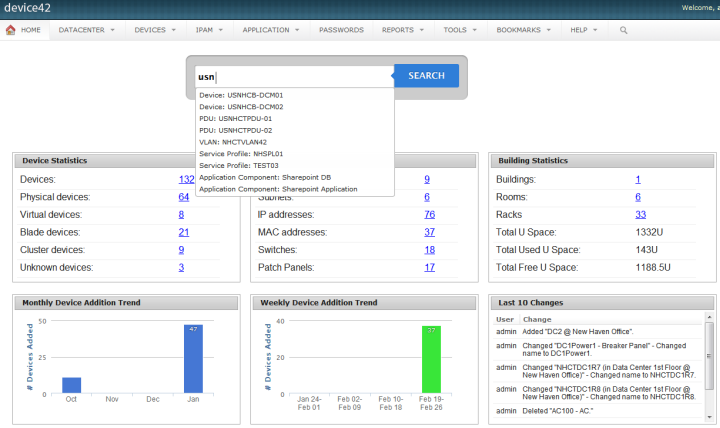
Device42, a Freshworks company, is an agentless discovery system for Hybrid IT. Device42 can continuously discover, map, and optimize infrastructure and applications across data centers and cloud, in order to provide an accurate views of the IT ecosystem.
$1,449
1-1K IPs
Nlyte Data Center Infrastructure Management (DCIM)
Score4.8 out of 10
N/A
Nlyte, headquartered San Mateo, California offers their eponymous a data center infrastructure management (DCIM) solution.
N/A
Pricing
Device42
Nlyte Data Center Infrastructure Management (DCIM)
Editions & Modules
Core 1-100 Devices
$1,449
1-1K IPs
Core 101-500 Devices
$2,999
1K-5K IPs
Core 501-1000 Devices
$4,999
5K-10K IPs
Core 1001-2500 Devices
$9,999
10K-25K IPs
Core 2500+ Devices
Request Quote
25K+ IPs
No answers on this topic
Offerings
Pricing Offerings
Device42
Nlyte Data Center Infrastructure Management (DCIM)
Free Trial
Yes
No
Free/Freemium Version
No
No
Premium Consulting/Integration Services
No
No
Entry-level Setup Fee
No setup fee
No setup fee
Additional Details
Pricing for each customer requesting a SaaS installation/deployment is negotiated on a case by case basis, and depends on many factors
—
More Pricing Information
Community Pulse
Device42
Nlyte Data Center Infrastructure Management (DCIM)
Considered Both Products
Freshworks Inc
Verified User
Chose Device42
When we compare both Nlyte & Device42. The below are the advantages of Device42 which helped us to choose it. 1. Support is very much good in Device42. 2. It has lots of advanced features CMDB, DCIM, ITAM, IPAM etc.
A de minimis incentive was given to thank the reviewer for their time. The incentive was not used to bias or drive a particular response, nor was the incentive contingent on a positive endorsement. More Info
Nlyte Data Center Infrastructure Management (DCIM)
Likelihood to Recommend
Freshworks Inc
1. Installbase management feature allows us to retire our old spreadsheet methods for tracking the data in favour of a singular database with some excellent reporting.2. We are also providing data connectivity from the WAN Providers and keeping all connections in Device42 gives us the ability have documentation of all connection that are made. 3. Ever changing and growing inventory that needs to be carefully tracked and inventoried. We find this so simple to use that we spend much less time than we used to on tracking these items.
A de minimis incentive was given to thank the reviewer for their time. The incentive was not used to bias or drive a particular response, nor was the incentive contingent on a positive endorsement. More Info
Nlyte is well suited for keeping a detailed inventory of the assets in the hosting center. With the ability to import hosting center floor plans, knowing exactly where each asset is located is a snap. When alarms occur in monitored devices, this also provides faster resolution because the exact point of alarm can be displayed on the floor plan. Nlyte is also well suited for organizations with data center assets housed in multiple locations. In some cases, as with my organization, some of the locations are Telco rooms or closets. Again, when properly set up, a device causing an alarm can be pinpointed to its exact location.
A de minimis incentive was given to thank the reviewer for their time. The incentive was not used to bias or drive a particular response, nor was the incentive contingent on a positive endorsement. More Info
A de minimis incentive was given to thank the reviewer for their time. The incentive was not used to bias or drive a particular response, nor was the incentive contingent on a positive endorsement. More Info
Nlyte Asset Optimizer (NAO) tracks every asset in our hosting centers and when integrated with Nlyte Energy Optimizer (NEO), which monitors the hosting center environment, we can see, at a glance, the asset causing the alarm and its exact location in the hosting center. This is a strength, as it provides for faster resolution of problems if/when they occur.
Nlyte Asset Optimizer (NAO) has a lot of built-in reports that are great for looking at. For example, servers of a specific brand, or how many Us are taken up by servers. I see this as a strength and use this capability for capacity planning.
A de minimis incentive was given to thank the reviewer for their time. The incentive was not used to bias or drive a particular response, nor was the incentive contingent on a positive endorsement. More Info
A de minimis incentive was given to thank the reviewer for their time. The incentive was not used to bias or drive a particular response, nor was the incentive contingent on a positive endorsement. More Info
Nlyte Asset Optimizer (NAO) is currently all manual entry of assets. It would be great if NAO could provide for automated discovery of hosting center assets. This automation would be limited to ICMP and SNMP communication so not every asset can provide automated discovery, but it would be great for all IP addressable devices.
A de minimis incentive was given to thank the reviewer for their time. The incentive was not used to bias or drive a particular response, nor was the incentive contingent on a positive endorsement. More Info
What I appreciate and love about Device42 is how everything links together from room layout,to server rack organisation,down to all VMs and Business applications. We are also able to get full value of our money and full visibility of our assets management process.
I am still using the other three products as they have features that Nlyte does not have, and that are really out of scope for Nlyte. I can give one example because this product is an in-house application. It is our CMDB application, and it interfaces with several other in-house systems to provide data that Nlyte is not designed for. Example: If we get an alarm from a server, and if there is currently a planned outage with a Request For Change (RFC), we ignore the alarm unless it exceeds the RFC window.
A de minimis incentive was given to thank the reviewer for their time. The incentive was not used to bias or drive a particular response, nor was the incentive contingent on a positive endorsement. More Info
A de minimis incentive was given to thank the reviewer for their time. The incentive was not used to bias or drive a particular response, nor was the incentive contingent on a positive endorsement. More Info
A de minimis incentive was given to thank the reviewer for their time. The incentive was not used to bias or drive a particular response, nor was the incentive contingent on a positive endorsement. More Info