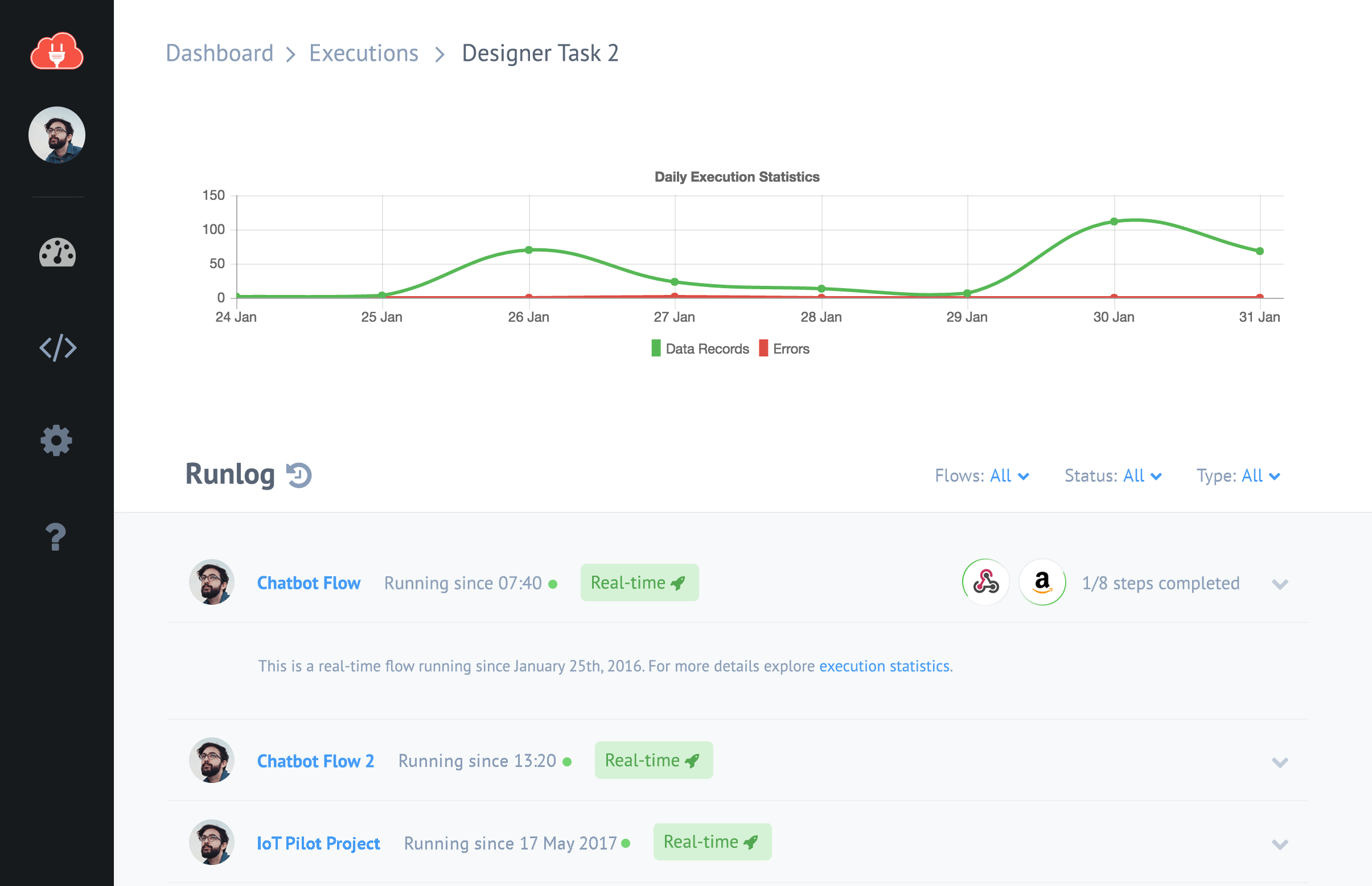
The elastic.io Integration Platform is a hybrid integration system that users can deploy on-premise or in the cloud. It is highly scalable, with over 100 prebuilt application connectors for out-of-the-box use and a flexible data structure.
$0
Contact elastic.io for estimation
Mule ESB
Score8.3 out of 10
N/A
Mule ESB, from Mulesoft, is an open source middleware solution.
N/A
Pricing
elastic.io Integration Platform
Mule ESB
Editions & Modules
Dedicated
$0
Contact elastic.io for estimation
Lean
$599
per buyer
Professional
$1,199
per buyer
Enterprise
$2,279
per buyer
No answers on this topic
Offerings
Pricing Offerings
elastic.io Integration Platform
Mule ESB
Free Trial
Yes
No
Free/Freemium Version
No
No
Premium Consulting/Integration Services
Yes
No
Entry-level Setup Fee
Optional
No setup fee
Additional Details
—
—
More Pricing Information
Features
elastic.io Integration Platform
Mule ESB
Cloud Data Integration
Comparison of Cloud Data Integration features of elastic.io Integration Platform and Mule ESB
elastic.io Integration Platform is well suited for developers already leveraging the Elastic Search cluster, who want to automate and simplify add-on integrations. If developers are streaming data between plugins and want to have event-based batching, this is a great product to do that, albeit a paid solution, it can enhance your deployment and automation of ES plugins.
A de minimis incentive was given to thank the reviewer for their time. The incentive was not used to bias or drive a particular response, nor was the incentive contingent on a positive endorsement. More Info
If you’re bringing anything into Salesforce you should just invest now into Mule, you will get your money’s worth and find a myriad of uses to build APIs between many other systems. Once you build a component you can easily reuse it as a building block to attach to another source/destination. This makes it easy to ramp up quickly and spread usage of Mule throughout your enterprise. A good value for medium to large companies, but probably cheaper to outsource your job to a consulting firm if you are smaller.
A de minimis incentive was given to thank the reviewer for their time. The incentive was not used to bias or drive a particular response, nor was the incentive contingent on a positive endorsement. More Info
A de minimis incentive was given to thank the reviewer for their time. The incentive was not used to bias or drive a particular response, nor was the incentive contingent on a positive endorsement. More Info
It is best suited for Rest API development. Mule ESB uses RAML as an API descriptor which is less complex and easy to understand. RAML is an open standard majorly supported by Mulesoft. Once RAML is developed, it is very easy (a few clicks)to create flows corresponding to the resources defined in the RAML. One can also include JSON schema validation in RAML, and with the use of APIkit router, Mule ESB makes the request validation very easy (it's automatic basically.)
Mule ESB comes with a large spectrum of community and enterprise connectors. We have connectors for all the major platforms like Facebook, Twitter, Salesforce, SAP, etc. This enables Mule ESB to integrate with the other systems in a faster and more robust way. Mule ESB has many components to fulfill the requirements of each integration (for example batch processing, parallel processing, choice, etc.)
Mule API gateway is one of the best tools (modules) of Mulesoft's offering. It supports API governance and management very well. One can easily enforce policies on their APIs with API gateway. It enables some of the must-have features in an API solution (i.e. throttling, oAuth, access levels, etc.)
Implementing a CI/CD (DevOps) environment for Mule ESB is a very easy task. Mule majorly uses MAVEN as its build tool, which in turn makes it best suitable for CI/CD approach. Mule also provides MAVEN plugins for auto deployments to the servers. Mule also has a best Unit testing module which is MUnit. MUnit can be used for both Unit and Functional testing, and it is easy to write and generates coverage reports in various formats.
A de minimis incentive was given to thank the reviewer for their time. The incentive was not used to bias or drive a particular response, nor was the incentive contingent on a positive endorsement. More Info
A de minimis incentive was given to thank the reviewer for their time. The incentive was not used to bias or drive a particular response, nor was the incentive contingent on a positive endorsement. More Info
A de minimis incentive was given to thank the reviewer for their time. The incentive was not used to bias or drive a particular response, nor was the incentive contingent on a positive endorsement. More Info
A de minimis incentive was given to thank the reviewer for their time. The incentive was not used to bias or drive a particular response, nor was the incentive contingent on a positive endorsement. More Info
A de minimis incentive was given to thank the reviewer for their time. The incentive was not used to bias or drive a particular response, nor was the incentive contingent on a positive endorsement. More Info
A de minimis incentive was given to thank the reviewer for their time. The incentive was not used to bias or drive a particular response, nor was the incentive contingent on a positive endorsement. More Info
A de minimis incentive was given to thank the reviewer for their time. The incentive was not used to bias or drive a particular response, nor was the incentive contingent on a positive endorsement. More Info