Elastic Observability, from Elastic, the makers of Elasticsearch, is a solution that aims to bring logs, metrics, and APM based on the former Opbeat (acquired by Elastic in 2017) traces together at scale in a single stack so users can monitor and react to events happening anywhere in an IT environment. It's free and open to start, and adds the Logs, Metrics, APM (formerly Opbeat), and Uptime modules to the Elastic (ELK) Stack.
N/A
meshIQ
Score8.9 out of 10
Enterprise companies (1,001+ employees)
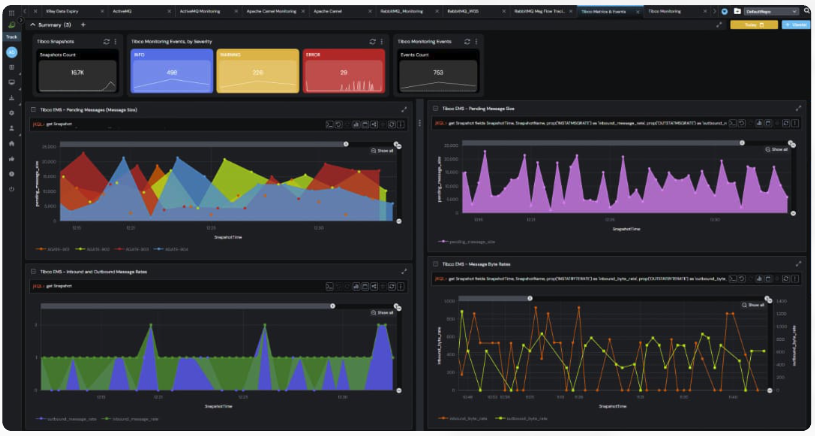
meshIQ provides observability and management capabilities for middleware platforms, from modern Kafka-based streaming to legacy messaging technologies such as IBM MQ, across cloud and on-premises environments.
We can use this Elastic Observability in our business problems such as Creating internal/operational efficiencies issues, customer relations/service, and business process outcomes issues. This product has a lot of features for the above problems. But this product may be having some issues when charting purposes. But it can adjust for that purpose.
A de minimis incentive was given to thank the reviewer for their time. The incentive was not used to bias or drive a particular response, nor was the incentive contingent on a positive endorsement. More Info
If you're involved in any business that is related to banking, insurance and lending industry, take the short way and save yourself from thousands of wasted dollars on fraud detection and application management issues, Nastel is my savior and it's the most powerful killer solution to beat the fraud and have a winning application performance management, It's like hiring a mathematics magician with super powers to help businesses get over the delayed amount of time spent on a problem, and the average time to process a claim, reduce errors and most importantly to decrease the number of tickets at the help center for a better and higher customer satisfaction score.
A de minimis incentive was given to thank the reviewer for their time. The incentive was not used to bias or drive a particular response, nor was the incentive contingent on a positive endorsement. More Info
A de minimis incentive was given to thank the reviewer for their time. The incentive was not used to bias or drive a particular response, nor was the incentive contingent on a positive endorsement. More Info
A de minimis incentive was given to thank the reviewer for their time. The incentive was not used to bias or drive a particular response, nor was the incentive contingent on a positive endorsement. More Info
A de minimis incentive was given to thank the reviewer for their time. The incentive was not used to bias or drive a particular response, nor was the incentive contingent on a positive endorsement. More Info
The UI needs a lot of improvements to meet today's standards while keeping the functional part highly performing as it used to be
Being unable to run reports through the workgroup security manager is a serious con, I think they need to consider giving it more attention
the auto-monitoring feature performance goes low when it's enabled during a heavy workloads, it leads to a lower/heavier performance, but during the latest update I feel it got lighter somehow.
They also need to give more attention to the encryption and enhance it with the latest encryption technologies
A de minimis incentive was given to thank the reviewer for their time. The incentive was not used to bias or drive a particular response, nor was the incentive contingent on a positive endorsement. More Info
Splunk is a very good product but the licensing costs are high; we utilise the best of both worlds by using both products for slightly different purposes. We put the voluminous data with simple use cases in Elastic where it doesn't cost too much and can be searched quickly while putting the less voluminous data with more complex use cases in Splunk so we can take advantage of Splunk's very comprehensive but often much slower SPL search query language
A de minimis incentive was given to thank the reviewer for their time. The incentive was not used to bias or drive a particular response, nor was the incentive contingent on a positive endorsement. More Info
A de minimis incentive was given to thank the reviewer for their time. The incentive was not used to bias or drive a particular response, nor was the incentive contingent on a positive endorsement. More Info
A de minimis incentive was given to thank the reviewer for their time. The incentive was not used to bias or drive a particular response, nor was the incentive contingent on a positive endorsement. More Info