An enterprise-grade configuration management system that provides controlled access to software assets.
N/A
Ansible
Score 9.1 out of 10
N/A
The Red Hat Ansible Automation Platform (acquired by Red Hat in 2015) is a foundation for building and operating automation across an organization. The platform includes tools needed to implement enterprise-wide automation, and can automate resource provisioning, and IT environments and configuration of systems and devices. It can be used in a CI/CD process to provision the target environment and to then deploy the application on it.
$5,000
per year
SolarWinds Kiwi CatTools
Score 8.1 out of 10
N/A
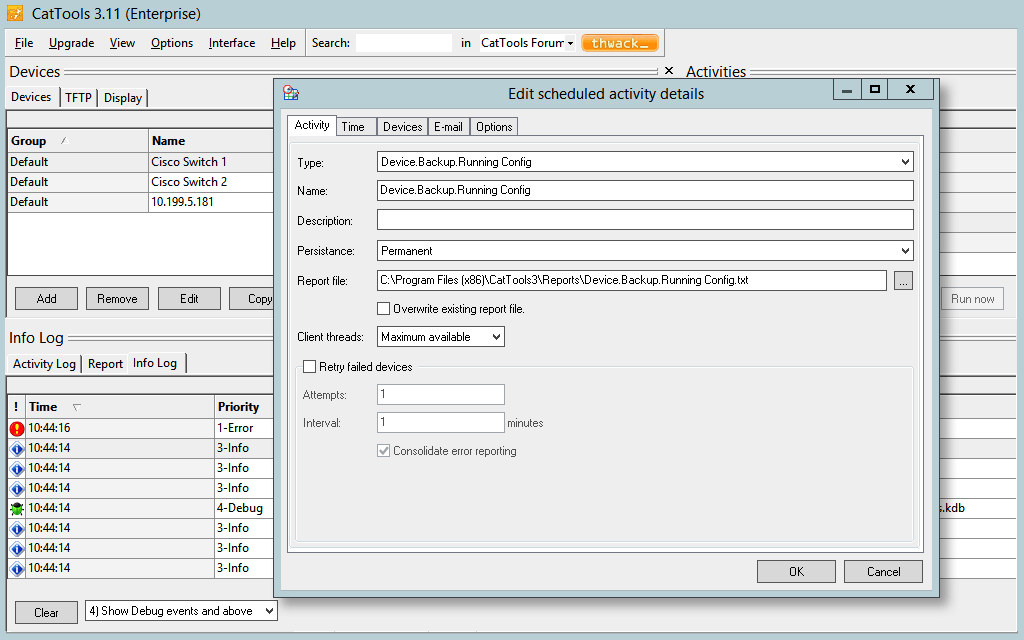
SolarWinds® Kiwi CatTools® is network automation tool designed to manage configurations on network devices such as routers, switches, and firewalls. It helps users work more efficiently by scheduling automatic backup activities and rolling out configuration changes to multiple devices at the same time. With native support for devices from dozens of manufacturers, Kiwi CatTools is designed to simplify network administration, configuration change alerting, and backup management.
GIT Stash is superior to IBM Rational ClearCase in many ways. Bundled with SourceTree, the UI is far more modernized and updated than IBM Rational ClearCase. Being able to visually see the individual branches that are created within the repository is much more straightforward …
If development is centrallized to one location and your company releases hundreds of customized versions of your software per year, then ClearCase is the best tool for managing the complexity of multiple versions of customized software. If your company has globally distributed …
Identity Manager focuses on authentication and account management, while Red Hat Ansible Automation Platform focuses on IT automation and system management. Red Hat Ansible Automation Platform was selected because it supports scalable automation, reduces manual administration, …
Our org was using puppet and burning too many people-hours just touching the scripts, troubleshooting, and maintaining why changes were made. Chose Red Hat Ansible Automation Platform as it was much easier to code and follow.
The way its structure it’s just way harder to find and if a script is modified it won’t tell you exactly who made the change or even if a change was made, when it runs it doesn’t tell you what happen and overall it’s really difficult to use compare to Red Hat Ansible Automation …
Managing Puppet can be a full-time job in itself. It requires a client to be installed and managed on each host. If your infrastructure was designed with a certain version of Puppet, upgrading can be very difficult. Ansible is much easier to start using and can deliver value …
Strengths:Cost-Effectiveness: CatTools is significantly more affordable than enterprise-grade tools like SolarWinds Network Configuration Manager (NCM) or Infoblox NetMRI. It is ideal for small to medium-sized businesses with tight budgets. Ease of Deployment: Kiwi CatTools is …
Rational ClearCase is well suited for a company where development is done from one single location and there are a lot of dependent projects, systems or modules that need to be version controlled. Especially good for a company that creates customized software for clients. Well suited for disciplined development environments. Waterfall methodology mentality seems a better fit for ClearCase than Agile.
ClearCase is not well suited for companies that have development geographically distributed and using Agile Methodologies.
I think it's the best defacto orchestrator for automation because it's so easy to integrate in other tools to it (dynatrace, cyberark, terraform, etc). It is a lot for a new or smaller team to use so I wouldn't recommend it to a new team using Ansible, in that case using Ansible navigator is a better start to understanding playbooks/inventories before diving into the complexity of Red Hat Ansible Automation Platform. EDA also takes a lot of connectivity between Red Hat Ansible Automation Platform and target systems to get working which can be difficult in very locked down envs unless you have approval from many other teams like networking and security.
Setting up device backup schedules for individual locations is quick and easy. The application is very straightforward and basic. The application covers 90% of our needs. Some devices that require configuration and file backups utilizing ftp or other methods are configured using a different set of tools. Backups can be stored in configured destination folders for easy review.
Rational ClearCase is excellent for handling versioning and branching. No other tool I've used has the depth that ClearCase has when it comes to handling complex branching scenarios and identifying where certain versions of particular files are within a particular configuration.
Rational ClearCase handles parallel development of many dependent applications really well.
The use of ClearCase Views to switch between projects and configurations is extremely convenient as opposed to the local workstation model of the competitors.
Easy to read sets of instructions to do various things in and out of a pipeline.
Templating
Cloud and on prem provisioning.
Scalability and reusability.
We use it for everything from provisioning hardware for deploying software to it to running pipelines and building containers, etc. It's readable, easy to scale, and great for creating re-usable templates, scripts, or instructions.
I can't think of any right now because I've heard about the Lightspeed and I'm really excited about that. Ansible has been really solid for us. We haven't had any issues. Maybe the upgrade process, but other than that, as coming from a user, it's awesome.
We are extremely happy with the use of AAP. It's better than expected, There is almost no limit when thinking of automation. The only problem is that the day to day is consuming a big part of our time. Patching and checking vulnerabilities are virtually killing us. But we can only improve with AAP.
It's overall pretty easy to use foe all the applications I've mentioned before: configuring hosts, installing packages through tools like apt, applying yaml, making changes across wide groups of hosts, etc. Its not a 10 because of the inconveinience of the yaml setup, and the time to write is not worth it for something applied one time to only a few hosts
CatTools is simple to set up and administer. Anyone who can install a Windows application can quickly set up an automated backup of one or more devices. It does what it was designed to do.
Great in almost every way compared to any other configuration management software. The only thing I wish for is python3 support. Other than that, YAML is much improved compared to the Ruby of Chef. The agentless nature is incredibly convenient for managing systems quickly, and if a member of your term has no terminal experience whatsoever they can still use the UI.
There is a lot of good documentation that Ansible and Red Hat provide which should help get someone started with making Ansible useful. But once you get to more complicated scenarios, you will benefit from learning from others. I have not used Red Hat support for work with Ansible, but many of the online resources are helpful.
The software is easy enough to set up and configure that even after using the product for years, we never had to contact support. We used some open source products before utilizing CatTools and could have used a speed dial to try and figure out the intricacies of the products.
GIT Stash is superior to IBM Rational ClearCase in many ways. Bundled with SourceTree, the UI is far more modernized and updated than IBM Rational ClearCase. Being able to visually see the individual branches that are created within the repository is much more straightforward than the versioning method of ClearCase. GIT also seems to be a lot faster when it comes to checking in/out code and creating the repository.
As I said earlier, Red Hat Ansible remains a top choice because it is a perfect combination of multiple capabilities. Terraform is good in IAC but not in config automation. Puppet is well-suited for developers, but not for system administrators and infrastructure integrators. OpenShift and Kubernetes are generic automators only.
Strengths:Cost-Effectiveness: CatTools is significantly more affordable than enterprise-grade tools like SolarWinds Network Configuration Manager (NCM) or Infoblox NetMRI. It is ideal for small to medium-sized businesses with tight budgets. Ease of Deployment: Kiwi CatTools is lightweight and easier to set up, while enterprise solutions often require substantial infrastructure and longer deployment times. Focus on Essentials: CatTools excels in its core functions, such as automated configuration backups, scheduled tasks, and essential compliance checks.
A 45min manual process to build VIPs with a SLA of 1 week can now be completed as self-service within 10 minutes in production.
Firewall Policy ranges in review and implementation time depending on complexity of requests. Our policy automation is able to provide detailed and accurate decisioning information that allows the operations team to approve requests and have them automatically implemented within minutes. Not only does this free up Ops for more important efforts, but it opens access many times quicker which allows much faster time to market.