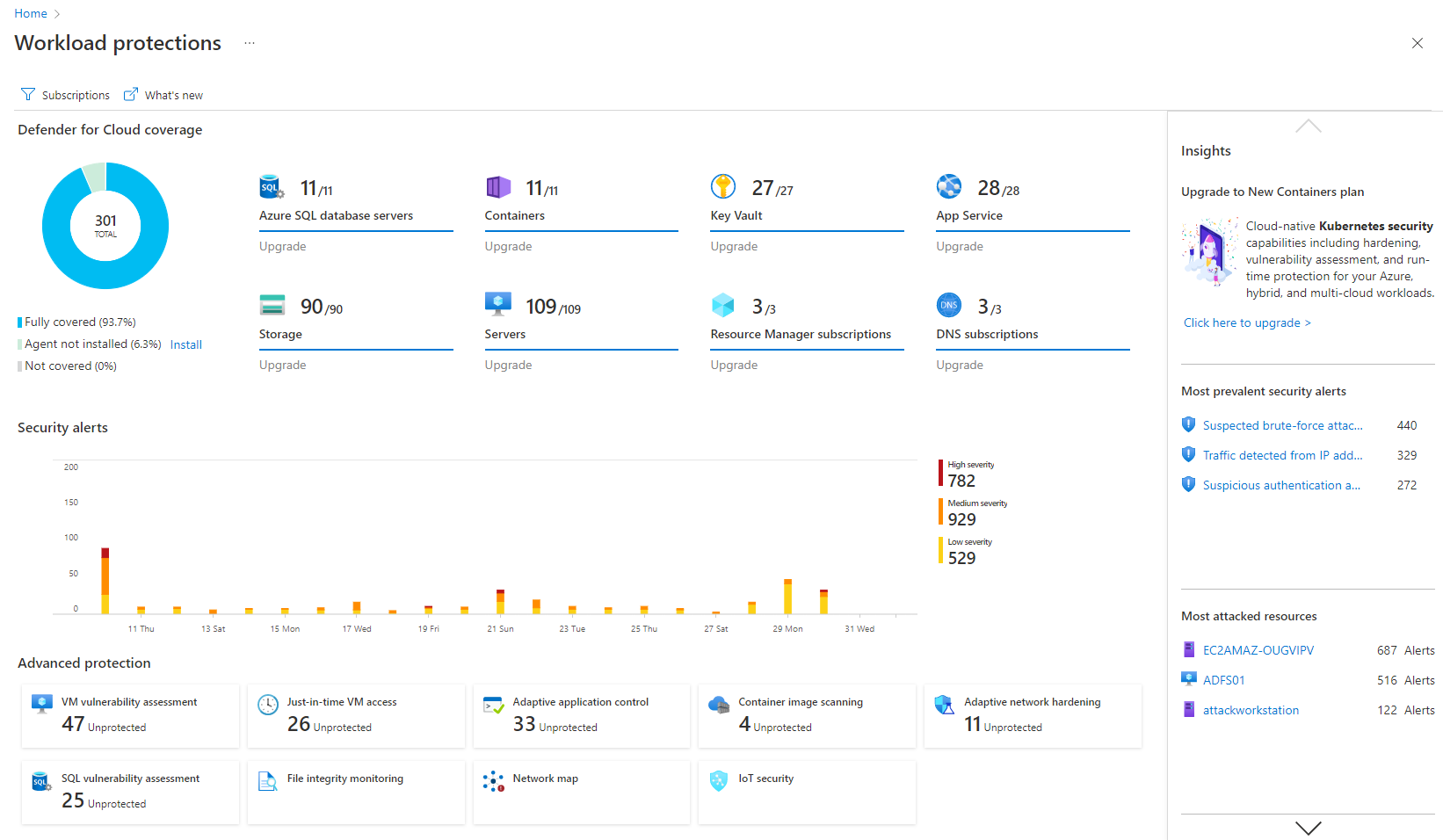
Microsoft Defender for Cloud is a Cloud Security Posture Management (CSPM) and Cloud Workload Protection Platform (CWPP) for Azure, on-premises, and multicloud (Amazon AWS and Google GCP) resources.
N/A
Microsoft Sentinel
Score8.6 out of 10
N/A
Microsoft Sentinel (formerly Azure Sentinel) is designed as a birds-eye view across the enterprise. It is presented as a security information and event management (SIEM) solution for proactive threat detection, investigation, and response.
Evaluated between cost. I just think it integrates better with the Microsoft stack and I mean, I think just cost from just that perspective and being the one pane of glass, I think that's enough.
A de minimis incentive was given to thank the reviewer for their time. The incentive was not used to bias or drive a particular response, nor was the incentive contingent on a positive endorsement. More Info
A de minimis incentive was given to thank the reviewer for their time. The incentive was not used to bias or drive a particular response, nor was the incentive contingent on a positive endorsement. TR verified that a representative sample of customers was invited. More Info
Microsoft
Verified User
Chose Microsoft Sentinel
Elastic seems to have a much better interface for log search and is able to filter out noise. Microsoft Sentinel also appears to generate a lot of false positives.
A de minimis incentive was given to thank the reviewer for their time. The incentive was not used to bias or drive a particular response, nor was the incentive contingent on a positive endorsement. TR verified that a representative sample of customers was invited. More Info
Verified User
Chose Microsoft Sentinel
ArcSight is an on-prem solution that has a different approach than Sentinel.
In a basis this product is more complex to maintain and deploy. The query functionality in Sentinel is more powerful and easier to maintain. ArcSight has a much slower performance and an interface that …
A de minimis incentive was given to thank the reviewer for their time. The incentive was not used to bias or drive a particular response, nor was the incentive contingent on a positive endorsement. More Info
I think it's good for cloud-native companies. A company that, from day zero, they're like, "We're going cloud, and this is how we're going to do it." They get it. It works well for them. Smaller organizations that are under X amount of resources- I don't know what that X might mean- but I feel like it plays well in smaller, more nimble organizations. If you're an older organization or if you're extremely large, it starts becoming a little difficult to manage at scale. And you have to sometimes throw bodies at the problem. Maybe not the most eloquent way of saying it, but that's what it feels like.
A de minimis incentive was given to thank the reviewer for their time. The incentive was not used to bias or drive a particular response, nor was the incentive contingent on a positive endorsement. More Info
What has really impressed me is how Microsoft Sentinel delivers centralised security monitoring across multiple data sources in our enterprise. It has reduced cost of handling large security logs by collecting and analyzing data without friction of managing traditional SIEM infrastructure. It is easy to work to integrate with Azure logs for quick data analysis.
A de minimis incentive was given to thank the reviewer for their time. The incentive was not used to bias or drive a particular response, nor was the incentive contingent on a positive endorsement. TR verified that a representative sample of customers was invited. More Info
It's really well laid out, with an easy-to-use, accessible UI.
With Microsoft Defender for Cloud, it has everything you need with the Safelink attachment, the Safelink emails for URL, the way it scans those URLs and attachments within the product, and you're seeing the results. And that adds an extra layer of security for the user, so you feel comfortable knowing the product monitors those. That's something I really like about that product.
A de minimis incentive was given to thank the reviewer for their time. The incentive was not used to bias or drive a particular response, nor was the incentive contingent on a positive endorsement. More Info
The visual presentation of data is terrific, so including what we had prior to Microsoft Sentinel, it presents data in a much more usable way, so that's been quite refreshing. It's not quite as complex to understand what you're looking at.
A de minimis incentive was given to thank the reviewer for their time. The incentive was not used to bias or drive a particular response, nor was the incentive contingent on a positive endorsement. TR verified that a representative sample of customers was invited. More Info
Integrations with on-premise workloads can sometimes be challenging. Needs improvement and well standardised integration points
Vulnerability categories can be difficult to understand. It should allow teams to focus on critical findings and help them keep aside low-severity or suppressed vulnerabilities
Pricing can be improved as it can be over-priced for smaller businesses and would potentially affect their ROI due to the small scale
A de minimis incentive was given to thank the reviewer for their time. The incentive was not used to bias or drive a particular response, nor was the incentive contingent on a positive endorsement. More Info
One feature that I would like to see improved is probably the log parsing. I think one of the big things that Splunk does better than Microsoft Sentinel is that it makes it easy to bring in new log streams of arbitrary formats and parse them out into columns and tables. Microsoft Sentinel is a lot more involved, though. It takes a lot more manual work to bring in different log sources and parse them out.
A de minimis incentive was given to thank the reviewer for their time. The incentive was not used to bias or drive a particular response, nor was the incentive contingent on a positive endorsement. More Info
It is a great product that integrates nicely when running an Azure platform and even multi-cloud environment. Not looking for point-solutions but a suite that answers most requirements. It is very comfortable being able to use KQL, workbooks and automation that is native to the azure platform
A de minimis incentive was given to thank the reviewer for their time. The incentive was not used to bias or drive a particular response, nor was the incentive contingent on a positive endorsement. More Info
My visibility is limited because I'm only doing very small pieces of what the overall org does. And also, we have limitations on what we're allowed to use. It's not like we get a new product as users or leadership level users, and everything is on, and we can just do whatever we want. We're very restricted in what we can use any tooling within the org because of the different levels of regulatory constraints we have, because of just the nature of who we are inherently. So that's why. I don't think it's necessarily the product. I think it's more or less of what we're able to do with the product.
A de minimis incentive was given to thank the reviewer for their time. The incentive was not used to bias or drive a particular response, nor was the incentive contingent on a positive endorsement. More Info
Mirosoft sentinel is easy to use once the inital setup is completed.The dashboard and centralized alerts make it simple to monitor security events and investigate incidents.Integration with other microsoft security tool is also helpful.Some advanced features and configurations can take time to understand, but overall it provides good, user-friendly security monitoring.
A de minimis incentive was given to thank the reviewer for their time. The incentive was not used to bias or drive a particular response, nor was the incentive contingent on a positive endorsement. TR verified that a representative sample of customers was invited. More Info
Microsoft support is one of the highest rated on the market. It has global and multilingual support. Calls can be made over the phone and the solution is virtually instantaneous with the help of Microsoft engineers. It's great!
A de minimis incentive was given to thank the reviewer for their time. The incentive was not used to bias or drive a particular response, nor was the incentive contingent on a positive endorsement. More Info
I believe Microsoft Defender for Cloud stacks up well against the other tools we looked at. It is native to the Azure platform and provides the same insights as the other tools. We selected Microsoft Defender for Cloud because it integrates well with the Azure resources and gives the needed insight, security alerts and recommendations.
A de minimis incentive was given to thank the reviewer for their time. The incentive was not used to bias or drive a particular response, nor was the incentive contingent on a positive endorsement. TR verified that a representative sample of customers was invited. More Info
Compared to platforms such as Splunk, LogRhythm, and Devo, Microsoft Sentinel’s cloud‑native, consumption‑based pricing model and reduced infrastructure overhead tend to offer better overall cost efficiency. This is especially true for organizations already invested in the Microsoft ecosystem, where Sentinel can deliver strong capabilities with a lower total cost of ownership.
A de minimis incentive was given to thank the reviewer for their time. The incentive was not used to bias or drive a particular response, nor was the incentive contingent on a positive endorsement. More Info
A de minimis incentive was given to thank the reviewer for their time. The incentive was not used to bias or drive a particular response, nor was the incentive contingent on a positive endorsement. More Info
A de minimis incentive was given to thank the reviewer for their time. The incentive was not used to bias or drive a particular response, nor was the incentive contingent on a positive endorsement. More Info
It's probably neutral. We see value, but it's, again, tick that kind of expense stuff. We're getting more insight and value into what is going on in that cloud workspace, but just noting the cost. So it's probably neutral. I'm not directly responsible, so the full kind of return on investment kind of cycle, that's someone else's problem. I'm like the end user. It's my team that will look at the data and look at the output of Microsoft Sentinel. So the ROI, someone else can worry about that.
A de minimis incentive was given to thank the reviewer for their time. The incentive was not used to bias or drive a particular response, nor was the incentive contingent on a positive endorsement. More Info