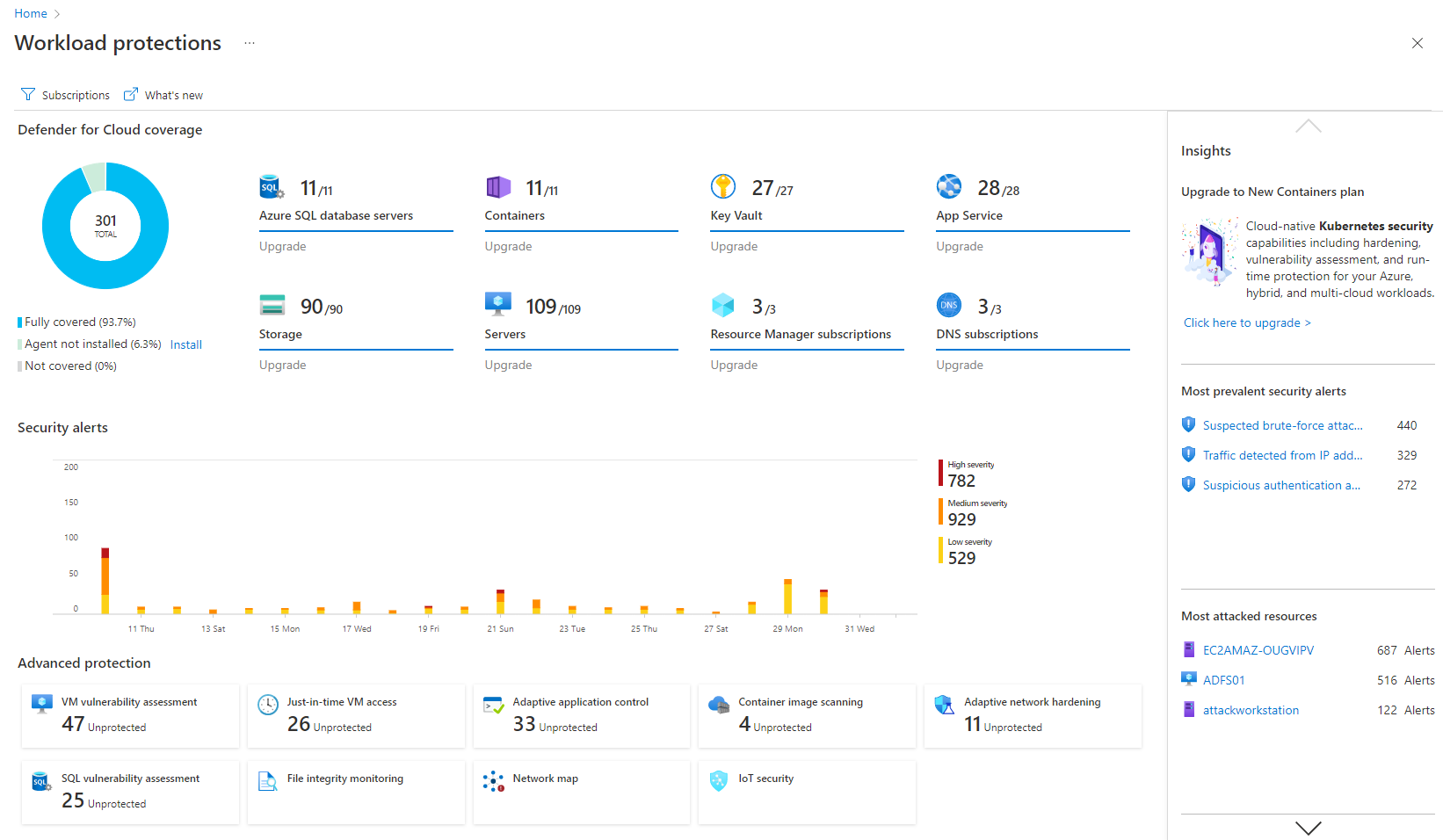
Microsoft Defender for Cloud is a Cloud Security Posture Management (CSPM) and Cloud Workload Protection Platform (CWPP) for Azure, on-premises, and multicloud (Amazon AWS and Google GCP) resources.
N/A
SUSE Security
Score 8.0 out of 10
N/A
SUSE® Security (formerly NeuVector) provides an end-to-end container security platform. This includes end-to-end vulnerability scanning and complete run-time protection for containers, pods and hosts.
Because we do a profound review of functionalities, configurations, and security operations from our soft team's perspective. The best one that adapts to our actual architecture, and I mean it's so negative for us because we are more prone to Microsoft products, was Microsoft …
Competitive-wise, we've looked at Palo Alto and Proofpoint. So we selected Microsoft Defender for Cloud on the basis it was linking closer to the identity, but we've had to also, I said earlier that we've aligned with Palo Alto for the secondary tech to look at it from a device …
Barracuda goes neck to neck with Microsoft Defender for Cloud in the anti-spam, anti-phishing email suite. But why I chose this product is because again, it's very well embedded with Microsoft technology, and we're a Microsoft shop, and it works well for us to use that product …
We were one of the first ones to deploy when Microsoft released it, so it's hard to compare, but what we hear from competitors, the fact that Microsoft can see the full ecosystem using this product makes it a lot better as compared to using a third party tool. So it's the ease …
Evaluated between cost. I just think it integrates better with the Microsoft stack and I mean, I think just cost from just that perspective and being the one pane of glass, I think that's enough.
I believe Microsoft Defender for Cloud stacks up well against the other tools we looked at. It is native to the Azure platform and provides the same insights as the other tools. We selected Microsoft Defender for Cloud because it integrates well with the Azure resources and …
Microsoft Defender for Cloud offered a more integrated and comprehensive solution for our multi-cloud environment, integrating well with our security and compliance needs
Microsoft Defender for Cloud is definitely the choice with the latest market trend and attacks that are currently happening. Microsoft has been able to safe guard a lot after the recent serious attacks happening globally in the digital world. There is a trust in this software …
There is the several ways to protect the applications and lot more tools available in the market. Most commonly we used Crowd strike Falcon for endpoint detection and response capabilities. McAfee endpoint protection also provide broad range of security features. Best …
We used to use Symantec and McAfee. It's been mostly defenders since, gosh, the last eight to 10 years. So we're a small organization. We don't have a lot of folks, so single-painted glass is really important to be able to see the whole environment in a single place. And the …
When we purchase this data fund, we check with not competition and we decided to purchase these tools because it's strong and we have a good relationship with Microsoft.
It is very good in comparison to other products that we have used. Its price is very effective and attractive, and it also provides good security policies. threat intelligence is also good and user protection is also very much better, and it also serves new updates as and when …
SUSE NeuVector is deployed on your Kubernetes, and data does not leave your data center. Sysdig is a cloud platform - you have no full control over what happens with your data. Also, SUSE NeuVector has a capability to prevent specific command execution ir containers, but Sysdig …
Microsoft Defender for Cloud is very good at allowing users to see how their Azure environment is secure through the secure score. The recommendations are an excellent source of the controls that should be in place to ensure a secure environment. There needs to be more protection and features for data security.
overall experience so far is good with product and its features.good to have such product in the IT industry to go for it when it come to kubernetes-native container security platform it have the ability to have deep visibility into your network which is the critical part of run-time container security.
Automation is crucial to managing sprawl and the additional complexity that comes with it. SOC management workbooks and process automation give significant flexibility.
The Security posture score and Security Alerts are neatly centralized and offer me crucial information quickly.
Defender for Cloud avoids the common compromise of simplicity for completeness (former Azure Security Center). The security warnings and advice go into great detail while remaining current and useful.
UI/UX. It can get a little messy when navigating around with all the flyouts in the Azure portal which can be frustrating, particularly when under time pressure.
The query languages for the queries and workbooks are another language that needs to be learned - it would be nice to have kept it closer to T-SQL or something like that to minimize the need to learn new syntax.
Adding cost estimations to the security recommendations would really improve the experience.
It is a great product that integrates nicely when running an Azure platform and even multi-cloud environment. Not looking for point-solutions but a suite that answers most requirements. It is very comfortable being able to use KQL, workbooks and automation that is native to the azure platform
My visibility is limited because I'm only doing very small pieces of what the overall org does. And also, we have limitations on what we're allowed to use. It's not like we get a new product as users or leadership level users, and everything is on, and we can just do whatever we want. We're very restricted in what we can use any tooling within the org because of the different levels of regulatory constraints we have, because of just the nature of who we are inherently. So that's why. I don't think it's necessarily the product. I think it's more or less of what we're able to do with the product.
Barracuda goes neck to neck with Microsoft Defender for Cloud in the anti-spam, anti-phishing email suite. But why I chose this product is because again, it's very well embedded with Microsoft technology, and we're a Microsoft shop, and it works well for us to use that product and have better visibility versus Barracuda being just an offshore, just a single product versus Microsoft Defender for Cloud being blended with other applications.
SUSE NeuVector is deployed on your Kubernetes, and data does not leave your data center. Sysdig is a cloud platform - you have no full control over what happens with your data. Also, SUSE NeuVector has a capability to prevent specific command execution ir containers, but Sysdig does not have such ability. Sysdig is not an open-source solution, but SUSE NeuVector is.