

DMARCTrust
What is DMARCTrust?
DMARCTrust is a cloud-based email authentication monitoring and inbound transport security application. The solution ingests compressed XML (Extensible Markup Language) reports to convert raw DMARC (Domain-based Message Authentication, Reporting, and Conformance) aggregate data into centralized dashboards tracking sending sources, message volume, authentication alignment, and security policy dispositions.
Key Capabilities
- Outbound Email Authentication Analytics: Ingests aggregate reports and resolves sending IP (Internet Protocol) addresses to recognizable service providers. The system monitors authentication performance over time, tracking SPF (Sender Policy Framework) and DKIM (DomainKeys Identified Mail) alignment, pass-rate trends, and failure spikes.
- In-Depth Investigation & Reporting: Provides granular report-level details, source insights, and RUF (Reporting Unauthorized Failures) failure reports when dispatched by receiving mail servers.
- Continuous DNS Protocol Monitoring: Records and monitors changes to DMARC, SPF, BIMI (Brand Indicators for Message Identification), TLS-RPT (Transport Layer Security Reporting), and MTA-STS (Mail Transfer Agent Strict Transport Security) records, issuing alerts upon confirmed modifications.
- Inbound Transport Protection: Tracks encrypted delivery sessions via TLS-RPT to identify certificate and policy errors. Higher-tier plans incorporate Receiver Shield to host and manage the MTA-STS policy lifecycle, alongside an SPF Optimizer designed to analyze and flatten SPF include chains.
- Data Integration & Export: Provides CSV (Comma-Separated Values) data export capabilities and API (Application Programming Interface) access on paid tiers for external data utilization.
Audience & Use Cases
- Audience: System administrators, IT operations managers, and cybersecurity analysts.
- Use Case: Monitoring domain sender legitimacy, separating authorized sending services from misconfigurations or spoofing attempts, auditing DNS (Domain Name System) security records, and enforcing transport-layer encryption policies for organizational email domains.
Technical Specifications
- Deployment Model: Cloud-hosted, agentless architecture. Integration requires publishing a dedicated aggregate-reporting address to the domain's DMARC DNS record.
- Free Plan: Supports 1 domain, up to 50 aggregate reports per month, and 7-day data retention.
- Starter Plan: Supports 2 domains, unlimited reports, 90-day data retention, automated alerts, source insights, TLS-RPT, failure reports, API access, CSV export, and 2 user seats.
- Pro Plan: Supports 5 domains, 180-day data retention, Receiver Shield (MTA-STS management), SPF Optimizer, and 5 user seats. Additional domain capacity is available as an add-on.
Categories & Use Cases
Videos
Screenshots

1 / 2
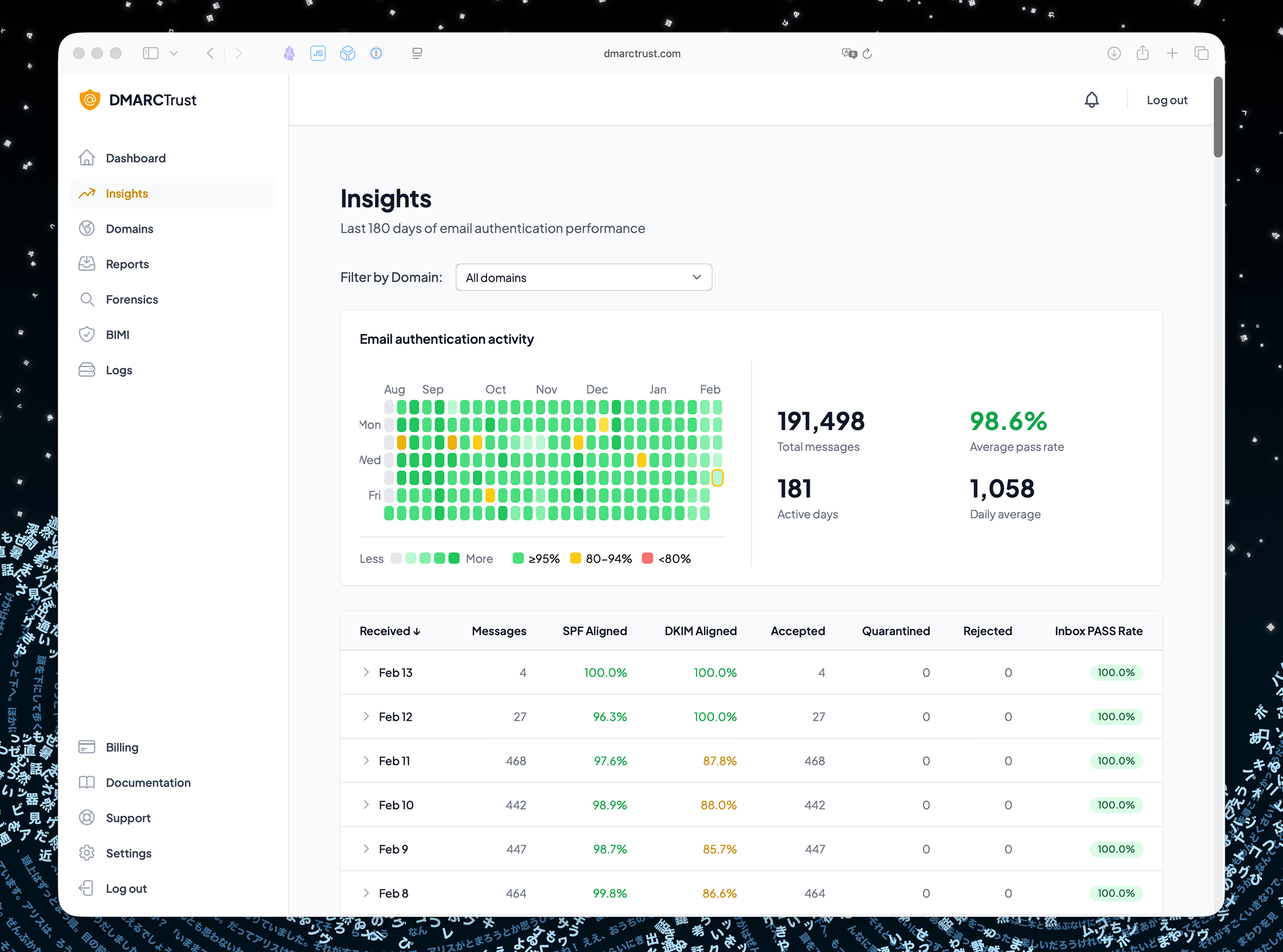
Screenshot of Quickly obtain a very clear dashboard to help you understand what DMARC is saying about your performance.
Technical Details
| Deployment Types | SaaS |
|---|---|
| Mobile Application | No |
| Supported Languages | English, French, German, Spanish |
FAQs
How much does DMARCTrust cost?
DMARCTrust starts at $0.
What are DMARCTrust's top competitors?
Valimail, PowerDMARC, and dmarcian are common alternatives for DMARCTrust.
Who uses DMARCTrust?
The most common users of DMARCTrust are from Small-Business.