

kMetal
What is kMetal?
kMetal is a Kubernetes infrastructure platform for running isolated tenant clusters on bare-metal servers. It integrates virtualization, networking, hosted control planes, and fleet operations behind Kubernetes APIs, removing the need to operate separate hypervisor and network-management products solely for Kubernetes isolation.
Operators install kMetal on bare-metal infrastructure and provision tenant clusters through Kubernetes-native workflows. Compute isolation uses KubeVirt and kernel-native KVM, giving each tenant a separate operating-system kernel. Software-defined networking provides an isolated network domain for each tenant. These capabilities are embedded in the platform and managed through Kubernetes tools such as kubectl.
The platform is organized around three areas:
- Hosted Control Planes – Tenant control planes run as pods on shared management nodes rather than requiring dedicated machines. Each tenant retains an independent API server, etcd datastore, lifecycle, and administrative access. In vendor testing, a 50-tenant deployment used three shared control-plane nodes instead of 150 dedicated machines, with approximately 200 mCPU and 256 MiB consumed per idle tenant. The same testing reported provisioning an isolated cluster in about two minutes and completing control-plane upgrades in roughly 16 seconds without downtime.
- Embedded Isolation – Each tenant receives a complete, CNCF-conformant Kubernetes cluster with dedicated control-plane state, KVM-isolated worker nodes, a separate kernel, and an isolated network domain. This provides compute and network separation beyond namespace-based or virtual-cluster models that share a host kernel and network.
- Fleet Management – Cluster and node profiles define approved operating-system images, Kubernetes versions, networking, storage, policies, and required add-ons. Lifecycle automation, policy enforcement, and drift remediation support fleets distributed across data centers, colocation facilities, and edge sites. Vendor benchmarks report reconciling 100 control planes in under 150 seconds.
- kMetal is storage-agnostic and can use CSI-compatible storage providers. It supports Cluster API, Terraform, GitOps, and Helm workflows for infrastructure provisioning and application delivery. The platform is developed by CLASTIX, the company behind the open-source Kamaji hosted-control-plane project.
According to CLASTIX’s internal analysis of on-premises deployments, kMetal can reduce infrastructure depreciation, operational labor, energy, facility, and productivity costs by consolidating control-plane resources and removing separately managed virtualization and networking products. Actual savings depend on the existing architecture, cluster count, hardware, licensing, and operating model.
kPool, currently described as a beta extension, adds cloud-style provisioning of Kubernetes on bare-metal instances, including pre-warmed GPU node pools for AI workloads.
Categories & Use Cases
Media

1 / 3
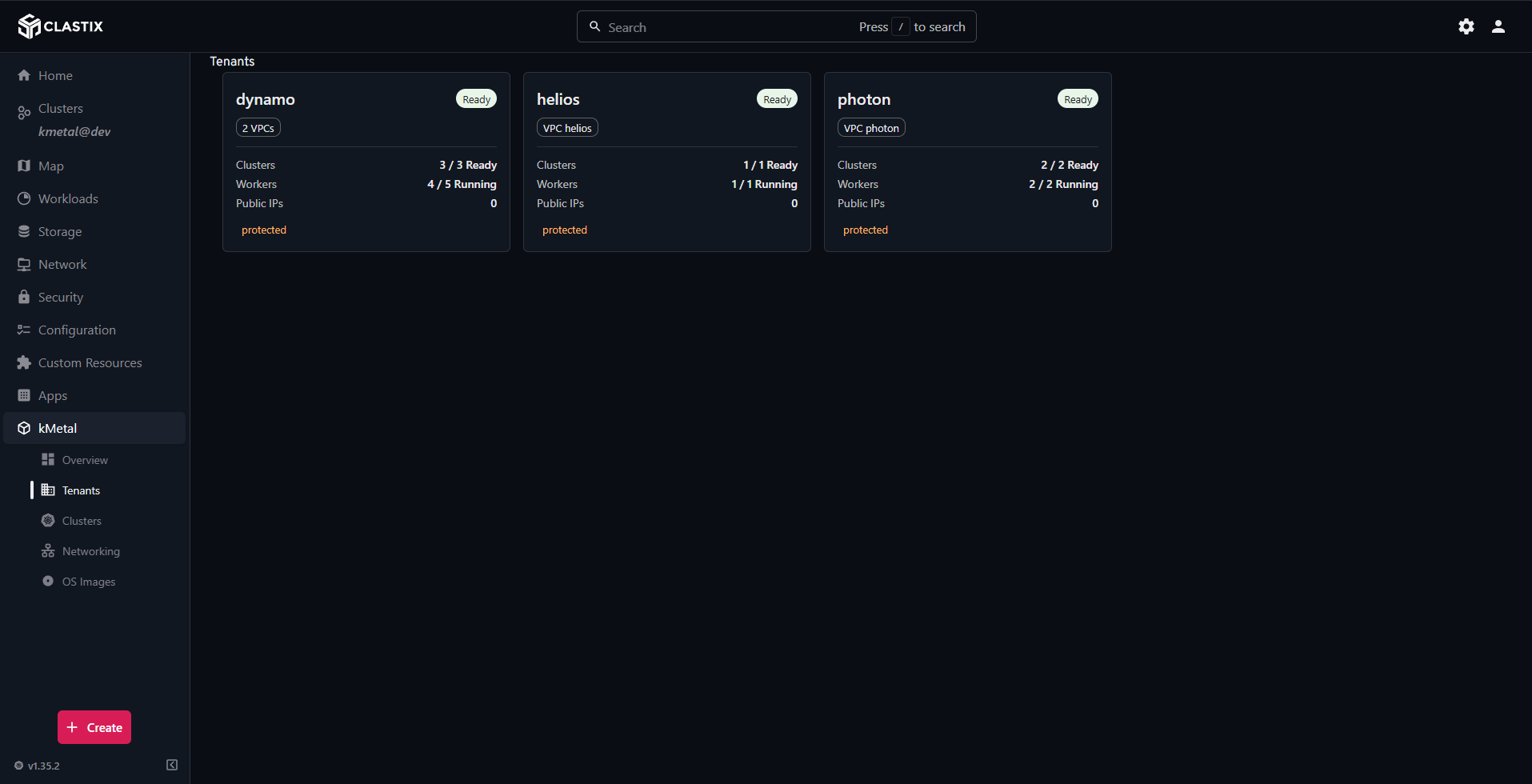
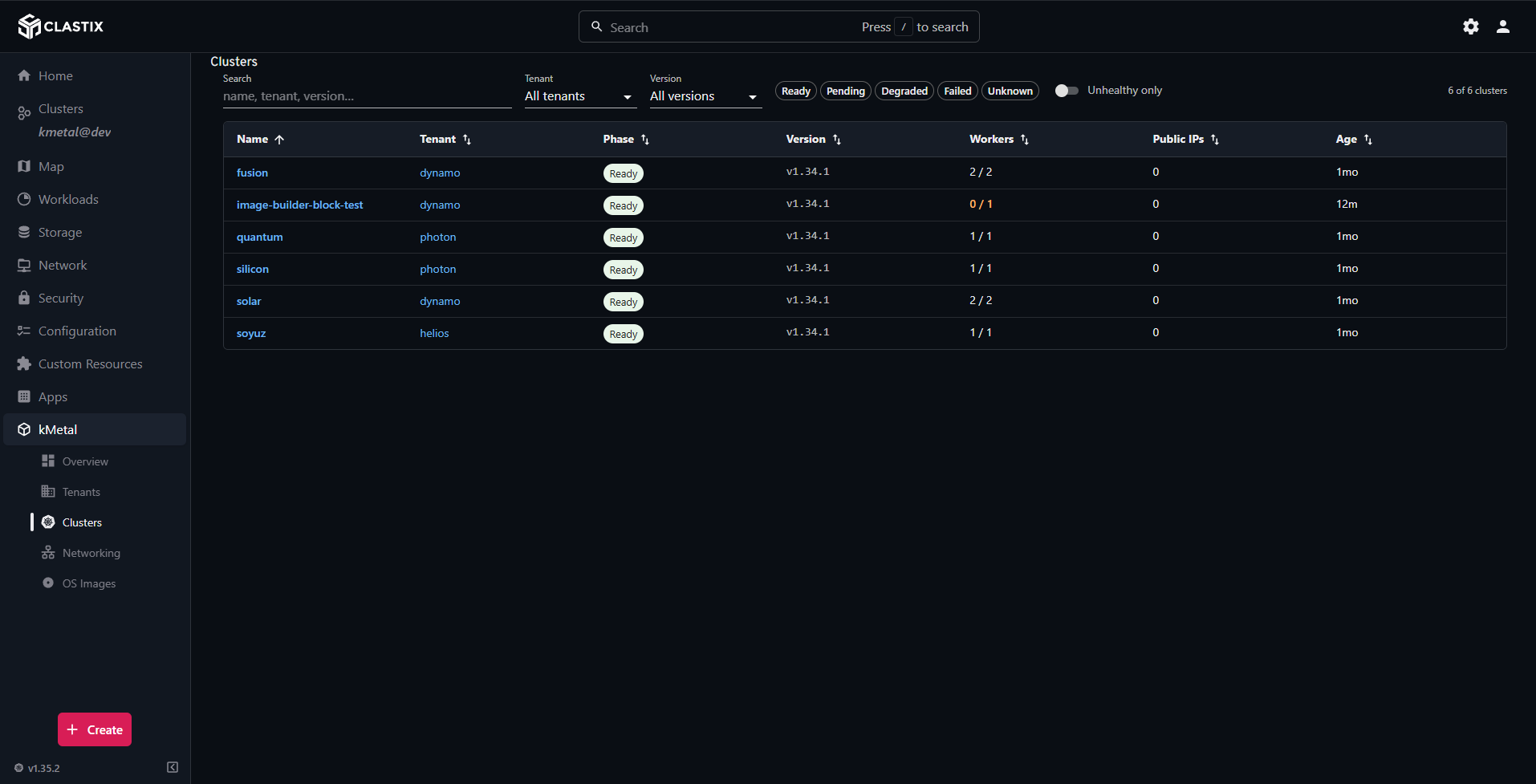
Screenshot of Overview – kMetal's single-pane operations dashboard: fleet-wide health across all tenants, clusters, and worker VMs, with total allocated CPU, memory, and storage, the entire bare-metal Kubernetes estate in one view.


