

Zoho IoT
1 Reviews and Ratings
What is Zoho IoT?
Zoho IoT is Zoho’s application platform for connecting physical assets, storing their telemetry, and building applications that monitor and act on that data. It is an Internet of Things (IoT) platform with Industrial IoT connectivity for machines, controllers, meters, and building systems.
Key Capabilities
- Models and instances: In the developer application, a device, asset, or location model holds templates for datapoints, commands, alarm rules, fields, and overview dashboards. The end application creates instances from those models, so one energy-meter model can produce many meter instances with the same setup.
- Telemetry: Gateway devices and sensors send payloads to the application. Datapoints extract time-stamped values and store them as received or as values computed with user-defined expressions. Supported value types are string, numeric, enum, boolean, and location. Realtime datapoints keep the current value from a message. KPI datapoints run on a schedule.
- Industrial and device connectivity: Cloud ingestion uses MQTT 3.1.1 and HTTPS. LoRaWAN devices connect through a LoRa Network Server datastream. Edge Lite, a lightweight agent for supported gateways, polls Modbus RTU, Modbus TCP, and Modbus RTU over TCP peripherals and sends commands. Edge Server, for plant-wide deployments, adds native drivers for Modbus, OPC UA, BACnet, Siemens S7, SNMP, SQL, MQTT, and HTTP, plus custom drivers. The Zoho IoT Agent also documents Ethernet/IP and GPIO. Registry maps and RS-485 port settings for Modbus peripherals can be written in the application and pushed to a gateway running Edge Agent.
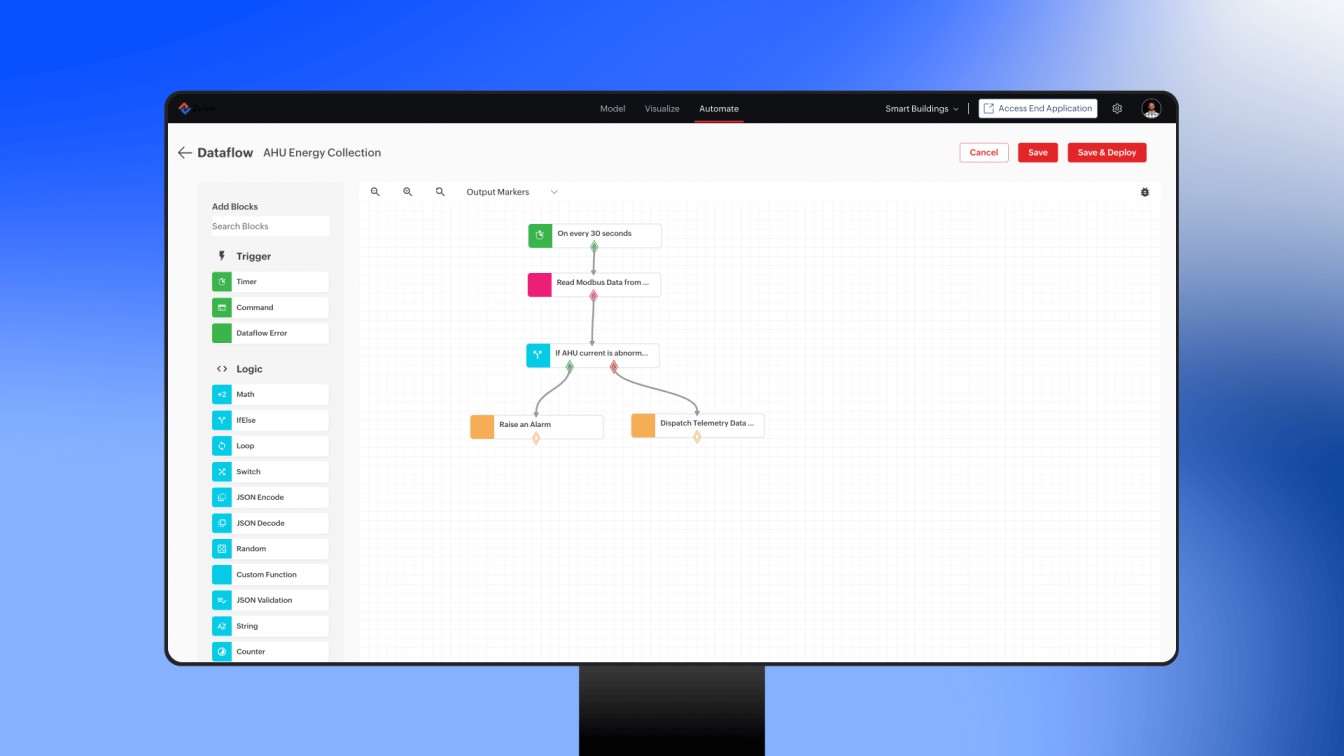
- Edge processing: Edge Server stores data in time-series and cache memory and runs pipelines that filter, transform, and route data before local storage or cloud upload. Edge Lite can apply formulas, aggregations, windowed calculations, and threshold events through its custom data-processing scripts.
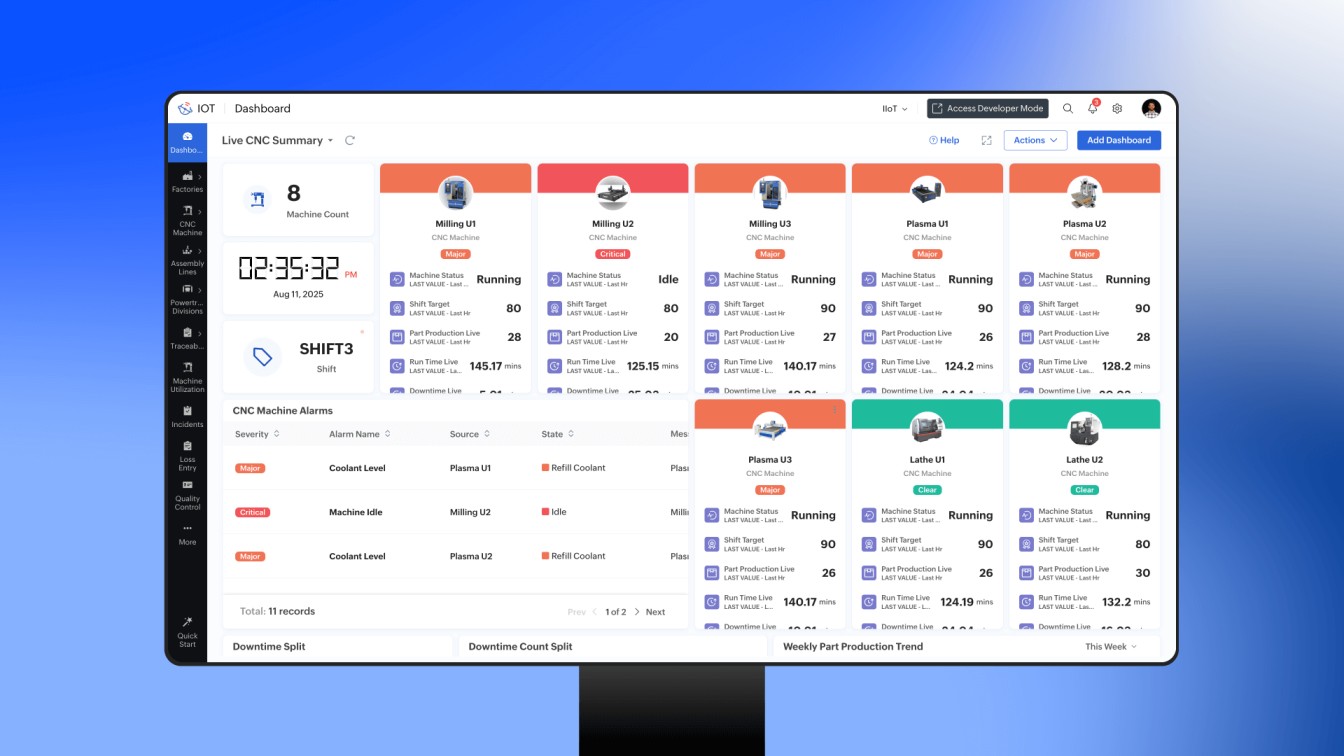
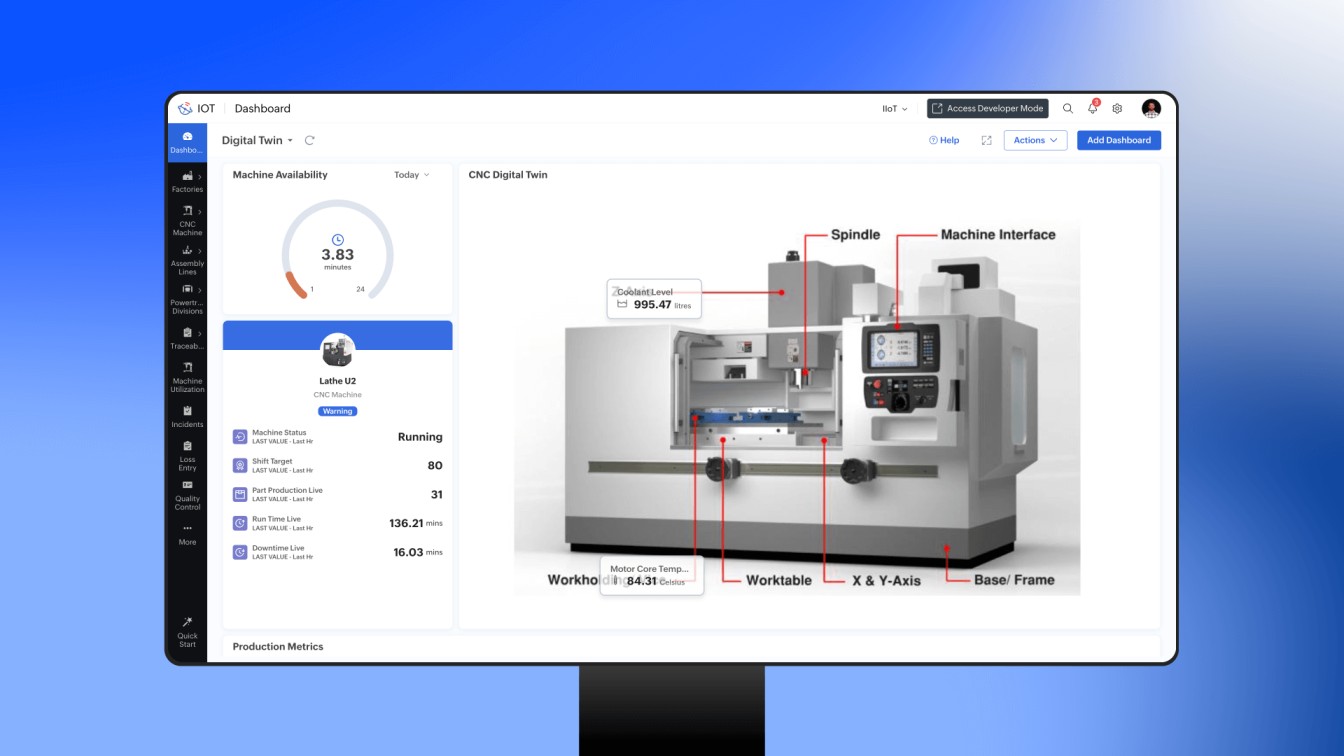
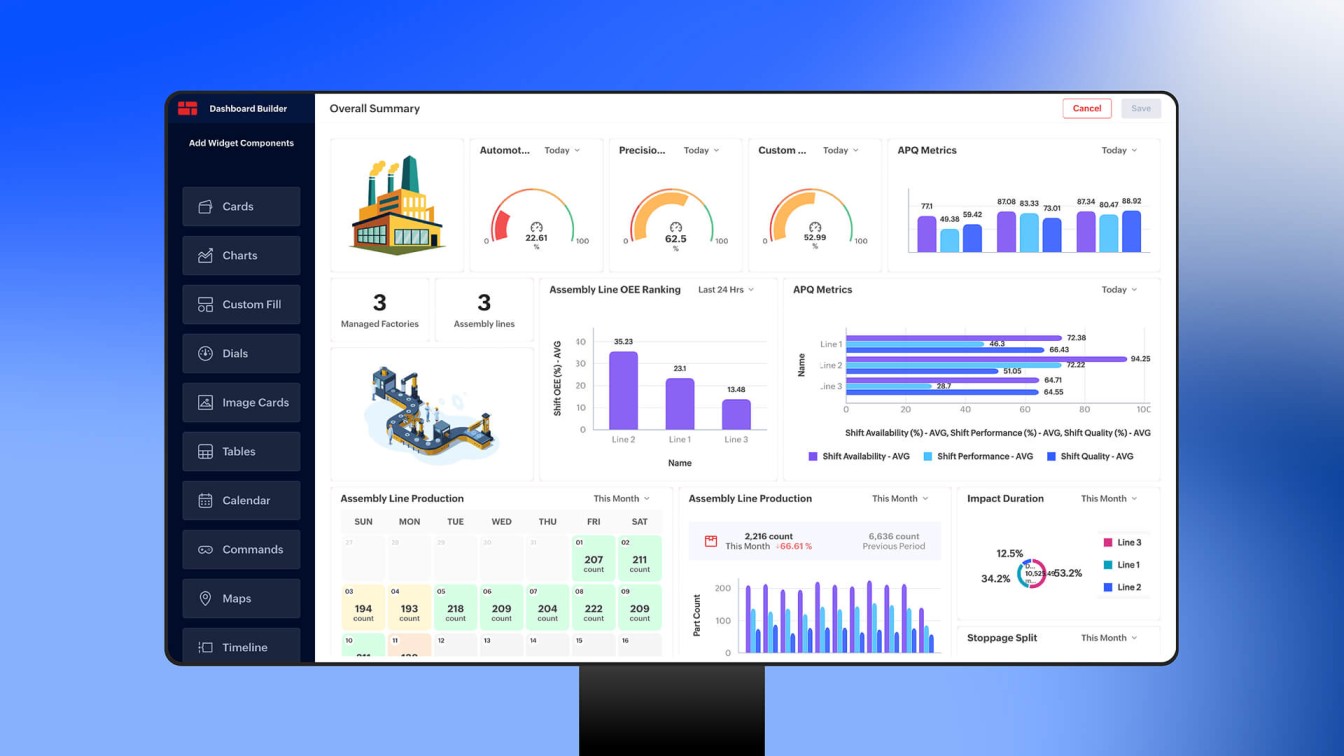
- Monitoring: Dashboards and widgets display datapoints, alarms, and reports. Role-specific views cover operators, maintenance, plant, energy, and business users. Managed entities can be organized in location hierarchies and parent-child asset hierarchies.
- Alarms, workflows, and commands: Alarm rules evaluate realtime datapoints, scheduled KPI datapoints, or device notifications. When a condition matches, an alarm can run a command, a custom function, a webhook, or an email. Workflow rules are separate: they fire on record create, edit, or delete, or on a schedule, and can send email, call a webhook, or run a custom function. Commands are actionable controls on devices and assets, including scheduled command execution.
- Device identity: MQTT devices authenticate with client certificates. Each certificate maps to a policy that allows telemetry, device events, command subscription, and Edge Agent configuration. A device may hold multiple certificates, and only one is active for a connection. Devices can be managed or unmanaged; unmanaging a device stops collection and disables its alarm rules.
- Application build-out: Custom modules, custom functions, message formatters, and message handlers extend the data model and payload handling. Managed service providers can expose a client portal and rebrand the application. REST APIs connect machine data to CRM, ERP, BI, and other Zoho applications.
Audience & Use Cases
- Audience: Operations, maintenance, and energy teams; connected-equipment manufacturers; system integrators; and developers building a Zoho IoT end application.
- Use Case: Machine and OEE monitoring, production and downtime tracking, quality and genealogy views, energy and utility monitoring, smart-building conditions, remote equipment monitoring, and multi-tenant customer portals for connected products. The same application can sit beside existing SCADA, BMS, MES, ERP, and historian systems.
Technical Specifications
- Edge ports: Edge Server uses MQTT 1883 and 8883 toward Zoho IoT, Modbus TCP on 502, and OPC UA on 4840. BACnet is a native driver.
- Edge Lite hardware: Documented targets include Teltonika TRB and RUT gateways, Atreyo AG-207 and AG-702, Raspberry Pi 3, 4, and 5, and Windows, Linux, and macOS computers. Zoho marks some RUT models as not recommended.
- Onboarding: Devices can be created from a custom device product, imported from the product gallery, or attached as a virtual device on a direct MQTT or HTTPS endpoint. A device product carries datapoint definitions and Modbus registry mappings.
- Capacity: Published plans meter devices and assets, incoming messages, datapoint storage and processing, alarm-rule executions, reports, and workflow, webhook, email, and custom-function actions. Limits differ by plan.
Categories & Use Cases
Videos
Screenshots


1 / 6
Screenshot of All Machines unified dashboard
Technical Details
| Deployment Types | On-Premise, SaaS |
|---|---|
| Operating Systems | Windows, Linux |
| Mobile Application | Apple iOS, Android |
| Supported Languages | English |
FAQs
How much does Zoho IoT cost?
Zoho IoT starts at $59.
What are Zoho IoT's top competitors?
Sight Machine, Tulip Interfaces, and Ubidots are common alternatives for Zoho IoT.