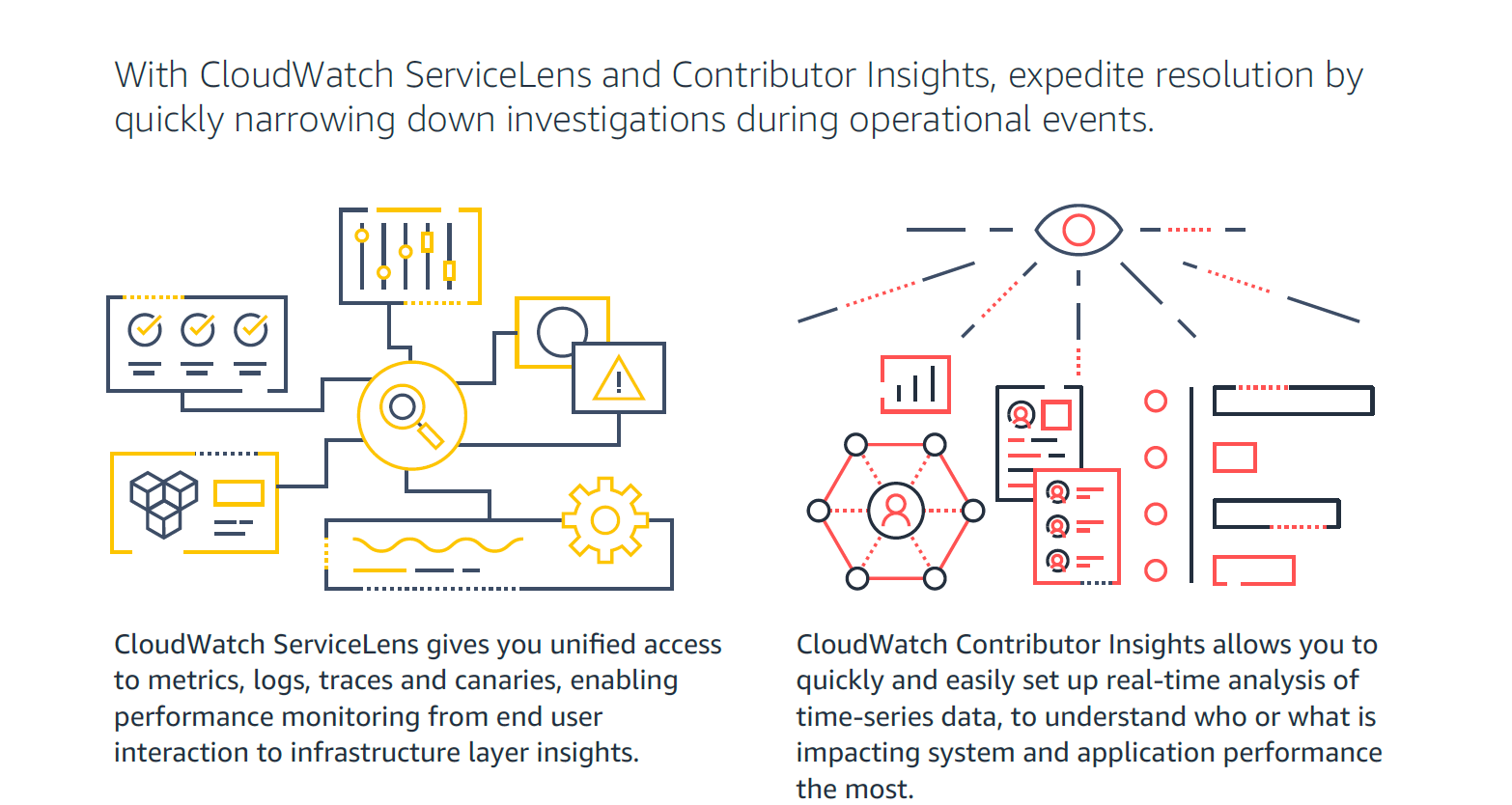
Amazon CloudWatch is a native AWS monitoring tool for AWS programs. It provides data collection and resource monitoring capabilities.
$0
per canary run
SolarWinds Kiwi Syslog Server
Score 8.3 out of 10
N/A
Solarwinds® Kiwi Syslog® Server is a syslog management tool for network and systems engineers. It receives syslog messages and SNMP traps from network devices (routers, switches, firewalls, etc.), and Linux®/Unix® hosts. Users can filter and view these messages based on time, hostname, severity, etc., and set up custom alerts. Kiwi Syslog Server has built-in actions to react appropriately to syslog messages. There are also log archival and clean-up features to help comply with security policies.
$319
Per Instance
Pricing
Amazon CloudWatch
SolarWinds Kiwi Syslog Server
Editions & Modules
Canaries
$0.0012
per canary run
Logs - Analyze (Logs Insights queries)
$0.005
per GB of data scanned
Over 1,000,000 Metrics
$0.02
per month
Contributor Insights - Matched Log Events
$0.02
per month per one million log events that match the rule
Logs - Store (Archival)
$0.03
per GB
Next 750,000 Metrics
$0.05
per month
Next 240,000 Metrics
$0.10
per month
Alarm - Standard Resolution (60 Sec)
$0.10
per month per alarm metric
First 10,000 Metrics
$0.30
per month
Alarm - High Resolution (10 Sec)
$0.30
per month per alarm metric
Alarm - Composite
$0.50
per month per alarm
Logs - Collect (Data Ingestion)
$0.50
per GB
Contributor Insights
$0.50
per month per rule
Events - Custom
$1.00
per million events
Events - Cross-account
$1.00
per million events
CloudWatch RUM
$1
per 100k events
Dashboard
$3.00
per month per dashboard
CloudWatch Evidently - Events
$5
per 1 million events
CloudWatch Evidently - Analysis Units
$7.50
per 1 million analysis units
One Time Price
$319.00
Per Instance
Offerings
Pricing Offerings
Amazon CloudWatch
SolarWinds Kiwi Syslog Server
Free Trial
Yes
Yes
Free/Freemium Version
Yes
Yes
Premium Consulting/Integration Services
No
No
Entry-level Setup Fee
No setup fee
No setup fee
Additional Details
With Amazon CloudWatch, there is no up-front commitment or minimum fee; you simply pay for what you use. You will be charged at the end of the month for your usage.
—
More Pricing Information
Community Pulse
Amazon CloudWatch
SolarWinds Kiwi Syslog Server
Considered Both Products
Amazon CloudWatch
Verified User
Anonymous
Chose Amazon CloudWatch
We use Cloudwatch for simpler monitoring, but these metrics and logs often feed into bigger ecosystems across our organization. The metrics and logs in Cloudwatch allow our developers quick and easy access to the data they need whilst easily integrating the same data into more …
Grafana is definitely a lot better and flexible in comparison with Amazon CloudWatch for visualisation, as it offers much more options and is versatile. VictoriaMetrics and Prometheus are time-series databases which can do almost everything cloudwatch can do in a better and …
In comparison to its competitors, Amazon CloudWatch is efficient, reliable, and has a fast response time, and it maximizes an application's life while also providing the best load balance and storage. The services that Amazon CloudWatch provides are far better and cheaper for …
We have also tested with SolarWinds NPM, and Zoho Monitors. They seemed to work fine and setup was not as involved as Amazon services, JSON, etc. However, the issue of upgrades made the other solutions incur more downtime overall for maintenance and software upgrades via the …
I think there is no alternative of [Amazon] CloudWatch service. However it provides lot of glue points which you can use to show different metrics, trigger events and update your dashboards.
I believe that CloudWatch is a better solution to use with AWS services and resources in terms of cost and ease of integration with AWS infrastructure services. But keep in mind that Elasticsearch is better at aggregating application-level metrics. We chose CloudWatch because of …
We found that CloudWatch is the best solution to use with AWS services in terms of cost and ease of integration with AWS infrastructure services. While Elasticsearch is better at aggregating application-level metrics, CloudWatch wins out in its capabilities to tightly integrate …
CloudWatch is the minimum viable product that is used as your baseline. Once you graduate beyond the basic needs, there is a wide range of tools from other AWS partners that go well above and beyond. However the cost of those tools is typically considerably more.
We thought about using Logstash for capturing our data. But we encountered several configuration issues, so as I mentioned before, if you're using AWS, the best way to do this is using the service they offer, as you don't encounter configuration problems. This is why I consider …
I think Amazon has put more efforts to develop AWS CloudWatch features to monitor each kind of AWS service you can use instead of Dynatrace One Agent that just can monitor some variables of Computing services and FaaS, unless Dynatrace One Agent integration with AWS CloudWatch …
Out of the box monitoring which compliments workloads implemented from infrastructure as code so we have standardized metrics across all our monitoring for our AWS workloads. Also incredibly easy to implement via the console which can be done in minutes oppose to hours of …
We choose Amazon CloudWatch because, first, we use AWS and we need a monitoring tool. That is why we considered CloudWatch as soon as we started deploying AWS services to our company. Second, CloudWatch is a great, handy tool to monitor our services. Its strength is obvious …
Currently, we only tried and used Cloud Watch, but for AWS it is perfect. Since this is an Amazon product monitoring Amazon services, integration is great. If we decide in the future to move away from AWS, we would reconsider changing alarm monitoring. AWS can be costly …
Amazon CloudWatch is fully integrated into your existing AWS account, and provides easy hooks into several different services to make a cohesive infrastructure. Unfortunately, using other services will not allow you to get into the weeds to do everything Amazon CloudWatch can …
CloudWatch is incredibly cheap compared to new relic and much more intuitive and easy to use than Nagios. It requires no setup, expertise, or otherwise extensive knowledge to use.
We used to use Miscosoft Azure, however when we came across Amazon CloudWatch, and all the features it can provide, it seemd no brainer to switch. We transitioned from Azure to CloudWatch within 2 years of using Azure, And may not go back. Hopefully Amazon will keep adding more …
Amazon CloudWatch is great in terms of the CloudWatch Logs feature, it integrates easily with other AWS services (CloudFormation, S3, Lambda, etc.) and is reasonably low cost, so it was a no-brainer for that area. For alerting, CloudWatch didn't offer much in the way of …
I feel that CloudWatch will always remain the backbone of log analytics, events, and alarms. However, we can use other products in conjunction with it for better log analytics and monitoring. In my organization, we also ingest logs from CloudWatch to Splunk and ELK. This way we …
Syslog-ng don't have customer support or technical support .But its a free software and no clarity on limitations ingestion bandwidth. No gui feature and everything should be done from backend. Gui can easily help to start and stop service ,easy to configure. Unlimited …
PRTG Network Monitor does not give enough reporting and visibility as SolarWinds Kiwi Syslog Server provides. PRTG Network Monitor Syslog is just a sensor but SolarWinds Kiwi Syslog Server has separate applications which are very useful.
SolarWinds Kiwi Syslog is a bare-bones Syslog Server. It doesn't have the advanced features of Splunk and SolarWinds Log Analyzer such as alerting, log analysis, event correlation, etc. However, if you're an SMB and just need a solution to fulfill a security requirement, then …
PRTG is a great package and very useful, but the jump from the free 100 sensor price model to the first tier of the paid model is WAY too expensive. SolarWinds Kiwi Syslog Server is very inexpensive and provides us with the results we needed for log monitoring.
Our group already had a license for the Orion Syslog server that comes bundled with Orion NPM, but it didn't quite meet our requirements for performance. Elasticsearch and Graylog easily met our performance requirements, but not enough team members were able to manage the …
I've not had any other interaction with other Syslog servers. The main reason for that is that Kiwi works outstandingly well at what it does. Simply put, I believe this product is a staple in the IT industry and will remain as such as long as they keep the tool current and …
The price for Kiwi was acceptable and it checked off all the boxes of a product that we needed. I also considered Graylog but Kiwi was much easier to configure.
If you use any AWS services, CloudWatch is the natural choice to monitor & troubleshoot your workload. Thankfully, for most AWS services, CloudWatch is either built-in or very easy to set up. However, being proficient in browsing & tracking the log events would take some training & practice. Having some experienced people on the team would help immensely, especially in spreading the skill to the rest of the team.
The SolarWinds Kiwi Syslog Server does what it's supposed to do. It's a bare-bones Syslog Server. If your company is just trying to fulfill security requirements or doesn't need all the advanced features of a product such as Splunk, then Kiwi will work well and not break the bank. Using the tool is very straightforward as there aren't a lot of options outside of just viewing logs.
It provides lot many out of the box dashboard to observe the health and usage of your cloud deployments. Few examples are CPU usage, Disk read/write, Network in/out etc.
It is possible to stream CloudWatch log data to Amazon Elasticsearch to process them almost real time.
If you have setup your code pipeline and wants to see the status, CloudWatch really helps. It can trigger lambda function when certain cloudWatch event happens and lambda can store the data to S3 or Athena which Quicksight can represent.
Collection of SNMP traps a reliable and stable collection server for these is crucial to troubleshooting and time to ROS. Kiwi excels at this.
Easy to install set up and train users on.
The free version is a good free tool and handy to use for personal labs and other smalle use cases.
SNMP traps to user readable format is great, sometimes syslog and smnp messages can be hard to interpret and read with out a knowledge of how to do this.
Memory metrics on EC2 are not available on CloudWatch. Depending on workloads if we need visibility on memory metrics we use Solarwinds Orion with the agent installed. For scalable workloads, this involves customization of images being used.
Visualization out of the box. But this can easily be addressed with other solutions such as Grafana.
By design, this is only used for AWS workloads so depending on your environment cannot be used as an all in one solution for your monitoring.
Although the tool itself is easy to integrate and is readily available for use, it has its limitations. The key limitations of cloudwatch are with respect to cost incurred on log retention and log querying. While for key use cases this is sufficient, for more advanced use cases, Amazon CloudWatch doesn't work out. Also, obviously it is tightly coupled with AWS, which makes you look away if you need a single tool for all monitoring
Kiwi Syslog has the best usability of any syslog server. While not being able to offer the most features, the ones it does have are intuitive and easy to work with. Everything that it has is where you think it should be. If you can't find it in the menus, it doesn't exist.
Support is effective, and we were able to get any problems that we couldn't get solved through community discussion forums solved for us by the AWS support team. For example, we were assisted in one instance where we were not sure about the best metrics to use in order to optimize an auto-scaling group on EC2. The support team was able to look at our metrics and give a useful recommendation on which metrics to use.
Because the solution is so simple to use and implement, support wasn't very necessary. The one time I did call them to better understand where logs were stored, they were very helpful and friendly. Kiwi has been around for some time and not a lot has changed over the years, so support for it is pretty straightforward and quick.
We use Cloudwatch for simpler monitoring, but these metrics and logs often feed into bigger ecosystems across our organization. The metrics and logs in Cloudwatch allow our developers quick and easy access to the data they need whilst easily integrating the same data into more prominent platforms for wider analysis, including Service desk support, SecOps, and ITOps monitoring within the organization.
Syslog-ng don't have customer support or technical support .But its a free software and no clarity on limitations ingestion bandwidth. No gui feature and everything should be done from backend. Gui can easily help to start and stop service ,easy to configure. Unlimited technical and customer support . Even when server got shutdown will get on-call or immediate support that will helps a lot to resolve errors