Amazon Relational Database Service (Amazon RDS) is a database-as-a-service (DBaaS) from Amazon Web Services.
N/A
OpenText Vertica
Score 10.0 out of 10
N/A
The Vertica Analytics Platform supplies enterprise data warehouses with big data analytics capabilities and modernization. Vertica is owned and supported by OpenText.
If your application needs a relational data store and uses other AWS services, AWS RDS is a no-brainer. It offers all the traditional database features, makes it a snap to set up, creates cross-region replication, has advanced security, built-in monitoring, and much more at a very good price. You can also set up streaming to a data lake using various other AWS services on your RDS.
Vertica as a data warehouse to deliver analytics in-house and even to your client base on scale is not rivaled anywhere in the market. Frankly, in my experience it is not even close to equaled. Because it is such a powerful data warehouse, some people attempt to use it as a transactional database. It certainly is not one of those. Individual row inserts are slow and do not perform well. Deletes are a whole other story. RDBMS it is definitely not. OLAP it rocks.
Automated Database Management: We use it for streamlining routine tasks like software patching and database backups.
Scalability on Demand: we use it to handle traffic spikes, scaling both vertically and horizontally.
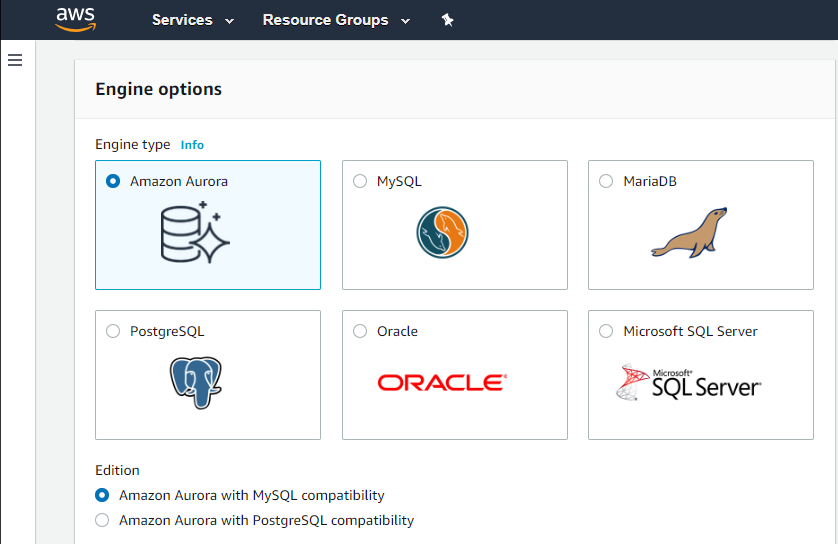
Database Engine Compatibility: It works amazingly with multiple database engines used by different departments within our organization including MySQL, PostgreSQL, SQL Server, and Oracle.
Monitoring: It covers our extensive monitoring and logging, and also has great compatibility with Amazon CloudWatch
It is a little difficult to configure and connect to an RDS instance. The integration with ECS can be made more seamless.
Exploring features within RDS is not very easy and intuitive. Either a human friendly documentation should be added or the User Interface be made intuitive so that people can explore and find features on their own.
There should be tools to analyze cost and minimize it according to the usage.
Could use some work on better integrating with cloud providers and open source technologies. For AWS you will find an AMI in the marketplace and recently a connector for loading data from S3 directly was created. With last release, integration with Kafka was added that can help.
Managing large workloads (concurrent queries) is a bit challenging.
Having a way to provide an estimate on the duration for currently executing queries / etc. can be helpful. Vertica provides some counters for the query execution engine that are helpful but some may find confusing.
Unloading data over JDBC is very slow. We've had to come up with alternatives based on vsql, etc. Not a very clean, official on how to unload data.
We do renew our use of Amazon Relational Database Service. We don't have any problems faced with RDS in place. RDS has taken away lot of overhead of hosting database, managing the database and keeping a team just to manage database. Even the backup, security and recovery another overhead that has been taken away by RDS. So, we will keep on using RDS.
I've been using AWS Relational Database Services in several projects in different environments and from the AWS products, maybe this one together to EC2 are my favourite. They deliver what they promise. Reliable, fast, easy and with a fair price (in comparison to commercial products which have obscure license agreements).
I have only had good experiences in working with AWS support. I will admit that my experience comes from the benefit of having a premium tier of support but even working with free-tier accounts I have not had problems getting help with AWS products when needed. And most often, the docs do a pretty good job of explaining how to operate a service so a quick spin through the docs has been useful in solving problems.
I haven't had any recent opportunity to reach out to Vertica support. From what I remember, I believe whenever I reached out to them the experience was smooth.
Amazon Relational Database Service (RDS) stands out among similar products due to its seamless integration with other AWS services, automated backups, and multi-AZ deployments for high availability. Its support for various database engines, such as MySQL, PostgreSQL, and Oracle, provides flexibility. Additionally, RDS offers managed security features, including encryption and IAM integration, enhancing data protection. The pay-as-you-go pricing model makes it cost-effective. Overall, Amazon RDS excels in ease of use, scalability, and a comprehensive feature set, making it a top choice for organizations seeking a reliable and scalable managed relational database service in the cloud.
Vertica performs well when the query has good stats and is tuned well. Options for GUI clients are ugly and outdated. IO optimized: it's a columnar store with no indexing structures to maintain like traditional databases. The indexing is achieved by storing the data sorted on disk, which itself is run transparently as a background process.