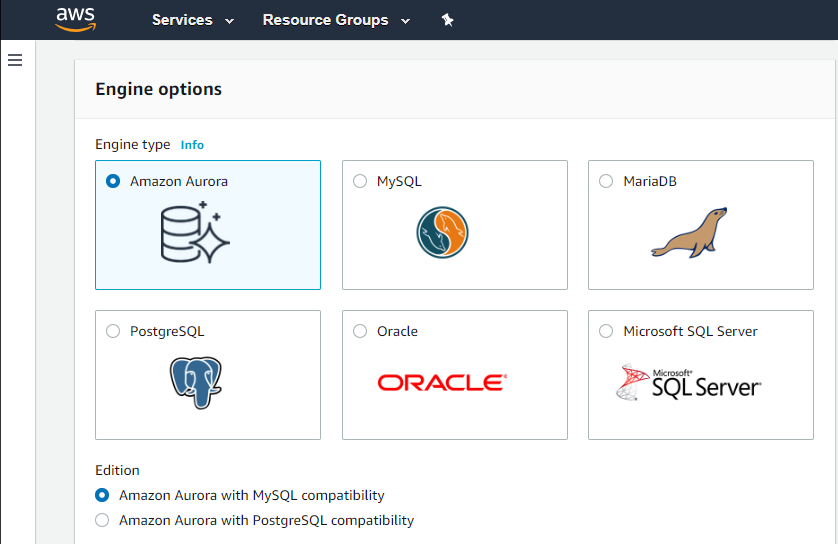
Amazon Relational Database Service (Amazon RDS) is a database-as-a-service (DBaaS) from Amazon Web Services.
N/A
Oracle Exadata
Score 9.8 out of 10
N/A
Oracle Exadata is an enterprise database platform that runs Oracle Database workloads of any scale and criticality with high performance, availability, and security. Exadata’s scale-out design employs optimizations that let transaction processing, analytics, machine learning, and mixed workloads run faster. Consolidating diverse Oracle Database workloads on Exadata platforms in enterprise data centers, Oracle Cloud Infrastructure (OCI), and multicloud environments helps organizations increase…
$2.90
Per Unit
Pricing
Amazon Relational Database Service (RDS)
Oracle Exadata
Editions & Modules
Amazon RDS for PostgreSQL
$0.24 ($0.48)
per hour, R5 Large (R5 Extra Large)
Amazon RDS for MariaDB
$0.25 ($0.50)
per hour, R5 Large (R5 Extra Large)
Amazon RDS for MySQL
$0.29 ($0.58)
per hour, R5 Large (R5 Extra Large)
Amazon RDS for Oracle
$0.482 ($0.964)
per hour, R5 Large (R5 Extra Large)
Amazon RDS for SQL Server
$1.02 ($1.52)
per hour, R5 Large (R5 Extra Large)
Database Server
$2.9032
Per Unit
Quarter Rack
$14.5162
Per Unit
Offerings
Pricing Offerings
Amazon RDS
Oracle Exadata
Free Trial
No
No
Free/Freemium Version
No
No
Premium Consulting/Integration Services
No
No
Entry-level Setup Fee
Optional
No setup fee
Additional Details
—
—
More Pricing Information
Community Pulse
Amazon Relational Database Service (RDS)
Oracle Exadata
Features
Amazon Relational Database Service (RDS)
Oracle Exadata
Access Control and Security
Comparison of Access Control and Security features of Product A and Product B
If your application needs a relational data store and uses other AWS services, AWS RDS is a no-brainer. It offers all the traditional database features, makes it a snap to set up, creates cross-region replication, has advanced security, built-in monitoring, and much more at a very good price. You can also set up streaming to a data lake using various other AWS services on your RDS.
Oracle Exadata is well-suited for environments where massive performance for Oracle databases is required. Storage indexes reduce the unnecessary I/O. Smart Flash Cache accelerates random reads/writes.
Our OLTP application demands very high concurrency. Multi-node Exadata provides high availability and zero downtime during DB patching. It comes with lots of built-in automations, so it reduces many routine tasks for sysadmins, like network, storage, and VM configuration, and it also reduces many Oracle DBA tasks, like Oracle software installation, patching, and upgrades.
Automated Database Management: We use it for streamlining routine tasks like software patching and database backups.
Scalability on Demand: we use it to handle traffic spikes, scaling both vertically and horizontally.
Database Engine Compatibility: It works amazingly with multiple database engines used by different departments within our organization including MySQL, PostgreSQL, SQL Server, and Oracle.
Monitoring: It covers our extensive monitoring and logging, and also has great compatibility with Amazon CloudWatch
Oracle Database : Deliver industry-leading security, high availability and scalability with Oracle Database, which has been significantly enhanced to take advantage of the Oracle Exadata Storage Servers.
Exadata Smart Scan : Improve query performance by offloading intensive query processing and data mining scoring to scalable intelligent storage servers.
Smart Flash Cache : Transparently cache 'hot' read and write data to fast solid-state storage, improving query response times and throughput. Exadata systems use the latest PCI flash technology rather than flash disks. PCI flash delivers ultra-high performance by placing flash directly on the high speed PCI bus rather than behind slow disk controllers.
Hybrid Columnar Compression : Reduce the size of data warehousing tables by 10x, and archive tables by 50x, to improve performance and lower storage costs for primary, standby, and backup databases. Query high, query low, archive high and archive low.
Infiniband Network : Connect multiple Oracle Exadata Database Machines using the InfiniBand fabric to form a larger single system image configuration. Each InfiniBand link provides 40 Gigabits of bandwidth–many times higher than traditional storage or server networks.
Petabyte Scalability : Easily scale data warehouse to support enterprise data growth.
It is a little difficult to configure and connect to an RDS instance. The integration with ECS can be made more seamless.
Exploring features within RDS is not very easy and intuitive. Either a human friendly documentation should be added or the User Interface be made intuitive so that people can explore and find features on their own.
There should be tools to analyze cost and minimize it according to the usage.
The process of patching and upgrade of Exadata server components could be improved with a goal to minimize the overall effort, make it fully automated and transparent.
Improved guidelines and possibly more sophisticated tools for sizing of new Exadata servers for migration from old legacy hardware.
We do renew our use of Amazon Relational Database Service. We don't have any problems faced with RDS in place. RDS has taken away lot of overhead of hosting database, managing the database and keeping a team just to manage database. Even the backup, security and recovery another overhead that has been taken away by RDS. So, we will keep on using RDS.
I've been using AWS Relational Database Services in several projects in different environments and from the AWS products, maybe this one together to EC2 are my favourite. They deliver what they promise. Reliable, fast, easy and with a fair price (in comparison to commercial products which have obscure license agreements).
I am comparing Exadata with the Oracle RAC database experience. In addition to Oracle RAC features, Exadata provides automatic performance optimization through Smart Scan and storage indexes. Deep integration with the Oracle ecosystem and tight coupling with Oracle Enterprise Manager for monitoring and management. Some downsides of Exadata are: a steep learning curve, concepts like cell offloading, IORM, and flash cache behavior aren’t intuitive initially. Operating Exadata requires specialized DBA skills.
I have only had good experiences in working with AWS support. I will admit that my experience comes from the benefit of having a premium tier of support but even working with free-tier accounts I have not had problems getting help with AWS products when needed. And most often, the docs do a pretty good job of explaining how to operate a service so a quick spin through the docs has been useful in solving problems.
Amazon Relational Database Service (RDS) stands out among similar products due to its seamless integration with other AWS services, automated backups, and multi-AZ deployments for high availability. Its support for various database engines, such as MySQL, PostgreSQL, and Oracle, provides flexibility. Additionally, RDS offers managed security features, including encryption and IAM integration, enhancing data protection. The pay-as-you-go pricing model makes it cost-effective. Overall, Amazon RDS excels in ease of use, scalability, and a comprehensive feature set, making it a top choice for organizations seeking a reliable and scalable managed relational database service in the cloud.
Oracle Exadata Database Machine had the best performance overall hands down. It clearly beat the competition and we were seeing 1000X improvement on SAP HANA. Oracle Exadata Database Machine beat that without us refactoring our code. To achieve that in HANA, we had to refactor the code somewhat. Now this was for our limited POC of 5 use cases. Given the large number of stored procedures we had in Sybase, we need to capture more production metrics but we are seeing incredible performance.
Single support from a single vendor with both machine and database from Oracle, which is costing us less.
With Exadata, we need less technical manpower and less technical support. A business transaction with the integrated and centralized database helps us focus on other business needs.
We don't need to buy additional licenses and Hardware for the next 3 to 5 years.