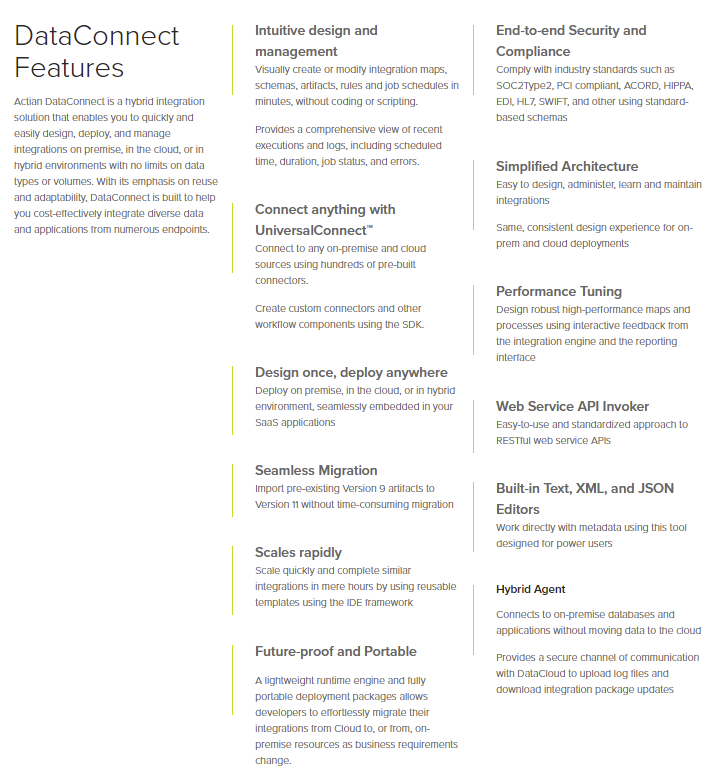
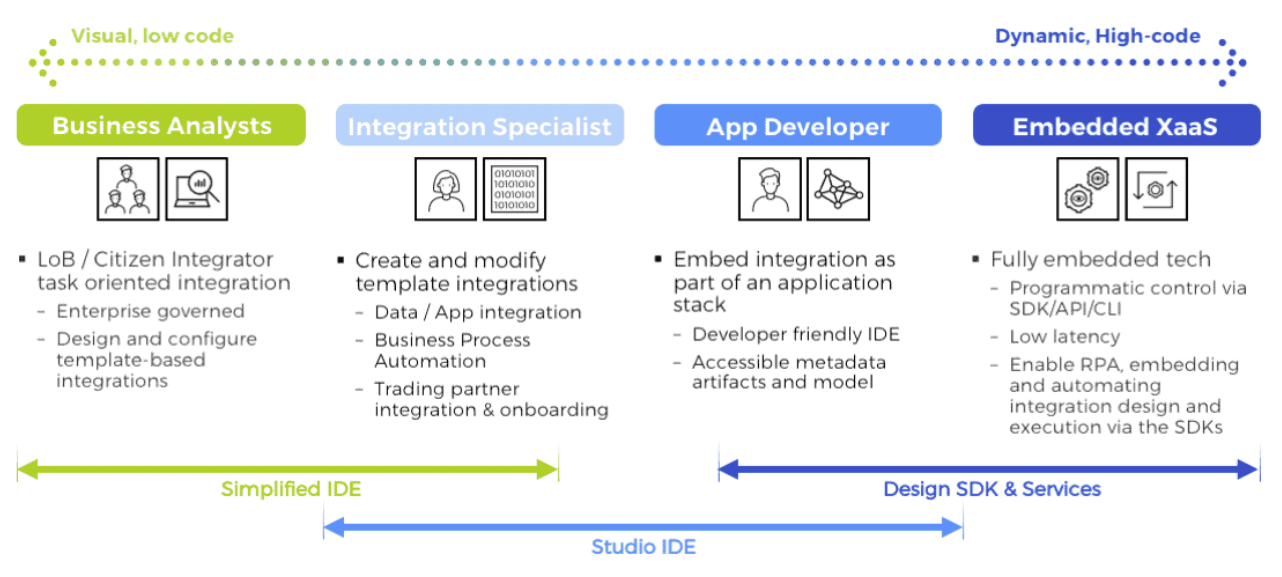
HCL DataConnect (formerly Actian DataConnect) is a hybrid integration solution that enables users to integrate anything, anywhere, anytime. It can be deployed in on-premise, cloud, and/or hybrid environments and offers quick onboarding. With its emphasis data quality, data reuse, adaptability and self-service integration, DataConnect is designed to support rapid onboarding and deliver the fast time to value.
N/A
Astro by Astronomer
Score 8.9 out of 10
N/A
For data teams looking to increase the availability of trusted data, Astronomer provides Astro, a data orchestration platform, powered by Airflow. Astro enables data engineers, data scientists, and data analysts to build, run, and observe pipelines-as-code. Astronomer is the driving force behind Apache Airflow™, the de facto standard for expressing data flows as code. Airflow is downloaded more than 8 million times each month and is used by hundreds of thousands of teams around the world.
N/A
Oracle Data Integrator (ODI)
Score 8.5 out of 10
N/A
Oracle Data Integrator is an ELT data integrator designed with interoperability other Oracle programs. The program focuses on a high-performance capacity to support Big Data use within Oracle.
Sr Integration Engineer - Dual Certified in Dell Boomi Developer 1 & 2, and Actian DataConnect
Chose Actian DataConnect
As I stated earlier, DataConnect makes a head-to-head run against the others. It has advantages and disadvantages compared to the competitors. The choice really comes down to pricing and specific requirement needs for the project you are planning. Questions such as …
Data Integrator was initially a part of a package deal for us with our new Student Information System. It was chosen prior to my arrival at the institution. Since I discovered we have SQL Server licenses, we have decided to use SSIS instead since I have a background in the MSBI …
I have used Trifacta Google Data Prep quite a bit. We use Google Cloud Platform across our organization. The tools are very comparable in what they offer. I would say Data Prep has a slight edge in usability and a cleaner UI, but both of the tools have comparable toolsets.
Oracle Data Integrator works very well if the rest of your systems are in the Oracle environment. There are some other good alternatives out there, but for what Oracle Data Integrator has to offer, it is good. It is also a little harder to use compared to the other ones I have …
We were using Actian Pervasive before switching to Oracle and the main reason was the cost. We were getting less functionality at even more cost. Although it is much faster in terms of operation, Oracle makes it easy to connect to all data sources making data integration easier …
I have used the Pentaho Data Integrator ETL tools in different projects with the SQL Server Integration Services product from the Microsoft product family. Oracle Data Integrator ETL product is efficient in projects where Oracle databases are heavily used. The end-user …
Talend Data Integrator has been evaluated during the setup of the architecture for a customer, in comparison to ODI, since it's an open source ETL. But, differently from the meaning of "open source", it has licence costs too that aren't that different from ODI ones. Moreover, …
ODI is the naturel successor of OWB, adopting the same EL-T approach but supporting a lot more technologies as source and target. The overall product is much more stable and not tied to the Oracle database. Unlike Informatica, ODI generates all the code in the native underlying …
We migrated to ODI from OWB - and we found ODI to be light years ahead of OWB (features, performance, and connectivity). We also looked at Informatica, but were turned down by its cost. Being a SAP Business Objects shop, we also considered the SAP Data Integrator tool (it …
Oracle's own ETL tool was Oracle Warehouse Builder, initially. When Oracle built the Oracle Business Intelligence Applications Suite, Oracle is in need of a strong ETL. As Oracle Warehouse Builder is not a strong ETL that customers prefer and as already Informatica captured …
We thought IBM was too expensive and more difficult to use. With Microsoft, since we have our main application running with Oracle DB, we understood it’d be easier for us to work with ODI.
Oracle Data Integrator is a superior tool when dealing with Hyperion Planning and Essbase cubes and applications. The native connectors allow for easy data movement and transformations from one environment to the other. I do believe that Oracle Data Integrator is a very complex …
Informatica was slightly more intuitive but slightly less powerful than Oracle Data Integrator. My use of Informatica was much less extensive than Oracle Data Integrator, so I can not speak as in-depth about the strengths and weaknesses of Informatica. We used ODI much more for …
ODI is less user friendly than FDM and DRM but is much easier to deploy than core ETL tools such as HAL or Informatica. The tool is easier to master and is usually more than capable of handling the run of the mill tasks required for Hyperion deployments. It has been a good …
IBM Infosphere, Informatica. I worked on the mentioned tools as well as ODI. I liked ODI because it is easy to use with great features that every other ETL tool has in the market.
Our organization was using the Oracle BPM and the Oracle Data Integrator has good integration with BPM. We got good support from Oracle in setting up the integrated environment.
I wouldn't recommend Data Integrator over SSIS, but it may be a better tool than other ETL offerings. Having a background in the Microsoft Stack, I am hesitant to recommend any other products especially in a Microsoft-centric company. If this was the only option to use, I think it does a good job at integrating systems after taking time to learn the approach. "Maps" in Data Integrator is definitely different than "process flow" philosophy in SSIS.
Astronomer is well suited for workflow and dependency management for enterprise-level data lakes. It is not a product for data processing though. Different source systems can be integrated, it also provides powerful interfaces for alerting and monitoring. Easy to build DAGs, graphical UI, API support makes the product more user-friendly as well. Astronomer also does a great job on user training.
I tried various ETL tools and here is [where and] why I recommend Oracle Data Integrator. 1. When you want to process structured data from different databases - Teradata, Exadata, DB2, SQL, Oracle etc. 2. Oracle Data Integrator supports all platforms, hardware, and OS. This is a major advantage compared to other leading tools. 3. The ELT architecture giving a cutting edge performance over leading ETL tools. There is no need to align Oracle Data Integrator between source and target. ODI uses the source and target servers to perform complex transformations. 4. Speeds up the development and maintenance by reducing the code that developers need to write
Converts data from various sources into one target format using various business logic rules and integrates with various DBMS types.
Transformed data from DB2, SQL Server and other Oracle databases into flat files and then used ETL jobs to load into Oracle DB target
Data Integrator and Goldengate were used together to accomplish the data movement needed for business and data consolidation in live environment. Data Integrator helped with development and in reducing lead time to convert data into target.
It is maturing and over time will have a good pool of resources. Each new version has addressed the issues of the previous ones. Its getting better and bigger.
As I stated earlier, DataConnect makes a head-to-head run against the others. It has advantages and disadvantages compared to the competitors. The choice really comes down to pricing and specific requirement needs for the project you are planning. Questions such as On-premise or Cloud, Security, and Specific Connectors available will drive your decision.
Talend Data Integrator has been evaluated during the setup of the architecture for a customer, in comparison to ODI, since it's an open source ETL. But, differently from the meaning of "open source", it has licence costs too that aren't that different from ODI ones. Moreover, the other components of the business intelligence architecture of the customer were Oracle, so we thought that ODI would suit at best with them, more than a different vendor software.
Oracle Data Integrator helps provide a business with the data it needs to defend the decisions it makes.
Oracle Data Integrator allows you to analyze data from what can be separate, different, and often outdated data sources. It allows you to make direct comparisons when analyzing data from different pieces of equipment.
Data from Oracle Data Integrator was used to analyze manufacturing quality and drive down spoilage, saving the company money.