Broadcom Application Delivery Analysis is an application performance management tool designed to prove how well a network delivers applications to users with application delivery analysis of performance and availability of SLA measurements.
N/A
SolarWinds AppOptics
Score 7.5 out of 10
N/A
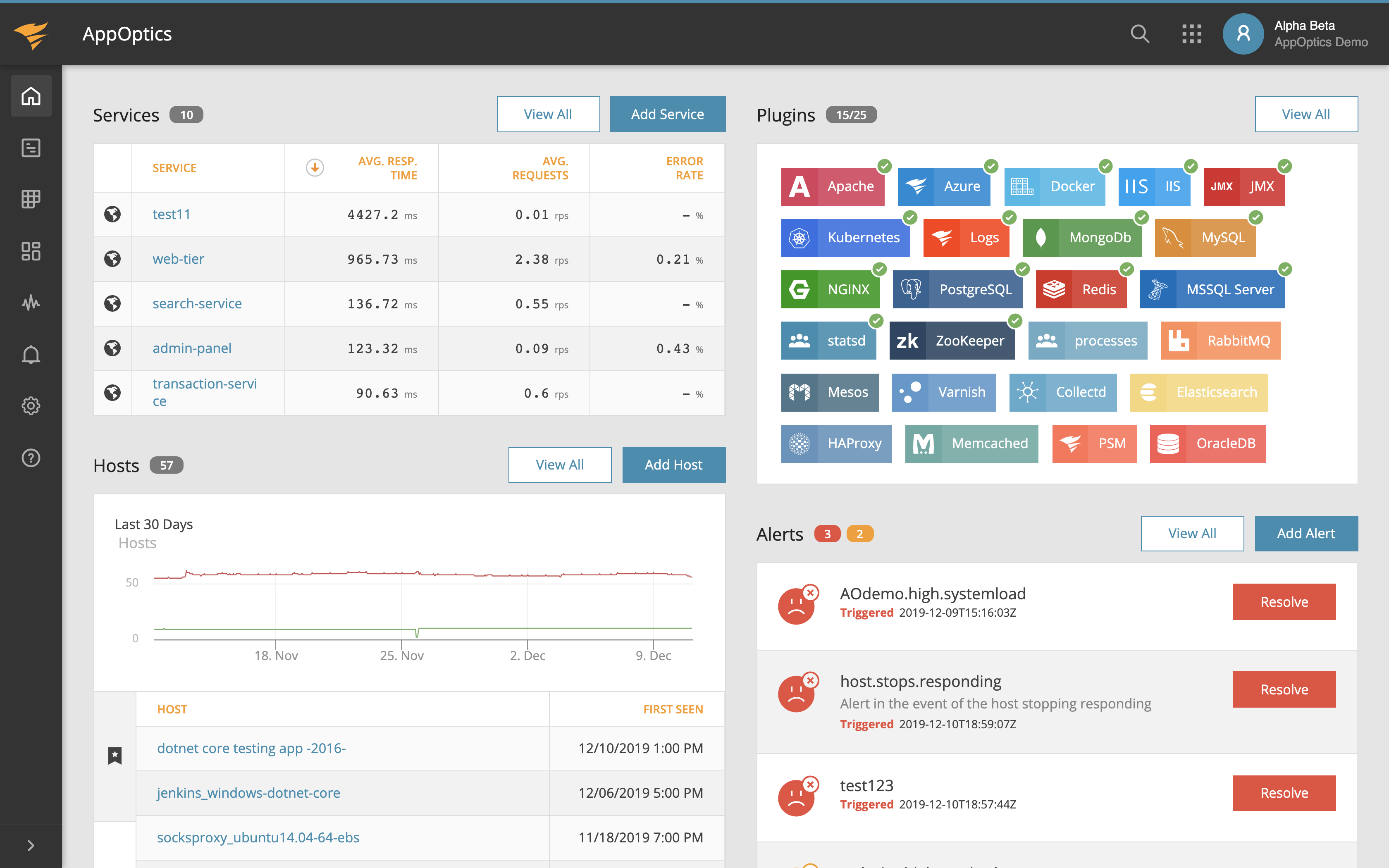
SolarWinds AppOptics (formerly Librato) is an IT infrastructure monitoring service and APM, based on technology acquired by SolarWinds with Librato in 2015 to expand its cloud monitoring portfolio.
N/A
Pricing
Broadcom Application Delivery Analysis
SolarWinds AppOptics
Editions & Modules
No answers on this topic
No answers on this topic
Offerings
Pricing Offerings
Broadcom Application Delivery Analysis
SolarWinds AppOptics
Free Trial
No
Yes
Free/Freemium Version
No
No
Premium Consulting/Integration Services
No
No
Entry-level Setup Fee
No setup fee
No setup fee
Additional Details
—
—
More Pricing Information
Community Pulse
Broadcom Application Delivery Analysis
SolarWinds AppOptics
Considered Both Products
Broadcom Application Delivery Analysis
Verified User
Anonymous
Chose Broadcom Application Delivery Analysis
Along with the Parasoft SOA tool, it is unquestionably among the top leaders in API testing and virtualization. Many open-source API testing libraries are free, including Rest Assured, Karate, and even Postman and SOAP UI, which goes against CA.
AppOptics was about 60% cheaper with most of the functionalities that we needed. Datadog had some advanced features which were not important to us, and hence we decided to go with AppOptics.
Everyone used to know the names of AppDynamics and Dynatrace when it comes to APM or Application Tracing Monitoring. Since these tools were the evolver of this particular technology, I still believe that these tools are the market player. But SolarWinds AppOptics is not less, …
As an early-stage startup, we evaluated the different options on the following parameters: Functionality Monitoring overhead Cost Easy-to-use dashboard AppOptics had most of the features that we needed and offered their services at a reasonable price that made sense for …
AppOptics is way more user friendly than Kibana. When you first log in to AppOptics, you have the information you need very easily while Kibana takes a lot of learning before getting your first results. Kibana almosts requires the help of developers and technicians to learn how …
It was a decision made based on our requirements. We felt like AppOptics gave us what we need precisely. When we tried it out, we were satisfied with the performance. It didn't compare to the rest in the market.
We felt the competitors were both more expensive and more difficult to configure and deploy. We selected SolarWinds AppOptics because it provided better value both in terms of cost and user experience.
SolarWinds AppOptics serves a specific use case for us--diving down on the application layer to identify root causes of latency. It does not offer the same use case as SignalFx, which offers metrics for the overall service and integration for custom metrics. AppOptics also does …
We analyzed a number of alternatives to AppOptics, but none combined strong performance in all of our key areas - we needed a solution which could be deployed on premise, supported multi tenant hosts, provided the ability to analyse individual requests, presented intuitive …
AppOptics provides us visibility of the overall system. SLACK helps us to keep the communication better among our collegues. Sentry One is also being used to dive deeper into SQL queries performance tuning. SolarWinds AppOptics clearly displays the flow of information in …
Look no farther than this tool if you need an API testing solution that also includes service virtualization. This technology also forces you to move your testing lifecycle to earlier stages of development, which improves the overall SDLC.
AppOptics is good for small to medium-sized organizations with less than 150 servers or less than 40 services to monitor. It performs well for this use case where people need to get an overview of application performance, and 95%ile data is okay. Somewhere every data point and every record is critical; it should be avoided.
This is an excellent tool for implementing Service virtualization in your own and/or third-party web services. This ensures that our automation and performance test environments are always available and consistent.
This application also aids in the setup and maintenance of test data, which is an important component of test automation.
This tool has a license fee and is not free. Many open-source tools provide free API testing solutions, therefore turning some of this tool's features open-source might be beneficial.
The tool's load testing component is not integrated and instead relies on the free Blaze meter.
The only thing that I would add is the possibility to display every single query our servers receive to eventually analyze them and query through them. We could also generate nice visualizations from that. Right now I believe we can only see averages.
AppOptics has performed well for all of the major functions we have needed it for. Especially when it comes to tracking down response time issues and researching app performance for different pages and different times of day we have been able to do everything we need to. We know there are some more advanced features that could help us in more niche areas, but haven't had the time to delve deeper into using or setting them up.
Solarwinds AppOptics is rated as 9 out of 10 and the reason is there are still few areas where AppOptics needs to improve such as Service Now Integration, GCP Cloud Support, Better Dashboard visualization for application transactions flow. Other than these feature everything is there in AppOptics and that's a reason given 9 points out of 10.
Along with the Parasoft SOA tool, it is unquestionably among the top leaders in API testing and virtualization. Many open-source API testing libraries are free, including Rest Assured, Karate, and even Postman and SOAP UI, which goes against CA.
What we found positive in AppOptics from others is:
Easy to install and manage.
Various stack support.
Point to point deep-dive metrics and correlation.
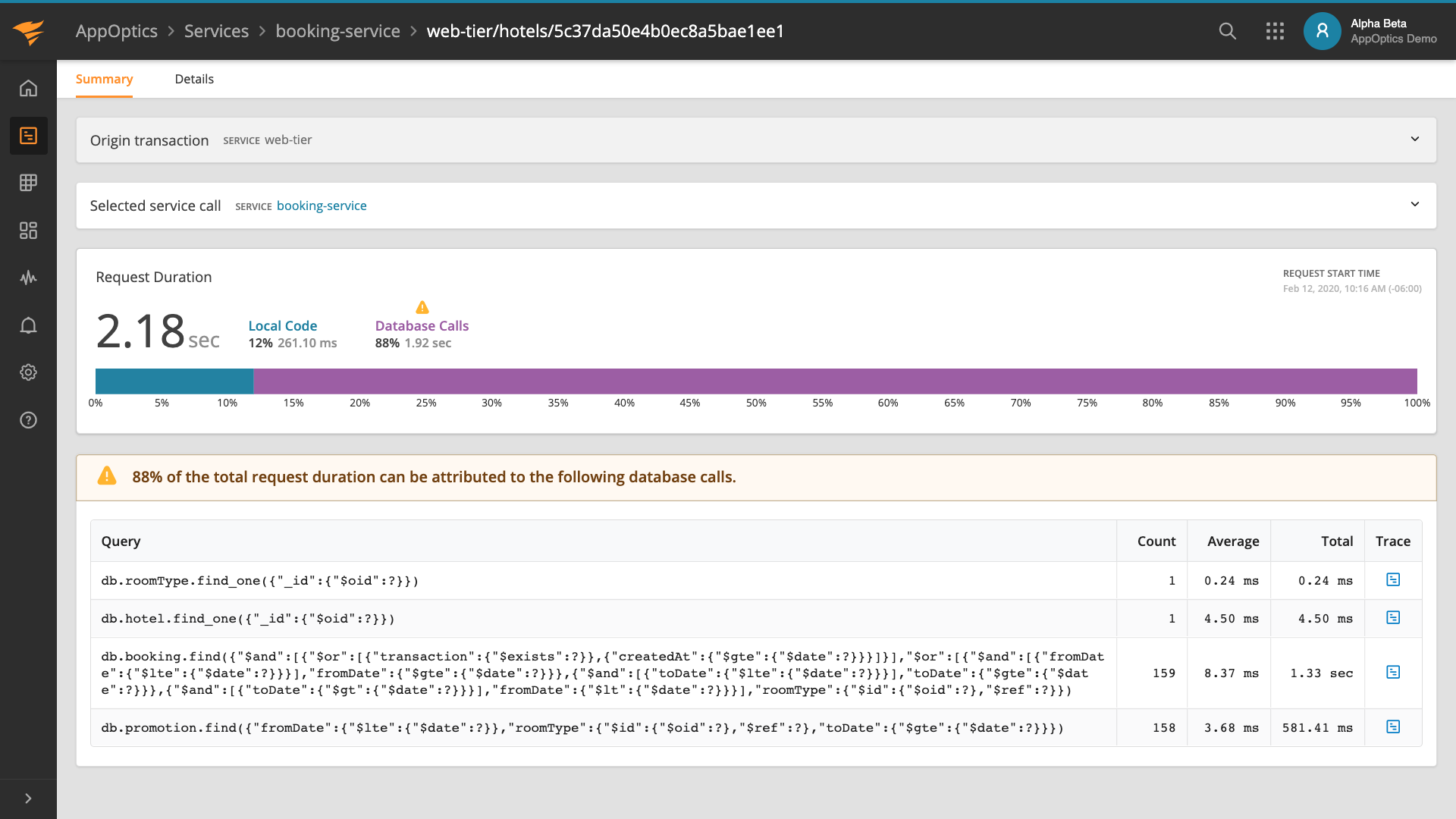
Metrics like DB connection, query analysis, latency in API calls, and other connections, response codes for various APIs, etc are the key ones in our case, which AppOptics provides efficiently.
In our group, this instrument produced a high return on investment. We saw a considerable reduction in downtime in our test environments thanks to service virtualization.
In addition, service virtualization reduces the expenses of interacting with third-party services, which is common in low-cost contexts.