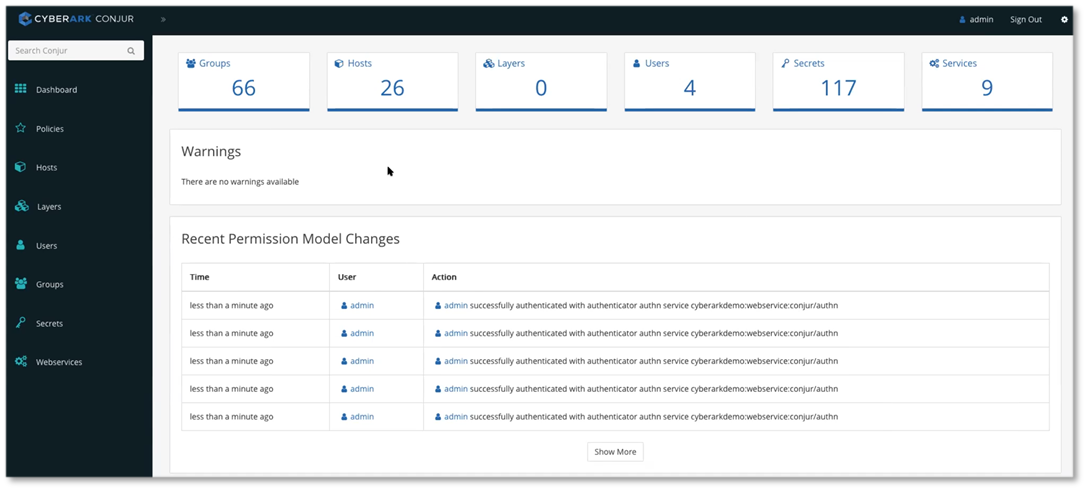
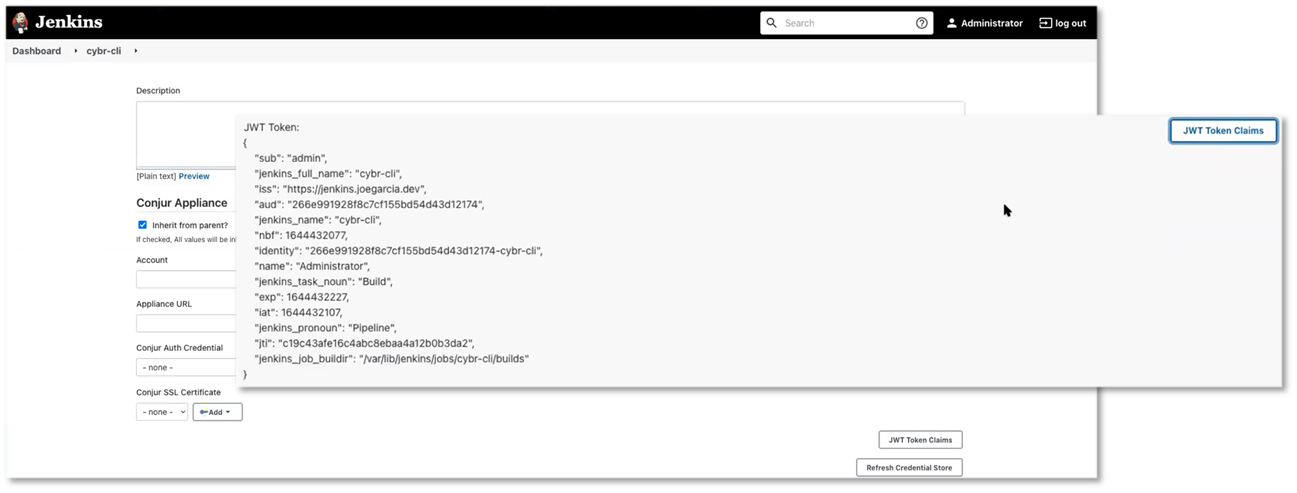
Cyberark Secrets Manager (formerly Conjur) is used to securely authenticate, control and audit non-human access across tools, applications, containers and cloud environments via a secrets management software solution.
N/A
Delinea Secret Server
Score7.2 out of 10
N/A
Secret Server (originally from Thycotic, now from Delinea since the 2021 Thycotic merger with Centrify) is an enterprise password management application, which is available with either a cloud-based or on-premise deployment which emphasizes fast deployment, scalability, and simplicity.
Cyberark Conjur is well-suited and includes the following: > Securing access to sensitive data in multi-cloud environments. > Providing secure access to secrets and credentials for 3rd party services and applications
A de minimis incentive was given to thank the reviewer for their time. The incentive was not used to bias or drive a particular response, nor was the incentive contingent on a positive endorsement. More Info
I would recommend Delinea to any organization or colleague, as I have used it to support our shared services model, as well as a dedicated model for people support to customers, for privileged access management. Delinea has provided us with effective methods for handling unnecessary login attempts to the customer infrastructure. Additionally, the connection thread is available in the audit trail for review, which is a valuable feature to have.
A de minimis incentive was given to thank the reviewer for their time. The incentive was not used to bias or drive a particular response, nor was the incentive contingent on a positive endorsement. More Info
A de minimis incentive was given to thank the reviewer for their time. The incentive was not used to bias or drive a particular response, nor was the incentive contingent on a positive endorsement. More Info
Password Management: Its entire purpose, really. Secret Server stores passwords in an incredibly easy to use way. They can be organized in groups, they contain all the information about the site or system the password is used for (including URLs for websites), and even a notes field. You can set up specific policies for expirations and complexity, and Secret Server can even generate strong passwords for you. Using a password is simple, too, since you can just click a button to add it to your clipboard; you don't even have to unmask the password.
Security: The passwords are stored encrypted in a SQL database, and the application requires an authenticated login. This could be local, but we tie it into Active Directory. Each folder of passwords has groups assigned (in our case, again, AD, but you can make them local groups) with different permission levels, so we can compartmentalize passwords. Desktop technicians don't have access to network switch passwords, etc.
Easy Setup: It took me about an hour to get the server running, from spinning up the VM to importing our old password list. It took a little longer to organize the passwords into proper folders, and then assigning groups, but it was easy to do.
Personal Passwords: Each user also gets a personal folder, where they can keep their own, unshared passwords. This is nice for sites or systems with individualized logins (e.g., a firewall, VPN, etc.)
Favorites: Secret Server lets you tag passwords as "favorites" so you can easily find ones you use constantly. The search feature is nice, but this is nicer.
A de minimis incentive was given to thank the reviewer for their time. The incentive was not used to bias or drive a particular response, nor was the incentive contingent on a positive endorsement. More Info
A de minimis incentive was given to thank the reviewer for their time. The incentive was not used to bias or drive a particular response, nor was the incentive contingent on a positive endorsement. More Info
A de minimis incentive was given to thank the reviewer for their time. The incentive was not used to bias or drive a particular response, nor was the incentive contingent on a positive endorsement. More Info
My rating is purely based on the configurational activities, as feature-wise delineation has all the features that are very beneficial for customers, though the implementation is a bit more manual work, which can be reduced with a low-code platform. Along with that, we can have a better UI to have intuitiveness and can manage the platform for shared customers in a better way. Overall, it is a very good tool for PAM.
A de minimis incentive was given to thank the reviewer for their time. The incentive was not used to bias or drive a particular response, nor was the incentive contingent on a positive endorsement. More Info
A de minimis incentive was given to thank the reviewer for their time. The incentive was not used to bias or drive a particular response, nor was the incentive contingent on a positive endorsement. More Info
Cyberark Conjur has been a great asset to our company as it is a one stop shop that holds individuals, teams, departments, and the entire company accountable for the safety network. Not only do you have to be authorized to access Cyberark Conjuryou have to reauthorize to open, copy, or see individual passwords or accounts leaving a cyber trace of all your actions. There's no way to accidently get into something you're not supposed to be in.
A de minimis incentive was given to thank the reviewer for their time. The incentive was not used to bias or drive a particular response, nor was the incentive contingent on a positive endorsement. More Info
There were not very many solutions that provided the entire package of taking an account from creation and deactivating it when no longer needed, as well as providing the discovery of unknown service accounts. Other solutions like RoboForm and LastPass did not offer the ability to manage your service accounts and added layers of complication to ensure security.
A de minimis incentive was given to thank the reviewer for their time. The incentive was not used to bias or drive a particular response, nor was the incentive contingent on a positive endorsement. More Info
A de minimis incentive was given to thank the reviewer for their time. The incentive was not used to bias or drive a particular response, nor was the incentive contingent on a positive endorsement. More Info
A de minimis incentive was given to thank the reviewer for their time. The incentive was not used to bias or drive a particular response, nor was the incentive contingent on a positive endorsement. More Info