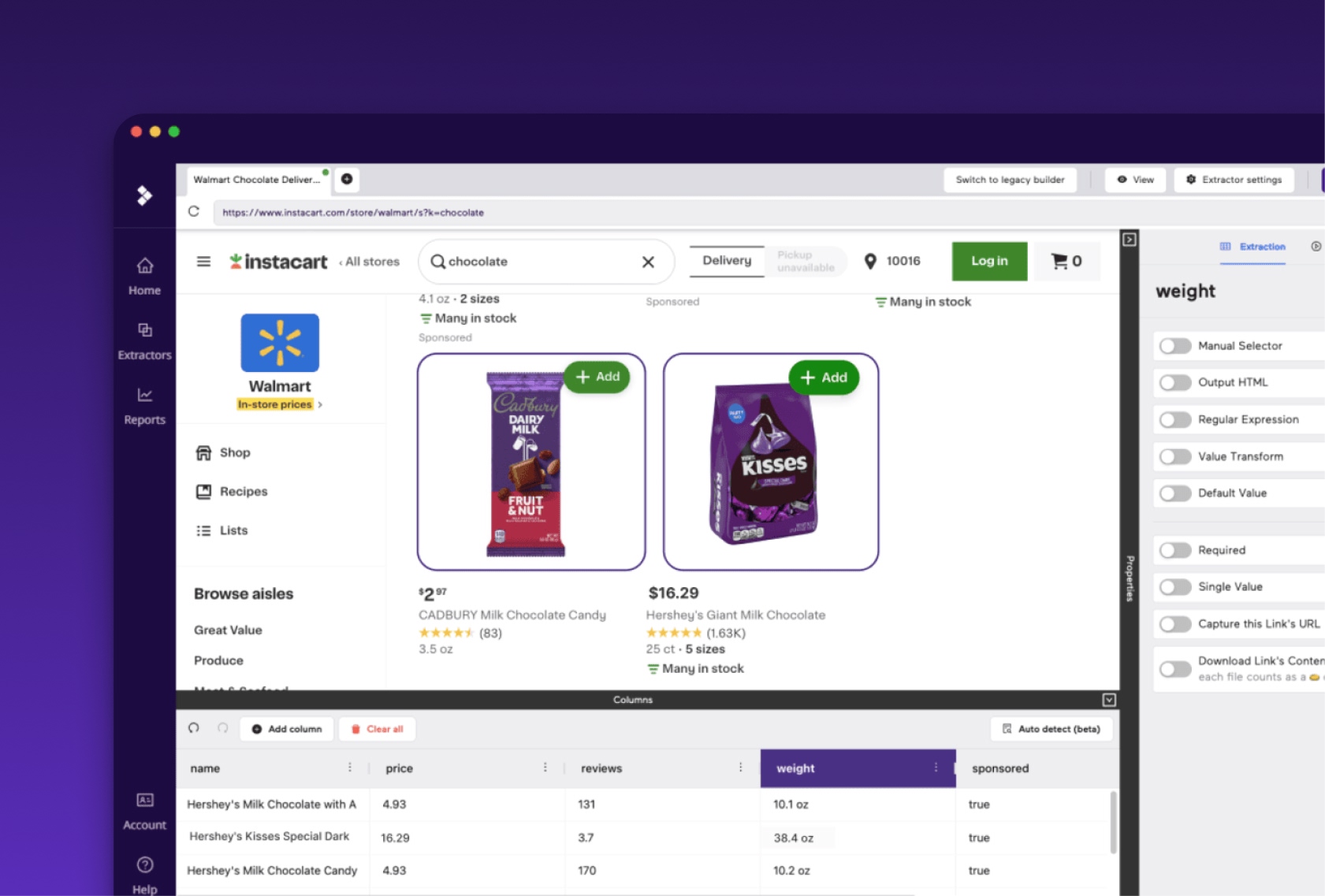
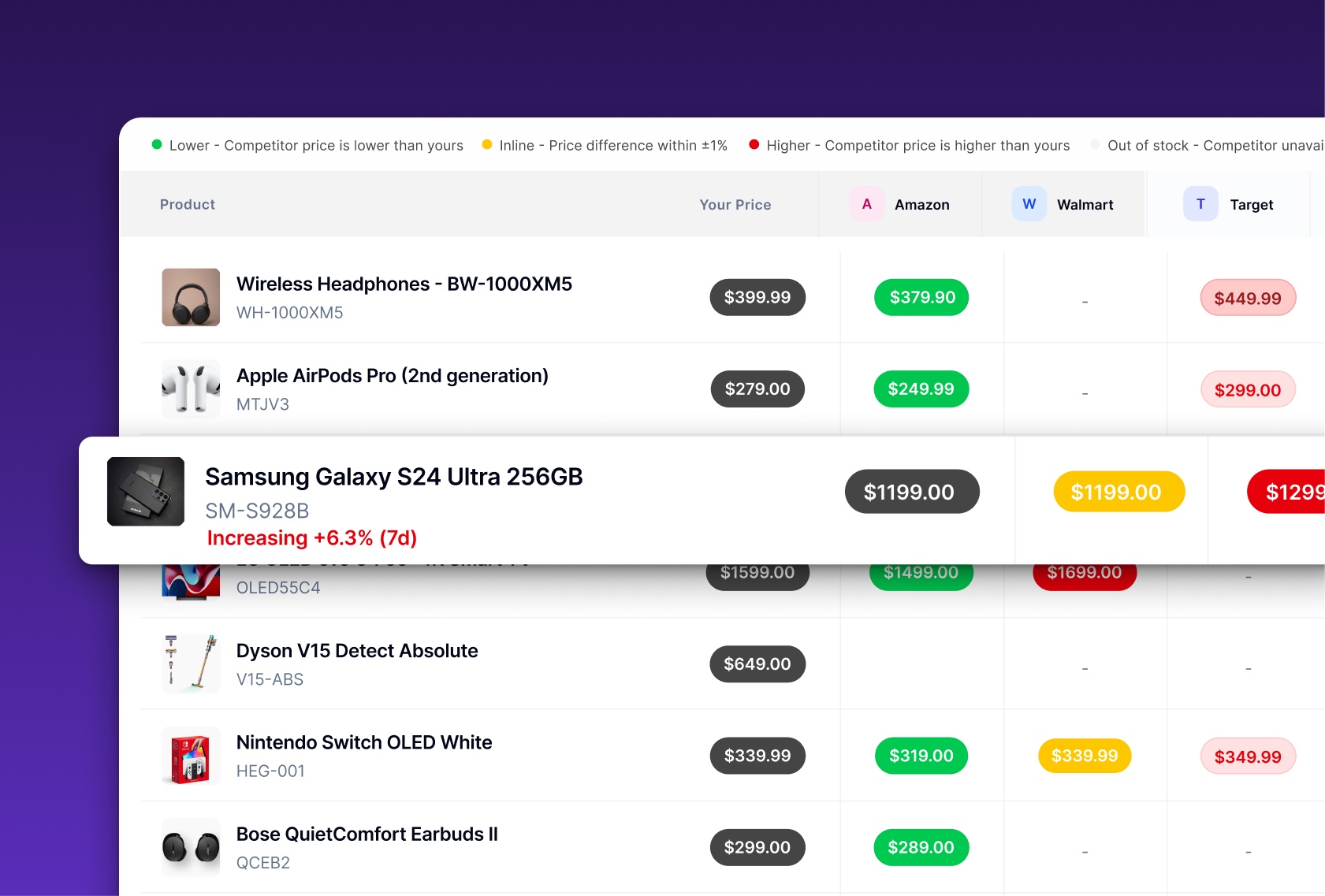
The Dexi Digital Commerce Intelligence Suite, now with the capabilities of the former Mozenda web scraping tool and service, can build product data feeds to push to various marketing channels such as Google Shopping, Doubleclick, search, email, retargeting, and affiliates. The smart part is the ability to apply competitor analysis directly within the feed, to ensure that the user's campaign strategy is both more insightful and dynamic.
Mozenda became a dexi brand since the June 2020 merger, and…
N/A
Import.io
Score9 out of 10
N/A
Import.io is a web data extraction platform that gathers structured data streams from websites. It supports automated extraction, monitoring, validation, and delivery, with self-service and managed options for teams that need web data at scale.
$249
per month per subscription
Pricing
Dexi.io with Mozenda
Import.io
Editions & Modules
No answers on this topic
Standard
$249
per month per subscription
Professional
$499
per month per subscription
Advanced
$899
per month per subscription
Offerings
Pricing Offerings
Dexi.io with Mozenda
Import.io
Free Trial
No
Yes
Free/Freemium Version
No
No
Premium Consulting/Integration Services
No
Yes
Entry-level Setup Fee
No setup fee
No setup fee
Additional Details
—
Standard is $299 per month and includes 50,000 successful queries. Professional is $499 per month and includes 200,000 successful queries. Advanced is $899 per month and includes 500,000 successful queries. Additional usage is charged at $7, $3.50, and $2.50 per 1,000 successful queries, respectively. A discount is available for annual billing.
Managed and Enterprise solutions use custom pricing based on data volume, source complexity, extraction frequency, delivery requirements, and support needs.
More Pricing Information
Community Pulse
Dexi.io with Mozenda
Import.io
Considered Both Products
Engage3 + Dexi
No answer on this topic
Import.io
Verified User
Chose Import.io
There are pros and cons to import.io the strongest being that it is extremely easy to set up and use as there are wizards and guides built in to hold your hand throughout the process but at the same token it does not have all the full-featured bells and whistles you may need …
A de minimis incentive was given to thank the reviewer for their time. The incentive was not used to bias or drive a particular response, nor was the incentive contingent on a positive endorsement. More Info
The Mozenda platform is well suited to some specific scenarios that may work well for your organization. It is especially helpful for basic scraping of information from simple websites. If the information you need to obtain is clearly stated on a website, then Mozenda is a simple solution to capture that data quickly and easily.
A de minimis incentive was given to thank the reviewer for their time. The incentive was not used to bias or drive a particular response, nor was the incentive contingent on a positive endorsement. More Info
We used Connotate as a data mining tool for web research as a teaching assistant for the College of Information Sciences and Technology. You could train agents to automatically gather data in a variety of ways, which I used in my own research. Connotate's analysis was not as useful to me as the data itself, because we were using it to inform us of trends rather than make decisions.
A de minimis incentive was given to thank the reviewer for their time. The incentive was not used to bias or drive a particular response, nor was the incentive contingent on a positive endorsement. More Info
Action Items. Mozenda is broken down into a series of actions that can be performed on a page. Some actions take you to other pages. The action list, while short, provides a comprehensive set of tools for scraping just about any website (I haven't met one where it didn't work yet).
Error Handling. I've used some scraping tools that have virtually no error handling. Mozenda has great error handling; the software almost always pinpoints the exact action where the agent failed and why.
Speed. Mozenda is very fast at obtaining results. Other "bot" software can be slow and cumbersome but Mozenda plows through pages rapidly and accurately aggregates information.
XPath compatibility. One of the most powerful features of Mozenda is the integrated ability to use XPaths to get at the exact bits of information we're after on a particular website. Access to visible information is only limited by imagination.
A de minimis incentive was given to thank the reviewer for their time. The incentive was not used to bias or drive a particular response, nor was the incentive contingent on a positive endorsement. More Info
A de minimis incentive was given to thank the reviewer for their time. The incentive was not used to bias or drive a particular response, nor was the incentive contingent on a positive endorsement. More Info
A de minimis incentive was given to thank the reviewer for their time. The incentive was not used to bias or drive a particular response, nor was the incentive contingent on a positive endorsement. More Info
I do not think I would have the budget to use it currently. When using it previously, was working with the developers to improve the product and was given accounts at no cost
A de minimis incentive was given to thank the reviewer for their time. The incentive was not used to bias or drive a particular response, nor was the incentive contingent on a positive endorsement. More Info
I'm only personally experienced with UBot Studio and Scrapy. UBot Studio isn't a bad application, though it has quite a large number of bugs when compared to Mozenda. UBot touts itself as low-code, but requires a significant understanding of programming logic to use the program effectively. Using UBot, we were able to get virtually all the results we wanted, but at a much higher labor cost than Mozenda. During initial implementation of UBot, it took me a full week to develop a particularly complicated agent. Using Mozenda, I was able to recreate the same agent in 4 hours. The ROI has been remarkable, and Mozenda really is a low-code platform.
A de minimis incentive was given to thank the reviewer for their time. The incentive was not used to bias or drive a particular response, nor was the incentive contingent on a positive endorsement. More Info
A de minimis incentive was given to thank the reviewer for their time. The incentive was not used to bias or drive a particular response, nor was the incentive contingent on a positive endorsement. More Info