Apache Spark vs. esProc SPL Community

Overview
ProductRatingMost Used ByProduct SummaryStarting Price
Apache Spark
Score 8.9 out of 10
N/A
Apache Spark is a multi-language engine for executing data engineering, data science, and machine learning on single-node machines or clusters.N/A
esProc SPL Community
Score 0.0 out of 10
Small Businesses (1-50 employees)
esProc SPL is an open-source and JVM-based analyzing and computing engine for structured data and semi-structured data, and capable at solving data problems, including hard to write, slow to run and difficult to operate and maintain. esProc SPL adopts self-created SPL (Structured Process Language) syntax, boasting the characteristics of low code, high performance, lightweight and versatility. Compared with SQL, SPL has more abundant data types and calculation features, which enhances…
$0
Pricing
Apache SparkesProc SPL Community
Editions & Modules
No answers on this topic
Offerings
Pricing Offerings
Apache SparkesProc SPL Community
Free Trial
NoNo
Free/Freemium Version
NoYes
Premium Consulting/Integration Services
NoNo
Entry-level Setup FeeNo setup feeNo setup fee
Additional Details
More Pricing Information
Community Pulse
Apache SparkesProc SPL Community
Best Alternatives
Apache SparkesProc SPL Community
Small Businesses

No answers on this topic

Jupyter Notebook
Jupyter Notebook
Score 8.5 out of 10
Medium-sized Companies
Cloudera Manager
Cloudera Manager
Score 9.9 out of 10
Posit
Posit
Score 10.0 out of 10
Enterprises
IBM Analytics Engine
Score 7.2 out of 10
Posit
Posit
Score 10.0 out of 10
All AlternativesView all alternativesView all alternatives
User Ratings
Apache SparkesProc SPL Community
Likelihood to Recommend
9.0
(24 ratings)
-
(0 ratings)
Likelihood to Renew
10.0
(1 ratings)
-
(0 ratings)
Usability
8.0
(4 ratings)
-
(0 ratings)
Support Rating
8.7
(4 ratings)
-
(0 ratings)
User Testimonials
Apache SparkesProc SPL Community
Likelihood to Recommend
Apache
Well suited: To most of the local run of datasets and non-prod systems - scalability is not a problem at all. Including data from multiple types of data sources is an added advantage. MLlib is a decently nice built-in library that can be used for most of the ML tasks. Less appropriate: We had to work on a RecSys where the music dataset that we used was around 300+Gb in size. We faced memory-based issues. Few times we also got memory errors. Also the MLlib library does not have support for advanced analytics and deep-learning frameworks support. Understanding the internals of the working of Apache Spark for beginners is highly not possible.
Read full review
scudata
No answers on this topic
Pros
Apache
  • Rich APIs for data transformation making for very each to transform and prepare data in a distributed environment without worrying about memory issues
  • Faster in execution times compare to Hadoop and PIG Latin
  • Easy SQL interface to the same data set for people who are comfortable to explore data in a declarative manner
  • Interoperability between SQL and Scala / Python style of munging data
Read full review
scudata
No answers on this topic
Cons
Apache
  • Memory management. Very weak on that.
  • PySpark not as robust as scala with spark.
  • spark master HA is needed. Not as HA as it should be.
  • Locality should not be a necessity, but does help improvement. But would prefer no locality
Read full review
scudata
No answers on this topic
Likelihood to Renew
Apache
Capacity of computing data in cluster and fast speed.
Read full review
scudata
No answers on this topic
Usability
Apache
If the team looking to use Apache Spark is not used to debug and tweak settings for jobs to ensure maximum optimizations, it can be frustrating. However, the documentation and the support of the community on the internet can help resolve most issues. Moreover, it is highly configurable and it integrates with different tools (eg: it can be used by dbt core), which increase the scenarios where it can be used
Read full review
scudata
No answers on this topic
Support Rating
Apache
1. It integrates very well with scala or python. 2. It's very easy to understand SQL interoperability. 3. Apache is way faster than the other competitive technologies. 4. The support from the Apache community is very huge for Spark. 5. Execution times are faster as compared to others. 6. There are a large number of forums available for Apache Spark. 7. The code availability for Apache Spark is simpler and easy to gain access to. 8. Many organizations use Apache Spark, so many solutions are available for existing applications.
Read full review
scudata
No answers on this topic
Alternatives Considered
Apache
Spark in comparison to similar technologies ends up being a one stop shop. You can achieve so much with this one framework instead of having to stitch and weave multiple technologies from the Hadoop stack, all while getting incredibility performance, minimal boilerplate, and getting the ability to write your application in the language of your choosing.
Read full review
scudata
No answers on this topic
Return on Investment
Apache
  • Business leaders are able to take data driven decisions
  • Business users are able access to data in near real time now . Before using spark, they had to wait for at least 24 hours for data to be available
  • Business is able come up with new product ideas
Read full review
scudata
No answers on this topic
ScreenShots

esProc SPL Community Screenshots

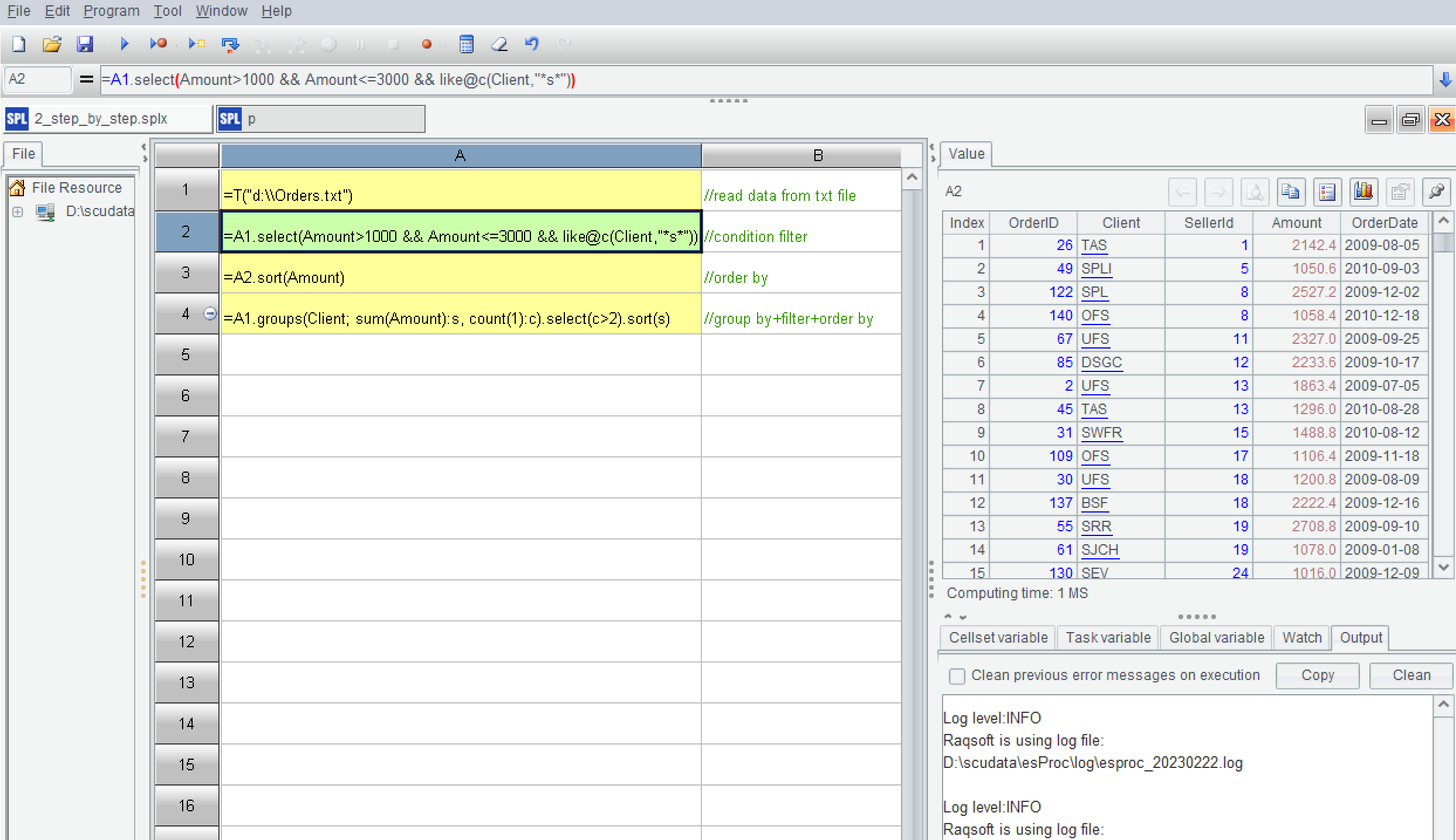
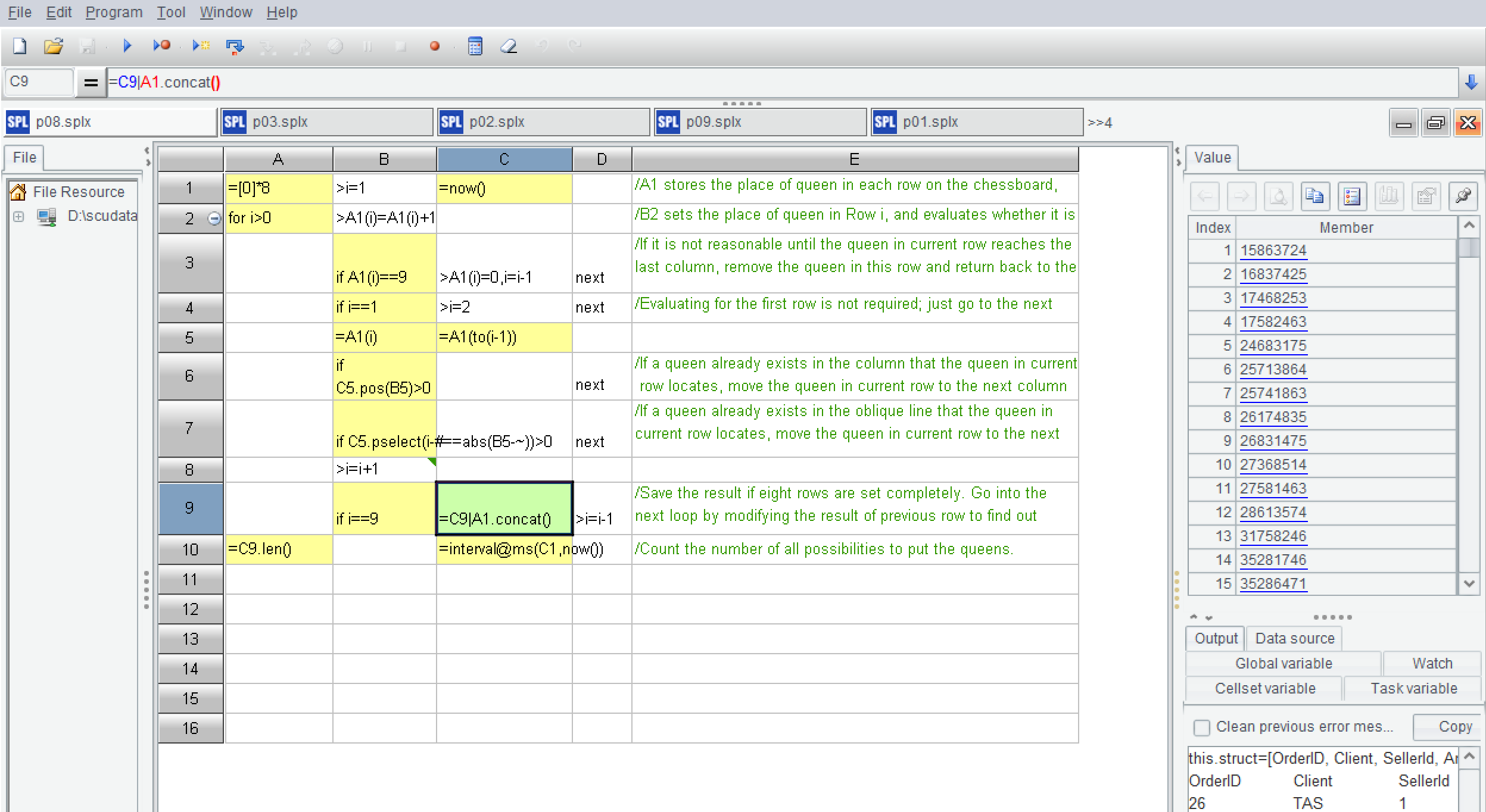
Screenshot of Debugging functions: set breakpoints, execute to cursor, single step, enter, skip, jump back. What you see is what you get, it is convenient to refer to intermediate results. Complete programming ability, the amount of code is smaller than that of Java, C#, and Python.Screenshot of supports executing SQL directly on txt/csv/xls/xlsx files, including operations such as condition filtering, fuzzy querying, group summarization, Join, from clause, with clause, Case when, COALESCE, Top-N, and limit n offset m.Screenshot of supports multi-step computation, which can break down a complex computing task into several simpler calculation steps to reduce computational complexity. The results of each step can be observed, making it easier to debug and maintain.Screenshot of provides an IDE that not only offers debugging and unit format programming, but also provides quick function help. Simply move the cursor to a function and press the Alt key to display a detailed explanation of the function.Screenshot of supports a complete flow processing structure, which has been simplified, including loops, conditionals, and sequential execution. This is an example of SPL code for solving the "Eight Queens Problem" to illustrate this.