Hololink is a web-based Augmented Reality editor which enables creation of AR through a visual no-code solution. AR created in Hololink is served directly in the mobile browser without the use of an app, making the whole process from creation to end-user 100% browser-based. Hololink gives creators access to: A visual storyboard to ensure a clear overview of all end-user interactions and the entire user journey, making it possible to use rich storytelling. The…
$59
per month For 1 white label including all pro features
Vuforia Studio
Score9.6 out of 10
N/A
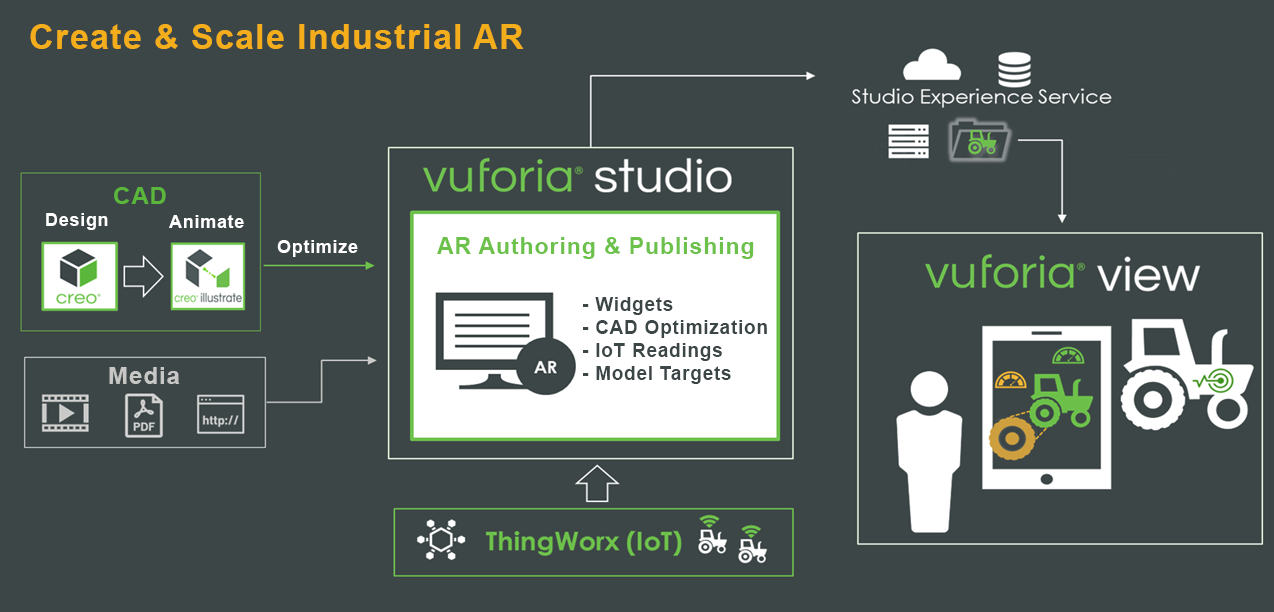
Vuforia Studio allows users to author and publish scalable AR experiences that transform manufacturing, service and training processes without the need for extensive programming or costly custom designers. The vendor states that Studio is the only drag-and-drop authoring environment that enables industrial content creators to: Accelerate content creation —…
I only know Hololink from an educational point of view, but as a teacher, I find it easy to use and a fun way to incorporate tech in reports and presentations. My knowledge of the demands in other traits is too little for me to decide whether Hololink is up for the task. For the tasks I've had at hand, Hololink has been a good choice.
Vuforia is free but there is a watermark on the output of it. So if you want to remove it then you have to purchase it. It's easy to use and some features like multiple targeting in images and object and surface tracking help you to achieve what you want.
A de minimis incentive was given to thank the reviewer for their time. The incentive was not used to bias or drive a particular response, nor was the incentive contingent on a positive endorsement. More Info
As opposed to all other AR creation tools that I know, Hololink does not require consumers to download an app, thereby bypassing the primary problem of creating AR experiences, which is getting people to download an app. Let it be known that native apps are going away, the future is web-based because it is easier.
The Hololink image-tracking, which enables AR elements to be projected upon real-world objects and images is exceptionally good compared to other AR projects that also use image-tracking. In Hololink your buttons, 3D models, and videos do not sail away from the objects that they're supposed to be attached to.
The people working on Hololink are very focused on UX, and the few times that I have had suggestions, they have been very attentive.
A de minimis incentive was given to thank the reviewer for their time. The incentive was not used to bias or drive a particular response, nor was the incentive contingent on a positive endorsement. More Info
Hololink comes pre-packed with a lot of 3D models there are cases where I would like to write text on models directly, instead of using the annotation function which Hololink provides. It would be easier than having to upload my own 3D models, which is also possible.
A de minimis incentive was given to thank the reviewer for their time. The incentive was not used to bias or drive a particular response, nor was the incentive contingent on a positive endorsement. More Info
A long time ago I use Aurasma. As I recall it was quite heavy because you had to transfer the Aura from your computer to the student's smartphones through signup on the internet and making them connect to your user with an invitational code, and if it didn´t work it was hard to figure out why. Hololink is just a scan away and you don´t have to connect to any user accounts to see other student products.
Vuforia studio is well suited in cases like you wants to track objects and surface in the plane. Image recognization at multiple targets is one of the very good functionalities of EasyAR. And if you want to render 3d objects in your mobile application then it's well suited. It is free too so you can create applications at minimal costs.
A de minimis incentive was given to thank the reviewer for their time. The incentive was not used to bias or drive a particular response, nor was the incentive contingent on a positive endorsement. More Info
AR is hot right now and thus helps attract people. In the future, the AR-excitement might lessen, but it has clear affordances in terms of communication that will continue to be relevant as long as people have smartphones or google-glasses or the likes.
A de minimis incentive was given to thank the reviewer for their time. The incentive was not used to bias or drive a particular response, nor was the incentive contingent on a positive endorsement. More Info