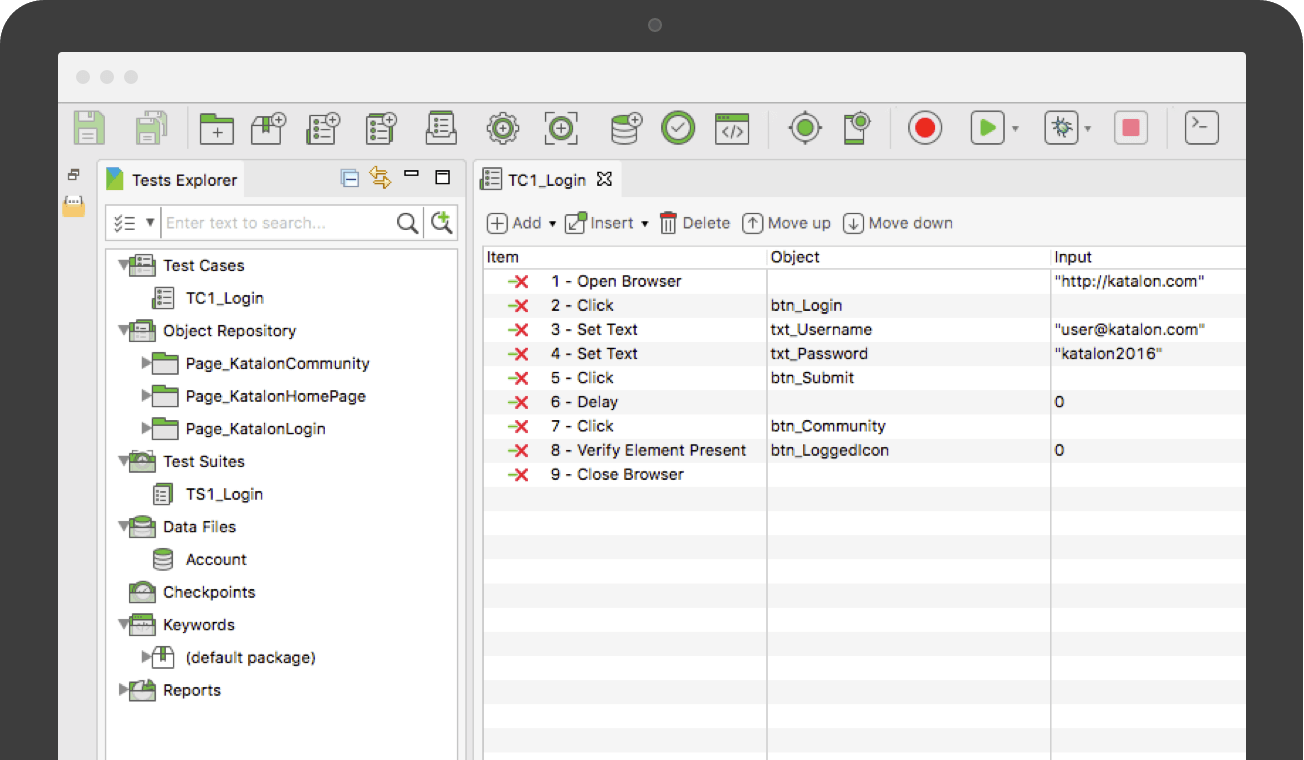
Katalon Studio is provided by the vendor as a free and robust automation solution for API, Web and Mobile testing. It is designed to eliminate the complexities of building an automation framework by integrating all necessary test components with built-in keywords and project templates. Katalon Studio includes a full feature set for a complete test automation process covering multiple platforms and testing types. New users can get started with test automation using its easy-to-use…
$69
per month
Postman
Score 8.7 out of 10
N/A
Postman, headquartered in San Francisco, offers their flagship API development and management free to small teams and independent developers. Higher tiers (Postman Pro and Postman Enterprise) support API management, as well as team collaboration, extended support and other advanced features.
$0
SpecFlow
Score 10.0 out of 10
N/A
SpecFlow is an open source BDD for .NET. that aims to bridge the communication gap between domain experts and developers by binding readable behavior specifications to the underlying implementation.
N/A
Pricing
Katalon
Postman
SpecFlow
Editions & Modules
Node Locked License
$69.00
per month
Floating License
$1,529.00
per year
Postman Free Plan
$0.00 US Dollars
Postman Basic Plan
$12 US Dollars
per month per user
Postman Professional Plan
$29 US Dollars
per month per user
Postman Enterprise Plan
$99 US Dollars
per month per user
No answers on this topic
Offerings
Pricing Offerings
Katalon
Postman
SpecFlow
Free Trial
Yes
No
No
Free/Freemium Version
Yes
Yes
No
Premium Consulting/Integration Services
Yes
No
No
Entry-level Setup Fee
No setup fee
No setup fee
No setup fee
Additional Details
Katalon Studio was originated from KMS Technology R&D. It has been a successful solution for numerous automation projects ranging from small team to enterprise client.
Katalon Studio is free for use, product development is funded by the testing services provided by KMS Technology. To support future releases, please consider subscribing to our business support services.
1. Postman Free plan: Start designing, developing, and testing APIs at no cost for teams of up to three people.
2. Postman Basic plan: Collaborate with your team to design, develop, and test APIs faster; $12/month per user, billed annually
3. Postman Professional plan: Centrally manage the entire API workflow; $29/month per user, billed annually
4. Postman Enterprise plan: Securely manage, organize, and accelerate API-first development at scale; $99/month per user, billed annually
—
More Pricing Information
Community Pulse
Katalon
Postman
SpecFlow
Features
Katalon
Postman
SpecFlow
API Management
Comparison of API Management features of Product A and Product B
Katalon TestOps is well suited for an oraganization who want to organize their automation collections and have everything in one place. It provides good insight on test runs, failures and also helps in defect tracking. It is extremely easy to schedule and run test suites automatically. With the help of test history, it becomes easier to triage the report and identify if it is a product issue or a test flakiness. Also with the automation run scheduling features with custom options, user do not have to manually trigger the runs and just run the scheduler to do the job.
Postman is good for organising your API credentials, vendor settings, environments etc. It's also a good way of getting stared with APIs as you get to use a GUI which can help you understand what we mean by a 'body' or 'bearer token'. I think people generally gravitate towards GUI tools for getting started in a new technology area.
It is best suited for implementing the automated test cases in a human readable form so it's easy for non-technical members of the team and stakeholders to understand the test cases, features and the functionalities of the application. Automation of Integration tests and End to End tests are good use case. It is less appropriate or situations where the focus is only on the writing and maintenance of unit tests.
Easy to setup and quick to get started: As Katalon comes with built-in features a new automation tester can automate easily. Script creation time is quick.
Test Analytics: Katalon also provides analytics which tells you the pattern of your automated tests at a different instance of time.
Third Party Integration: Katalon provides amazing integration with 3rd party tools like JIRA, ALM, GIT, JENKINS, etc.
Image-based testing: Katalon also provides inbuilt image based test automation.
It has opened a door for me to explore more out of it, as it is associated with so many APIs that I never felt any difficulty in finding the right API template, which are well organized and easily available.
It is very secure to use and provides great services which are user-friendly.
Due to this software I have got rid of the excessive emails and the slack channels, Now I am using my own private API and even it give me an option to produce my personal Postman’s API Builder from its Private API Network and this features has shared my excessive workload.
Versatility to be used in combination with different kinds of automated testing like automated performance testing, API testing, UI testing etc. I use JavaScript, Selenium, C#, email testing libraries, database testing libraries in combination with BDD with SpecFlow. I am able to use all these with SpecFlow to make my automation framework to be able to automate any kind of automated testing.
It provides different widely used runner options like NUnit, XUnit etc. Before I started to work on establishing proper test automation in my workplace, the previous automation framework (non-BDD based) as well as unit tests used NUnit runner. The transition to using BDD was smooth because we could use the same runner and there were no compatibility issues.
The auto-complete feature is good. I use it with Visual Studio as well as Rider and I don't have to recall the entire Gherkin statements. I just type a few words and the entire Gherkin statement implemented in framework is auto-suggested by SpecFlow. It saves time and context switching.
Integration with Azure is painstakingly slow as it takes too much time to upload reports to Azure. When raised with the support team i was advised to contact Microsoft who promptly and correctly replied that its an issue with the katalon plugin.
Non Responsive Customer Support. Several mails were replied late.
The Desktop app uses too much memory when booting up and running tests even on a 16gb RAM.
SpecFlow does not accepts optional input variables in the methods defined during Gherkin statement implementation. Cucumber supports optional input variables in the methods defined during Gherkin statement implementation.
The tests identified while using SpecFlow with NUnit removes all white spaces in the scenario names. It makes the tests less readable. If the white spaces are not auto-removed, it would be much better for readability as well as their actual identification in the repository.
1. Friendly user friendly - when I started using Postman, I was a beginner to the API world, and it gave me a friendly view to begin its usage 2. Postman offers many features, including API testing, monitoring, documentation, and mock servers 3. Environment variables simplify testing across multiple environments (dev, prod) without repetitive configuration.
I love the support. They have provided answers and solutions for most of our questions or doubts that could come up. They also have provided basic tutorials on how to get familiarized with the program.
There is a lot of in-depth documentation for Postman available online, including detailed guides with screenshots and videos. They provide example APIs for new users to explore while learning how to use the tool. Generally, bugs in the client are quickly addressed through frequent free updates. Community and professional support options are available - most of the time, the free/community level support is adequate
Katalon Studio is above both the tools is due to its codeless test automation feature and having API, desktop, web, and mobile automation in one place but obviously there is room for improvement when desktop automation is of primary importance in the automation.
Previous to using Postman, I would either use browser tools directly, or write an in-house tool to send requests. Postman eliminates that need while providing a much better experience and more features. At the base level, Postman is as simple as typing in the address as you would in a browser. Authentication can be provided simply as well.
SpecFlow is .Net based which supports C#. Behave is Python based. Cucumber is Java based. Ghost Inspector is no-code based but provides very limited testing features. We wanted to implement BDD so we rued out using Ghost Inspector. Most of the developers in my team are C# experts so it was decided for everyone's comfort to go for SpecFlow rather than Behave or Cucumber. It's import to have technical experts in the language of the automation framework because there are many situations where the solutions to the test automation needs are not straightforward and implementing those requires expertise in the related programming language.
Support can be better: As mentioned before, katlon community is still growing but is currently a small community. If you are stuck, its hard to find help in the community and one has to reach out to the support for help. This takes a while before you can get solution to your problem.
Result upload takes little longer time: It is been observed that uploading tests results takes little longer.
Sometimes it gets hard to integrate: Since this is fairly a new tool, requires lot of learning curve to get the job done effectively.
Postman is free (although there's a paid tier that offers more features) so using it for testing APIs comes with little to no risk (besides learning curve).
The learning curve is a little steep for non-developer users, but developers should find it easy to pick up and use right out of the box, so to speak.
Everyone stays on the same page regarding the behavior of existing functionalities whether it be technical or non-technical individuals. So there is less need for multiple people to get involved which saves time and thus money.
Reusing the same code through the implemented Gherkin statement saves test automation time and thus reduces cost.
We combine SpecFlow with other opensource testing technologies to make our automation framework more versatile which further saves costs for us.