Milvus vs. MongoDB

Overview
ProductRatingMost Used ByProduct SummaryStarting Price
Milvus
Score 0.0 out of 10
N/A
Milvus is an open source vector database built to power embedding similarity search and AI applications. Milvus makes unstructured data search more accessible, and provides a consistent user experience regardless of the deployment environment. Milvus 2.0 is a cloud-native vector database with storage and computation separated by design. All components in this refactored version of Milvus are stateless to enhance elasticity and flexibility.N/A
MongoDB
Score 8.8 out of 10
N/A
MongoDB is an open source document-oriented database system. It is part of the NoSQL family of database systems. Instead of storing data in tables as is done in a "classical" relational database, MongoDB stores structured data as JSON-like documents with dynamic schemas (MongoDB calls the format BSON), making the integration of data in certain types of applications easier and faster.
$0
per month
Pricing
MilvusMongoDB
Editions & Modules
No answers on this topic
Shared
$0
per month
Serverless
$0.10million reads
million reads
Dedicated
$57
per month
Offerings
Pricing Offerings
MilvusMongoDB
Free Trial
NoYes
Free/Freemium Version
YesYes
Premium Consulting/Integration Services
NoNo
Entry-level Setup FeeNo setup feeNo setup fee
Additional DetailsFully managed, global cloud database on AWS, Azure, and GCP
More Pricing Information
Community Pulse
MilvusMongoDB
Considered Both Products
Milvus

No answer on this topic

MongoDB
Chose MongoDB
The environment I work in is somewhat unique in that we use both MySQL and MongoDB. However, each is used for specific purposes that the other is not well suited for. MongoDB is not a relational database like MySQL, so it serves as the perfect place to dump key bits of data for …
Chose MongoDB
We have [measured] the speed in reading/write operations in high load and finally select the winner = MongoDBWe have [not] too much data but in case there will be 10 [times] more we need Cassandra. Cassandra's storage engine provides constant-time writes no matter how big your …
Chose MongoDB
Both Couchbase and MongoDB are document-oriented NoSQL databases, so they have very similar features. While they do have some fundamental differences in terms of how they scale, shard, etc. the one key reason why we went with MongoDB is its availability and support from the …
Chose MongoDB
The flexible structure underlying MongoDB's construction is not found in other competitors; the ability to easily change the structure without affecting other stored documents. It is very ideal for projects that you cannot predict that the structure will change this way. Of …
Chose MongoDB
Implementing new features for application becomes simpler with MongoDB since you don't need to run database migration scripts just to for example add new fields to database only to store some extra data. This is especially good for the deployment phase. Only new version of …
Chose MongoDB
MongoDB is a robust and scalable db which offers a lot of cool features out of the box. Being open sourced and backed by a great community with developer tools like mongo compass , it was a no-brainer to go for it. It has connectors in almost all programming languages and is a …
Chose MongoDB
MongoDB is more of a general purpose nosql database, while elasticSearch is a search engine oriented nosql solution.
Percona Server for MongoDB is a more suitable solution for the enterprise field.
Chose MongoDB
I would say Cassandra is better than MongoDB since it has the backing of Facebook to it. Its inherent properties like versioning put it into the other category of columnar databases, but it's one of the NoSQL databases which you should definitely consider for your organization …
Chose MongoDB
MongoDB is the most reliable and fastest for storing document-based data. It has a place among the most popular DB's these days.
Chose MongoDB
This tool is only capable of reading real-time data very smoothly. The transition was also pretty easy and quick. Syntax is also very easy and comfortable to learn and use.

The main reason for selecting is that it works very fast under the Intellijet module environment and we …
Chose MongoDB
In our early development days we weighed NoSQL databases like MongoDB with RDBMS solutions like MySQL. We were more familiar with MySQL from past experience but also were wary of painful data migrations that slowed down development iterations and increased the risk of outages …
Chose MongoDB
Also, using DocumentDB, and both are good, each was chosen based on the developer's expertise. So take advantage of in-house skills.
Chose MongoDB
Snowflake and Redshift are much more mature and have been around longer. MongoDB is definitely much less expensive and if you are in a startup, this is an almost for-sure option. Redshift can be slow and Mongo is much faster. However, losing the relational database aspect could …
Chose MongoDB
I just felt MongoDB was easier to use and more cost-effective. Aggregation pipelines are great.
Chose MongoDB
It's very fast and easiest to use. Many companies are using this nowadays. It's helped to complete many software products very quickly so the year income has increased compared with last years. Many programmers are now leaning this tool as back end developers so that we changed …
Chose MongoDB
We selected MongoDB because of the following
  • Ease of deployment
  • Use and provisioning on their cloud
Chose MongoDB
MongoDB is our go-to database solution for any project, and the more we work with it the more we love it. Some say that NoSQL is pointless... Our developers wholeheartedly disagree, because they love working with it. Though both NoSQL and SQL have their purposes, in most …
Chose MongoDB
Your default choice should not be MongoDB in my opinion. Most user-facing systems are relational by nature so a well known and reliable SQL database would be easier to maintain and simpler to develop long term. If you highly value speed of development go with firebase. If you …
Chose MongoDB
It does not belong to certain cloud platforms. MongoDB is an independent program that works with any cloud platform including Amazon Web Services and the Google Cloud Platform. For companies who want to maintain a cloud agnostic structure, MongoDB is a great choice for NoSQL …
Chose MongoDB
We wanted to use free ware relational database for our need. MongoDB was perfect fit.
Chose MongoDB
MongoDB and Cassandra are both database system from the NoSQL family. MongoDB can be used in lots of use cases while Cassandra has a specific usage. There are some features that MongoDB provides efficiently while Cassandra doesn't and vice-versa. Like, you can update the data …
Chose MongoDB
We tend to choose MongoDB when we're faced with a particular situation: we know that we need a NoSQL database in general, and want an open-source implementation that allows us to prevent against platform lock-in. Amazon's new DocumentDB product even allows us to choose to use …
Features
MilvusMongoDB
NoSQL Databases
Comparison of NoSQL Databases features of Product A and Product B
Milvus
-
Ratings
MongoDB
10.0
Ratings
12% above category average
Performance00 Ratings10.00 Ratings
Availability00 Ratings10.00 Ratings
Concurrency00 Ratings10.00 Ratings
Security00 Ratings10.00 Ratings
Scalability00 Ratings10.00 Ratings
Data model flexibility00 Ratings10.00 Ratings
Deployment model flexibility00 Ratings10.00 Ratings
Best Alternatives
MilvusMongoDB
Small Businesses
InfluxDB
InfluxDB
Score 9.0 out of 10
IBM Cloudant
IBM Cloudant
Score 7.4 out of 10
Medium-sized Companies
SQLite
SQLite
Score 8.0 out of 10
IBM Cloudant
IBM Cloudant
Score 7.4 out of 10
Enterprises
SQLite
SQLite
Score 8.0 out of 10
IBM Cloudant
IBM Cloudant
Score 7.4 out of 10
All AlternativesView all alternativesView all alternatives
User Ratings
MilvusMongoDB
Likelihood to Recommend
-
(0 ratings)
10.0
(0 ratings)
Likelihood to Renew
-
(0 ratings)
10.0
(0 ratings)
Usability
-
(0 ratings)
10.0
(0 ratings)
Availability
-
(0 ratings)
9.0
(0 ratings)
Support Rating
-
(0 ratings)
9.6
(0 ratings)
Implementation Rating
-
(0 ratings)
8.4
(0 ratings)
User Testimonials
MilvusMongoDB
Likelihood to Recommend
No answers on this topic
MongoDB [is] great at storing JSON data grouped into "collections". In this format, you can store any JSON documents and conveniently categorize them by collections. The JSON document contained in MongoDB is called binary JSON or BSON and, like any other document in this format, is unstructured. Therefore, unlike traditional DBMS, any kind of data can be stored in collections, and this flexibility is combined with the horizontal scalability of the database. It should be noted that MongoDB does not have links between documents and “collections” (this is partially compensated by the Database Reference - links in the DBMS, but this does not completely solve the problem). As a result, a situation arises in which there is a certain set of data that is not related to other information in the database, and there is no way to combine data from different documents. In SQL systems, this would be an elementary task.
Read full review
Pros
No answers on this topic
  • Easy to learn. When I picked up MongoDB for the first time, I had little background in database management or modeling. If you have a background in javascript (and JSON)... then you can figure out how to use MongoDB pretty fast.
  • Fast performance.
  • It's relatively easy to set up in certain environments because there are lots of ready-made solutions out there.
  • There's a lot of support in the existing ecosystem for it —, especially in the node.js realm.
  • Query syntax is pretty simple to grasp and utilize.
  • Aggregate functions are powerful.
  • Scaling options.
  • Documentation is quite good and versioned for each release.
Read full review
Cons
No answers on this topic
  • I love the idea of Map-Reduce native support in MongoDB. Admittedly I have not used it as much as I would like -- it always seems to trip me up.
  • Recent additions to the aggregation queries have helped reduce (no pun intended) my need to better wield the weapon that is Map-Reduce.
Read full review
Likelihood to Renew
No answers on this topic
MongoDB is one of the most famous non-relational databases in the world, there are famous active projects that use this database. I think that the same company that develops the database gives you the online induction totally free is something that really is very positive. Accounts with a first-class support to be able to relate the correct implementation of the database, in addition to teaching you the best practices to optimize your projects, I believe that with this decision it is more than obvious which is the best decision at the time of seeing with which database to work.
Read full review
Usability
No answers on this topic
It is one of the reasons why we prefer it to store documents in a JSON-style format, to access the desired document very quickly regardless of its size, to be readable by human eyes, and to be easily scalable and manageable.
Read full review
Support Rating
No answers on this topic
I have reached multiple times to the MongoDB community for the help and they have provided each and easy solution for every problem. Over the internet and on stack overflow many people responds over the challenges. Now this tool is very much used in every company and projects so internally many people are there to give a support.
Read full review
Implementation Rating
No answers on this topic
While the setup and configuration of MongoDB is pretty straight forward, having a vendor that performs automatic backups and scales the cluster automatically is very convenient. If you do not have a system administrator or DBA familiar with MongoDB on hand, it's a very good idea to use a 3rd party vendor that specializes in MongoDB hosting. The value is very well worth it over hosting it yourself since the cost is often reasonable among providers.
Read full review
Alternatives Considered
No answers on this topic
The environment I work in is somewhat unique in that we use both MySQL and MongoDB. However, each is used for specific purposes that the other is not well suited for. MongoDB is not a relational database like MySQL, so it serves as the perfect place to dump key bits of data for quick retrieval later. This is something we can't easily do with MySQL. On this smaller database, MongoDB also lets us retrieve data more quickly with its fast and efficient querying.
Read full review
Return on Investment
No answers on this topic
  • We can make more open and flexible systems due to its easy adaptation to new evolutions in web applications.
  • In the latest versions it offers support for different transactions and we could carry out real tests related to the concurrency of the application.
  • MongoDB allows you to have distributed clusters, which improves the speed of the queries by reducing the latency that exists between the database cluster and the service that executes the query.
Read full review
ScreenShots

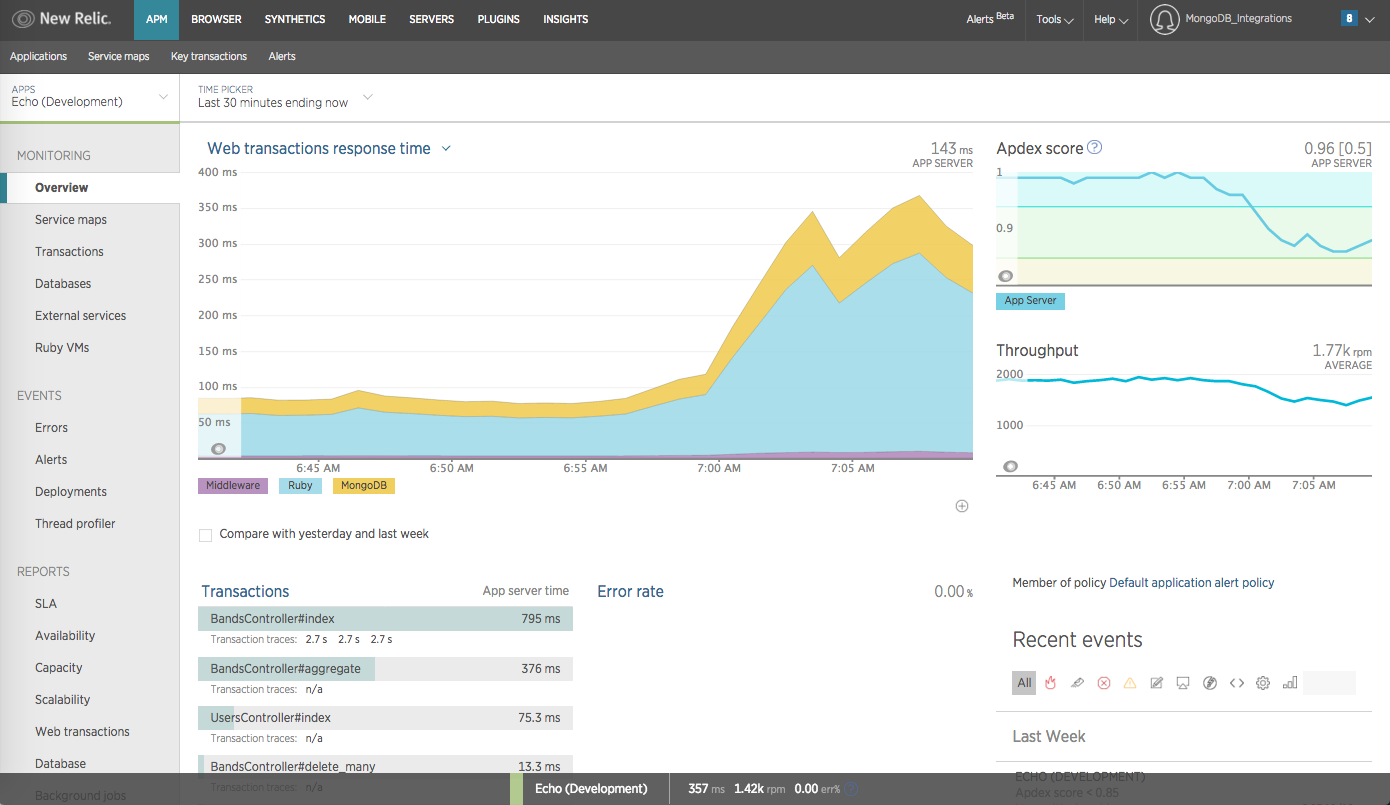
MongoDB Screenshots

Screenshot of Screenshot of Screenshot of Screenshot of Screenshot of Screenshot of