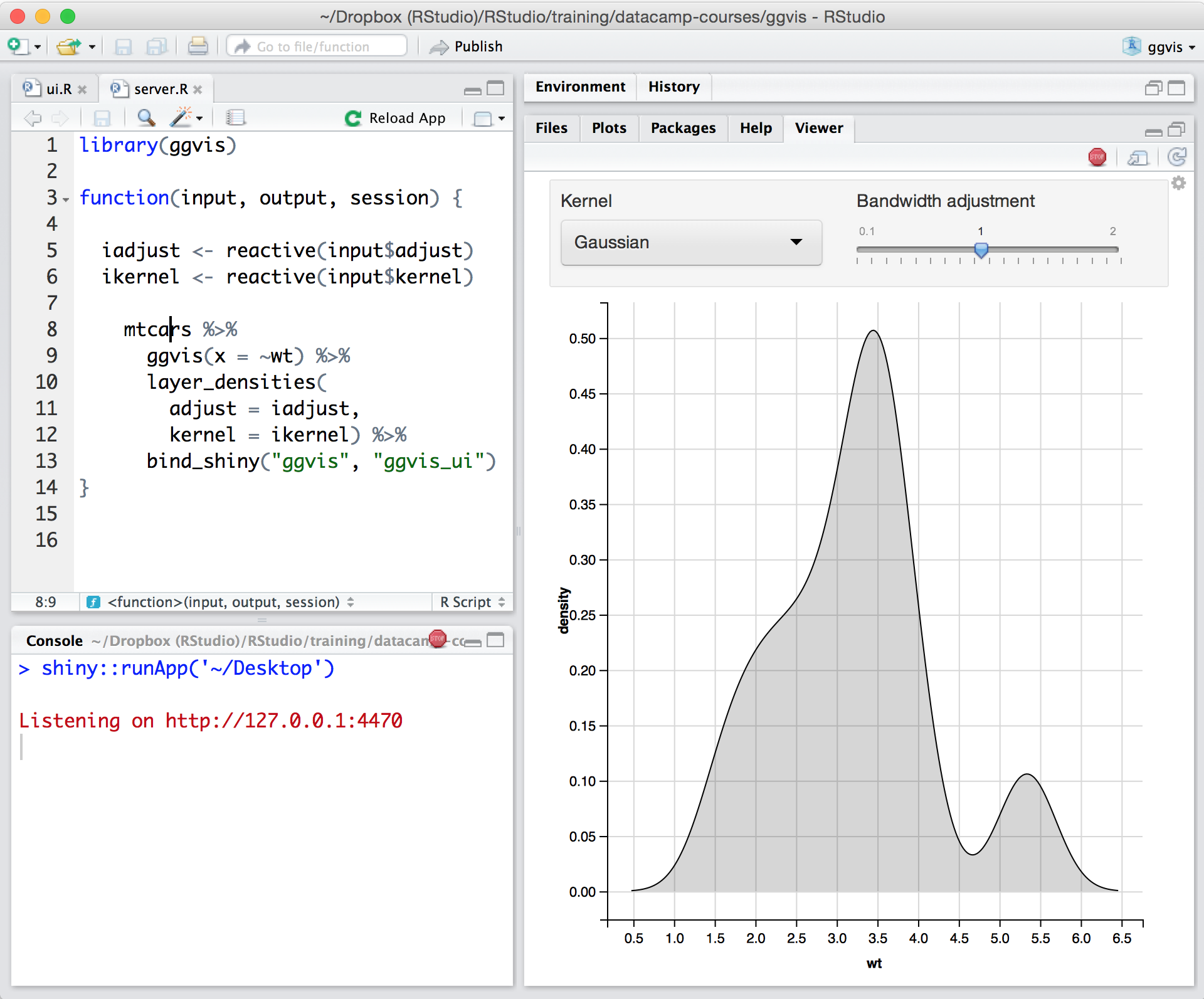
In my humble opinion, if you are working on something related to Statistics, RStudio is your go-to tool. But if you are looking for something in Machine Learning, look out for Python. The beauty is that there are packages now by which you can write Python/SQL in R. Cross-platform functionality like such makes RStudio way ahead of its competition. A couple of chinks in RStudio armor are very small and can be considered as nagging just for the sake of argument. Other than completely based on programming language, I couldn't find significant drawbacks to using RStudio. It is one of the best free software available in the market at present.
A de minimis incentive was given to thank the reviewer for their time. The incentive was not used to bias or drive a particular response, nor was the incentive contingent on a positive endorsement. TR verified that a representative sample of customers was invited. More Info
React is a JavaScript user interface construction library that works well for:
Developing web apps with dynamic and complicated user interfaces.
creating reusable UI elements that may be used in other applications.
creating single-page applications with dynamic content updates that don't require a page reload.
The Virtual DOM's effective updating mechanism allows it to handle large volumes of data updates.
React, on the other hand, might be less suitable for:
Websites that are simple, stagnant, and have no interaction. Other libraries or simple HTML, CSS, and JavaScript may be a better fit in such circumstances.
Web sockets may be a better choice for applications that need real-time updates, such as chat or gaming apps.
When creating mobile apps, React Native is a better option.
Server side rendering only, as React is designed to run on the client side.
The support is incredibly professional and helpful, and they often go out of their way to help me when something doesn't work.
The one-click publishing from RStudio Connect is absolutely amazing, and I really like the way that it deploys your exact package versions, because otherwise, you can get in a terrible mess.
Python doesn't feel quite as native as R at the moment but I have definitely deployed stuff in R and Python that works beautifully which is really nice indeed.
A de minimis incentive was given to thank the reviewer for their time. The incentive was not used to bias or drive a particular response, nor was the incentive contingent on a positive endorsement. More Info
React is fantastic for building performant user interfaces. Our web app is snappy and great for our customers.
React has the philosophy of doing one thing and doing it well which is the view layer of the application. This makes it incredibly intuitive and flexible for developers to use.
React has lead the way in being able to write modular and structured code. It is a drastic improvement since the days of spaghetti jQuery code.
React has an unmatched community. The amount of tools and libraries available is fantastic, and there plenty of solutions available online for common problems.
A de minimis incentive was given to thank the reviewer for their time. The incentive was not used to bias or drive a particular response, nor was the incentive contingent on a positive endorsement. More Info
Python integration is newer and still can be rough, especially with when using virtual environments.
RStudio Connect pricing feels very department focused, not quite an enterprise perspective.
Some of the RStudio packages don't follow conventional development guidelines (API breaking changes with minor version numbers) which can make supporting larger projects over longer timeframes difficult.
A de minimis incentive was given to thank the reviewer for their time. The incentive was not used to bias or drive a particular response, nor was the incentive contingent on a positive endorsement. TR verified that a representative sample of customers was invited. More Info
Debugging React is challenging. Bugs in react code generate stack traces internal to React and it is often totally unclear how it relates to the code you actually wrote.
Relating your React elements to corresponding DOM elements is difficult. The intentional separation of virtual and actual DOM also makes it difficult to map the elements to the structures in the DOM. This is partially ameliorated by the use of the React dev tool, which provides a DOM-like view of the React elements, but the tool still does not provide a direct correspondence with the DOM that is often necessary to figure out why something isn't right.
Because JSX is React-specific and not a language feature, a special compilation process is necessary to convert JSX code to normal JS. Coming from a C++ background, compiling things doesn't bother me, but many JS developers are used to a less structured development.
A de minimis incentive was given to thank the reviewer for their time. The incentive was not used to bias or drive a particular response, nor was the incentive contingent on a positive endorsement. More Info
There is no viable alternative right now. The toolset is good and the functionality is increasing with every release. It is backed by regular releases and ongoing development by the RStudio team. There is good engagement with RStudio directly when support is required. Also there's a strong and growing community of developers who provide additional support and sample code.
A de minimis incentive was given to thank the reviewer for their time. The incentive was not used to bias or drive a particular response, nor was the incentive contingent on a positive endorsement. TR verified that a representative sample of customers was invited. More Info
For someone who learns how to use the software and picks up on the "language" of R, it's very easy to use. For beginners, it can be hard and might require a course, as well as the appropriate statistical training to understand what packages to use and when
A de minimis incentive was given to thank the reviewer for their time. The incentive was not used to bias or drive a particular response, nor was the incentive contingent on a positive endorsement. More Info
React is just a bit of a different animal. I was avoiding it for the longest time. I thought for sure I would land on Vue or something else with a more approachable and familiar appearance. But after taking an online course in React, I started realize what people were raving about (and complaining about) and decided to implement it at our office for one of our products.
A de minimis incentive was given to thank the reviewer for their time. The incentive was not used to bias or drive a particular response, nor was the incentive contingent on a positive endorsement. More Info
RStudio is very available and cheap to use. It needs to be updated every once in a while, but the updates tend to be quick and they do not hinder my ability to make progress. I have not experienced any RStudio outages, and I have used the application quite a bit for a variety of statistical analyses
A de minimis incentive was given to thank the reviewer for their time. The incentive was not used to bias or drive a particular response, nor was the incentive contingent on a positive endorsement. TR verified that a representative sample of customers was invited. More Info
Since R is trendy among statisticians, you can find lots of help from the data science/ stats communities. If you need help with anything related to RStudio or R, google it or search on StackOverflow, you might easily find the solution that you are looking for.
A de minimis incentive was given to thank the reviewer for their time. The incentive was not used to bias or drive a particular response, nor was the incentive contingent on a positive endorsement. More Info
Since it's open-source and very popular, the community support for React and related tools and libraries is excellent. There are a lot of people using the same tools, and so issues tend to get fixed quickly and "recipes" are easy to come by. And since it's backed by Facebook, they have a dedicated engineering team working on the progression of React.
A de minimis incentive was given to thank the reviewer for their time. The incentive was not used to bias or drive a particular response, nor was the incentive contingent on a positive endorsement. More Info
RStudio was provided as the most customizable. It was also strictly the most feature-rich as far as enabling our organization to script, run, and make use of R open-source packages in our data analysis workstreams. It also provided some support for python, which was useful when we had R heavy code with some python threaded in. Overall we picked Rstudio for the features it provided for our data analysis needs and the ability to interface with our existing resources.
A de minimis incentive was given to thank the reviewer for their time. The incentive was not used to bias or drive a particular response, nor was the incentive contingent on a positive endorsement. TR verified that a representative sample of customers was invited. More Info
While this is a widely contested debate with various blog posts and benchmarks all over the place, its really a personal choice to determine what works for the team. Coming from a Angular 1.x background, I decided to try a new framework when Angular 2.x was announced and at that time React is gaining popularity and Vue hasn't taken off yet. Compared to Angular 1.x and Vue (hybrid of React and Angular) that split the logic from the html templates, I loved the way React breaks code into components using the jsx syntax. In my mind, this allows for cleaner components and easier maintenance
A de minimis incentive was given to thank the reviewer for their time. The incentive was not used to bias or drive a particular response, nor was the incentive contingent on a positive endorsement. More Info
RStudio is very scalable as a product. The issue I have is that it doesn't necessarily fit in nicely with the mainly Microsoft environment that everybody else is using. Having RStudio for us means dedicated servers and recruiting staff who know how to manage the environment. This isn't a fault of the product at all, it's just part of the data science landscape that we all have to put up with. Having said that RStudio is absolutely great for running on low spec servers and there are loads of options to handle concurrency, memory use, etc.
A de minimis incentive was given to thank the reviewer for their time. The incentive was not used to bias or drive a particular response, nor was the incentive contingent on a positive endorsement. More Info
Using it for data science in a very big and old company, the most positive impact, from my point of view, has been the ability of spreading data culture across the group. Shortening the path from data to value.
Still it's hard to quantify economic benefits, we are struggling and it's a great point of attention, since splitting out the contribution of the single aspects of a project (and getting the RStudio pie) is complicated.
What is sure is that, in the long run, RStudio is boosting productivity and making the process in which is embedded more efficient (cost reduction).
A de minimis incentive was given to thank the reviewer for their time. The incentive was not used to bias or drive a particular response, nor was the incentive contingent on a positive endorsement. TR verified that a representative sample of customers was invited. More Info
A de minimis incentive was given to thank the reviewer for their time. The incentive was not used to bias or drive a particular response, nor was the incentive contingent on a positive endorsement. More Info