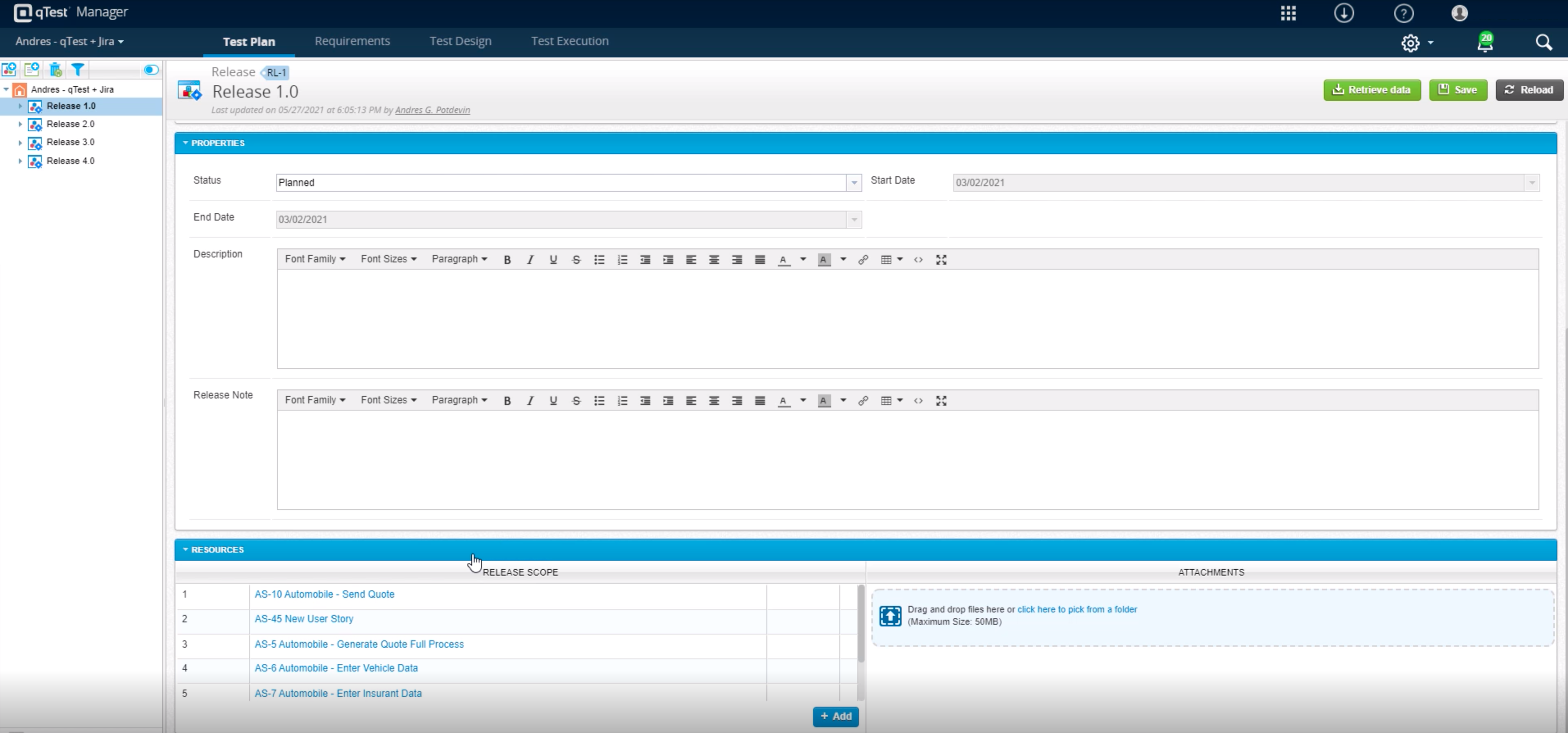
Tricentis qTest (formerly QASymphony) provides enterprise-level agile testing tools giving businesses visibility and control needed to ensure application quality in fast-paced development environments. Tricentis and QASymphony merged in summer 2018.
$1,200
per year per user
Tricentis Testim
Score7.6 out of 10
N/A
Testim.io, from Tricentis since the February 2022 acquisition, leverages machine learning for the authoring, execution and maintenance of automated test cases. Testim uses dynamic locators and learns with every execution. It is designed to produce fast authoring and stable tests that learn, thus eliminating the need to continually maintain tests with every code change.
Tricentis qTest integrates seamlessly with Jira, making it ideal for teams that manage user stories and defects in Jira while keeping test cases and execution in qTest. When paired with automation tools like tosca, Selenium, or WebdriverIO, qTest is excellent for aggregating both manual and automated test results in one place.
A de minimis incentive was given to thank the reviewer for their time. The incentive was not used to bias or drive a particular response, nor was the incentive contingent on a positive endorsement. More Info
Testim has been great at automating Frontend and integration regression testing. I do not think it would work wellTricentis Testimfor backend code testing, if it could not be done through UI. The record function is very good, and makes automating test cases much faster and more accurate. We have had great success using Testim to verify SalesForce environments, NetSuite environments, and our own JumpCloud application as well.
A de minimis incentive was given to thank the reviewer for their time. The incentive was not used to bias or drive a particular response, nor was the incentive contingent on a positive endorsement. More Info
Tricentis qTest manages test cases very well and keeps step by step by details of each and every scenarios
Tricentis qTest provides all the details related to functionality in a single place which saves time and efforts of QA
QA doesnt require much knowledge for test case execution as every details are there in Tricentis qTest test cases which saves the time of knowledge transfer
A de minimis incentive was given to thank the reviewer for their time. The incentive was not used to bias or drive a particular response, nor was the incentive contingent on a positive endorsement. More Info
It provides a codeless testing environment, allowing non-technical users such as business analysts and testers to create and maintain automated tests without writing code. This democratizes test automation and accelerates test creation.
The platform leverages artificial intelligence (AI) and machine learning (ML) algorithms to analyze user interactions with the application and automatically generate test scripts. This significantly reduces the time and effort required to create test cases.
Its AI capabilities enable tests to adapt to changes in the application's user interface (UI) automatically. If UI elements change, the platform can identify and update the tests accordingly, reducing maintenance overhead.
A de minimis incentive was given to thank the reviewer for their time. The incentive was not used to bias or drive a particular response, nor was the incentive contingent on a positive endorsement. TR verified that a representative sample of customers was invited. More Info
We can add some more integration features with JIRA so the users can directly mark the test as executed from JIRA itself when functional testing is done.
Tricentis qTest can provide some features like sending reminders for retesting if there are failed test cases marked while testing to keep Tricentis qTest up to date.
A de minimis incentive was given to thank the reviewer for their time. The incentive was not used to bias or drive a particular response, nor was the incentive contingent on a positive endorsement. TR verified that a representative sample of customers was invited. More Info
Providing more comprehensive reporting and analytics capabilities, including customizable dashboards and insights into test execution results, could help users gain deeper insights into their test coverage and quality.
Expanding integration capabilities with a wider range of external systems, tools, and test management platforms could increase flexibility and interoperability within the testing ecosystem.
Enhancements in organizing and managing test scenarios and test suites could improve the user experience. Features such as better folder structures, tags, and hierarchical organization could make it easier to manage large test suites.
A de minimis incentive was given to thank the reviewer for their time. The incentive was not used to bias or drive a particular response, nor was the incentive contingent on a positive endorsement. TR verified that a representative sample of customers was invited. More Info
A de minimis incentive was given to thank the reviewer for their time. The incentive was not used to bias or drive a particular response, nor was the incentive contingent on a positive endorsement. TR verified that a representative sample of customers was invited. More Info
This is one of the most intuitive tools, while also having the capability to do complex test scenarios. There are very few things we are unable to test with this tool. The support is also very quick and very helpful.
A de minimis incentive was given to thank the reviewer for their time. The incentive was not used to bias or drive a particular response, nor was the incentive contingent on a positive endorsement. More Info
It successfully balances deep enterprise functionality with a clean and modern interface. One of its strongest points is the intuitive, folder based navigation, which makes organizing test case and cycles feel natural. Learning curve is relatively shallow for the new team members to become productive without extensive onboarding. Also the deep integration with JIRA is a significant boost to its usability.
A de minimis incentive was given to thank the reviewer for their time. The incentive was not used to bias or drive a particular response, nor was the incentive contingent on a positive endorsement. More Info
While the users do have some small amount of coding background, this tool does not require much prior knowledge to get off the ground. In order to do some of the more complicated test scenarios, there is a learning curve, but overall the re-usability and ease of use is fantastic.
A de minimis incentive was given to thank the reviewer for their time. The incentive was not used to bias or drive a particular response, nor was the incentive contingent on a positive endorsement. More Info
A de minimis incentive was given to thank the reviewer for their time. The incentive was not used to bias or drive a particular response, nor was the incentive contingent on a positive endorsement. TR verified that a representative sample of customers was invited. More Info
The customer support is the best I have ever experienced, both personally and in a job role. The chat anytime is a very nice option, there has never been more than a few minute wait to connect with someone, and the agents are very knowledgeable and helpful.
A de minimis incentive was given to thank the reviewer for their time. The incentive was not used to bias or drive a particular response, nor was the incentive contingent on a positive endorsement. More Info
A de minimis incentive was given to thank the reviewer for their time. The incentive was not used to bias or drive a particular response, nor was the incentive contingent on a positive endorsement. TR verified that a representative sample of customers was invited. More Info
All of them offer formidable solutions in the test management realm, but each one caters to different niche and need. qTest distinguishes itself with its deep integration capabilities, especially with Agile and DevOps tools, enabling streamlined CI/CD process. Its modern, user-centric interface contrasts with ALM's more dated appearance and complex setup. While TestRail provides a clean user experience and caters to a broad spectrum of business, qTest's scalability, from SMBs to large enterprises, stands out. PractiTest's cloud-based solution is geared towards mid-sized companies, but qTest's flexibility, advanced analytics, and robust reporting grant teams actionable insights. qTest' approach to a more holistic test management closely aligning with modern software development practices
A de minimis incentive was given to thank the reviewer for their time. The incentive was not used to bias or drive a particular response, nor was the incentive contingent on a positive endorsement. More Info
We evaluated several other products, and what gave Tricentis Testim the edge was the ease of use, the customer support and the pricing. While others seemed to have a bit more complex functionality, we have been able to build almost every use case the way we would expect, with very few workarounds.
A de minimis incentive was given to thank the reviewer for their time. The incentive was not used to bias or drive a particular response, nor was the incentive contingent on a positive endorsement. More Info
A de minimis incentive was given to thank the reviewer for their time. The incentive was not used to bias or drive a particular response, nor was the incentive contingent on a positive endorsement. More Info