

BillingBench
What is BillingBench?
BillingBench is a denial management and payer intelligence platform for medical billing professionals and revenue cycle teams. It combines a citation-audited policy dataset with aggregate denial data that captures cross-practice adjudication trends as the network scales, covering both the documentation requirements payers publish and the adjudication patterns their adjusters follow.
Core Tools
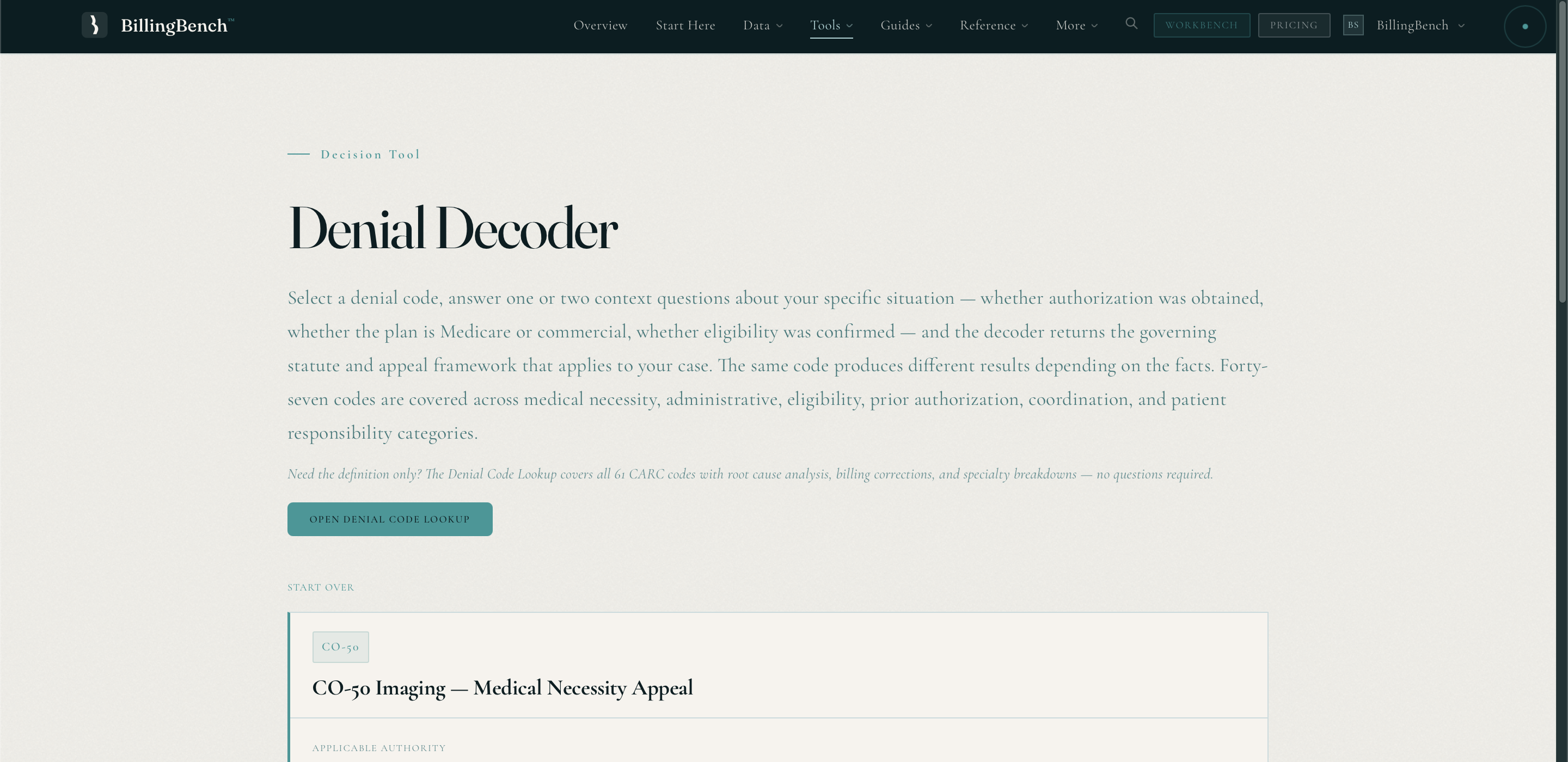
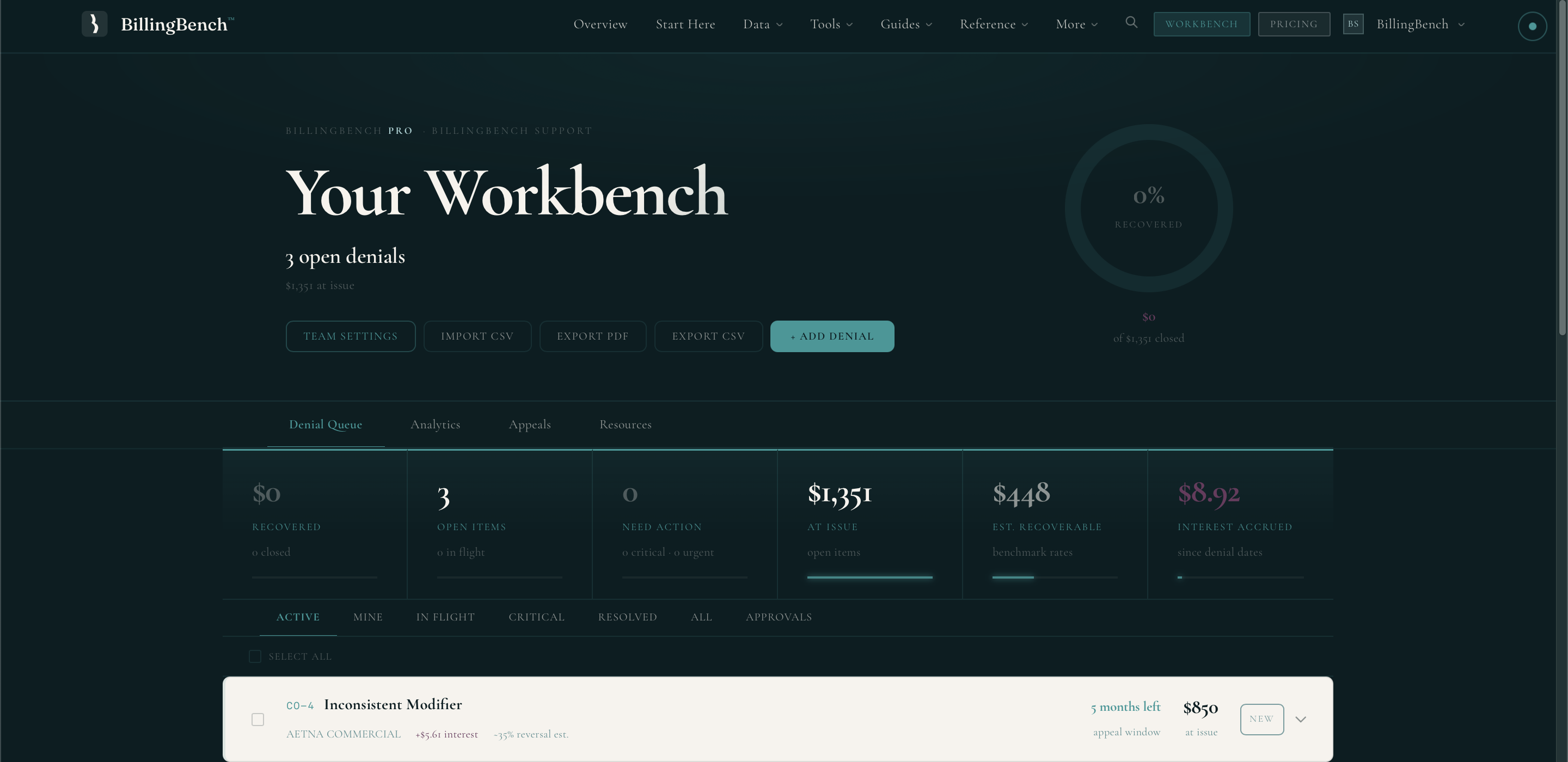
The platform includes a Denial Code Decoder that interprets CARC codes with cause analysis, recommended fixes, and specialty routing; an Appeal Builder that assembles structured appeal letters with statutory citations by denial type, specialty, and payer; a Modifier Matrix with verified, payer-specific modifier rulings; prior authorization checklists by specialty and payer; a Timely Filing Calculator for deadline lookup; an 835 ERA Parser that extracts aggregate financial data from remittance files to drive internal practice analytics and contribute to the platform's aggregate denial data; and a Denial Queue for tracking open denials with deadlines and status.
Policy Layer and Aggregate Data
A core design principle is the distinction between what payers state in their coverage policies and how their adjusters apply those policies in practice. The aggregate-data layer combines anonymized 835 ERA data contributed across the platform. As the network scales, that data produces comparative denial-rate benchmarks by payer, CPT code, and CARC code that reflect actual adjudication patterns rather than published criteria alone. It helps billing teams see when a payer's denial behavior on a specific procedure has shifted, sometimes before a formal policy update.
Citation Verification
Policy citations are verified against primary sources and updated on a defined review cycle. Every Aetna CPB number is confirmed against aetna.com. Every Medicare NCD and LCD is confirmed against the CMS Medicare Coverage Database. Each entry carries a source URL, verification date, and changelog. The appeal arguments and prior authorization frameworks are written to reflect clinical reasoning, given that clinical necessity determinations are evaluated on clinical grounds rather than billing codes alone. Full methodology published at http://billingbench.com/methodology.
Independence
BillingBench has no affiliate relationships with RCM vendors, clearinghouses, or payers. The platform contains no sponsored content and no paid placement.
Data Privacy
No patient identifiers are accepted at any tier. The 835 ERA Parser processes remittance files and extracts only financial data: payer name, CARC code, dollar totals, and date. No patient information is transmitted or stored. Visit http://billingbench.com/privacy for more details.
Security and Compliance
BillingBench is hosted on Vercel (SOC 2 Type II) with data stored in Supabase PostgreSQL on AWS (SOC 2 Type II). All data is encrypted at rest and in transit. Row-level security policies are enforced at the database layer, so each user and each workspace can only access their own records regardless of how the application is reached. Multi-factor authentication via authenticator app (TOTP) is required for all authenticated features and enforced at the infrastructure level. Full security and compliance details are available at http://billingbench.com/security, as well as the BillingBench Whistic Trust Center at https://public-profile.whistic.com/23c5e233-4858-4e8b-bab3-6a42f9c0b441.
A Business Associate Agreement is included with every account. The agreement is pre-executed on BillingBench's end; covered entities accept it at account creation and can download a signed copy at any time. The 835 ERA Parser runs entirely in the browser using a segment whitelist that processes only remittance fields that do not carry patient identifiers. No ERA file content is transmitted to BillingBench servers. A client-side PHI scrubber adds another layer of protection before any output is saved. Account data is deleted within 30 days of closure, or within 48 hours upon request. Full details on BillingBench's BAA documentation are available at http://billingbench.com/hipaa.
Categories & Use Cases
Screenshots




1 / 7
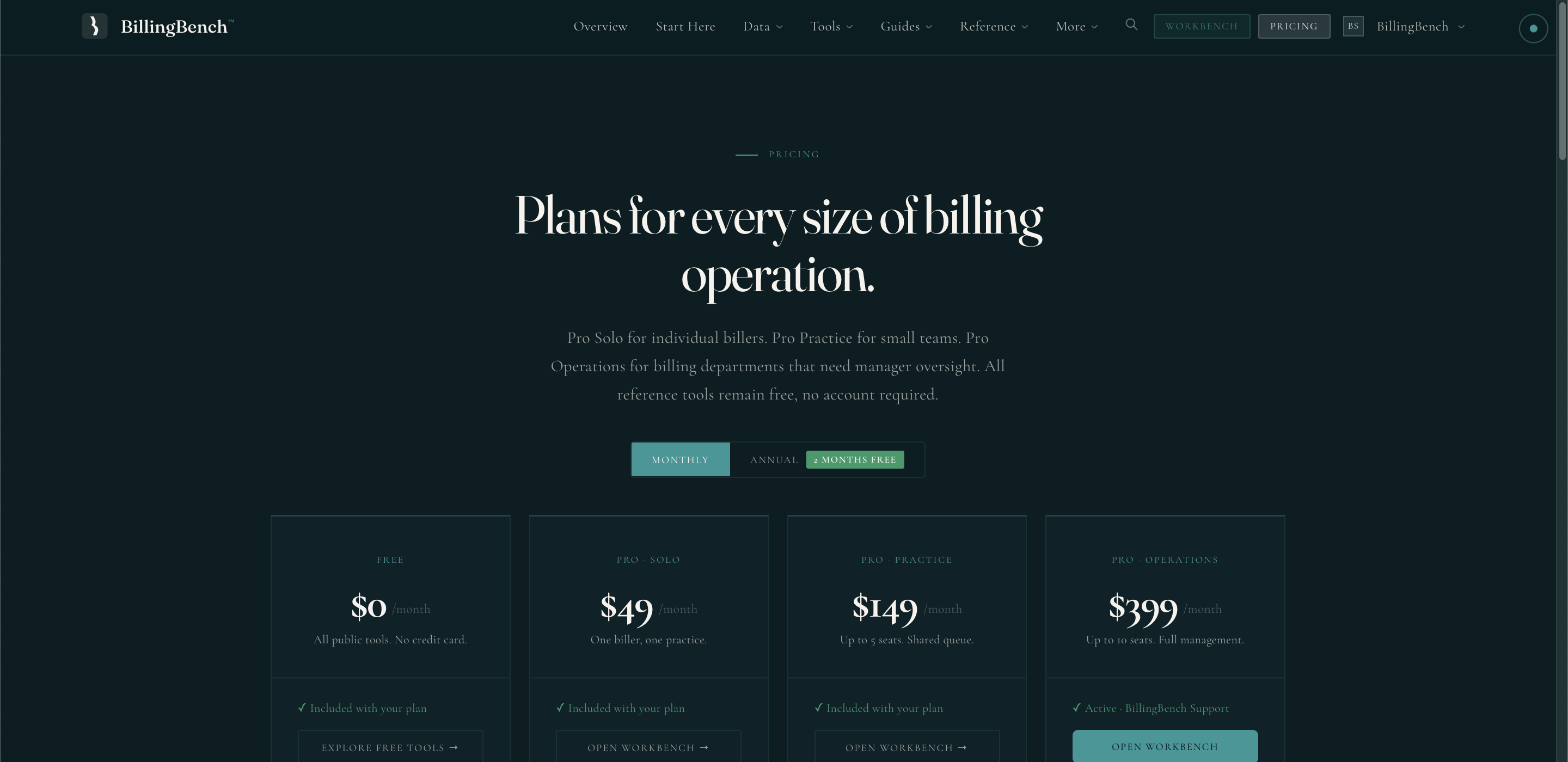
Screenshot of BillingBench overview: specialty-level denial benchmarks, payer intelligence, and workflow tools for medical billing and revenue cycle operations.
Technical Details
| Deployment Types | SaaS |
|---|---|
| Mobile Application | No |
| Supported Countries | United States |
| Supported Languages | English |
| Security | Security Report on Whistic Security Network |