
TrustRadius: an HG Insights company

SAP Sustainability Footprint Management

Score8 out of 10

17 Reviews and Ratings

What is SAP Sustainability Footprint Management?

SAP Product Footprint Management is a software solution used to calculate product footprints periodically and at scale across the entire product lifecycle.

Read more details.

Media

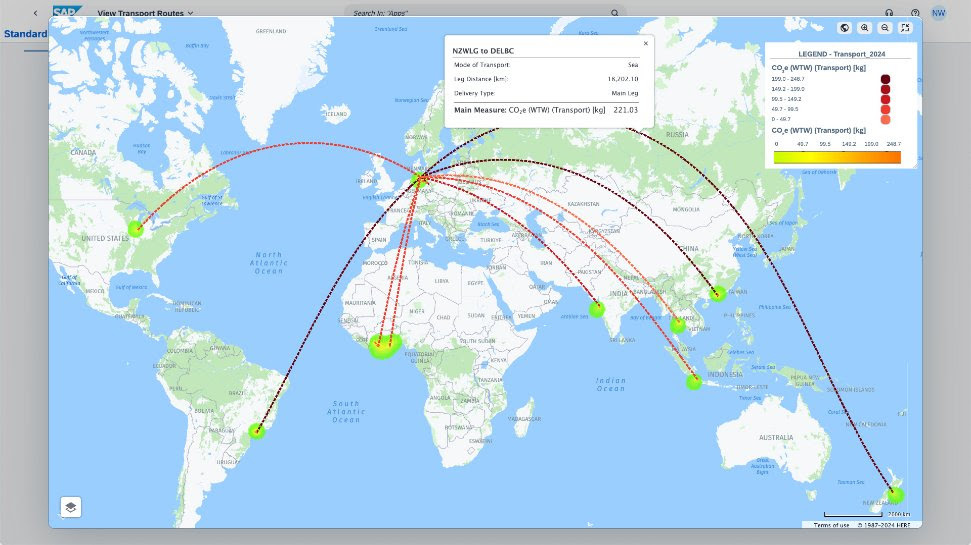
Screenshot of a visualization of transport routes.
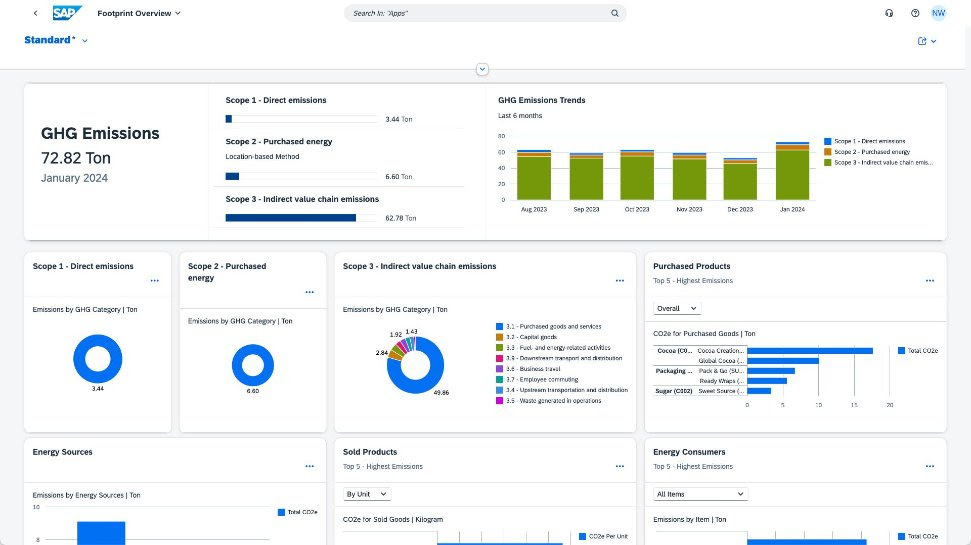
Screenshot of GHG emissions.

1 / 2

Screenshot of a visualization of transport routes.

Who Buys & Uses SAP Sustainability Footprint Management

Simplifies vague concepts

Use Cases and Deployment Scope

I use it to convert vague sustainability concepts into concrete data. From this, we can measure and reduce CO2 emissions. It also vizualises improvements, enabling easy reporting to business leaders in our division and at corporate level. Further, I can engage colleagues in our sustainability initiatives and update them. The solution is part of the SAP product suite and integrates well, as I use other software I notice the commonality between them.

Pros

  • Provides a visual representation of inputs and outputs for things like transport and energy use
  • Complex intonation is displayed in a clear UI graphically
  • The tool is flexible so we tailor it to our different internal structures
  • Integrates well with the SAP product suite and the commonality makes this a straightforward switch.

Cons

  • Accuracy of the data could be better. Vague inputs give definite figures which I’m skeptical about.
  • Integration with other SAP products could be improved further to use all the data in the system.
  • The learning curve can be tricky for non technical users and those unfamiliar with the SAP platform.
  • Third party data integrations would improve the efficiency, removing the need to manually gather data. That would save time too

Return on Investment

  • Communication to upper management enables us to measure improvement
  • Communication across the business is easy and we can quickly put internal communications with graphics togerher
  • We reliably meet our regulatory reporting requirements and can use the data to implement improvement plans to ultimately lessen the impact of our operations. This alone justifies the cost and confirms ROI.
  • Some internal training had to be delivered when we started using the system but I expect that is necessary with any new software.

Usability

Alternatives Considered

Microsoft Cloud for Sustainability

Other Software Used

SAP Sustainability Control Tower

SAP Sustainability Footprint Management Review

Use Cases and Deployment Scope

I use SAP Sustainability Footprint Management to solve complex carbon accounting and measurement , emission factor

Pros

  • Product enviromantal foot print
  • corproate footprint
  • Orgnizsational footprint
  • Employee engamanet

Cons

  • Complex Software
  • Not easy to inteagrite
  • Base line eatures mising

Return on Investment

  • Sustainable business steering & innovation
  • Business transformation

SAP Sustainability Footprint Management review

Use Cases and Deployment Scope

I am a consultant for SAP EHS and sustainability solutions. I implement projects of this type, in addition to carrying out pre-sales as well.

Pros

  • Carbon footprint in the oil industry & energy
  • Carbon footprint in the chemical industry
  • Carbon footprint in the pharmaceutical industry

Cons

  • Improve Input Data Integration with SAP EHS-EM
  • Improve emission factors database
  • Improved output (reports and graphs)

Return on Investment

  • External reports
  • Corporate indicators
  • Mapping environmental impacts

SAP Sustainability Footprint Management - a consultant's perspective

Use Cases and Deployment Scope

As a SAP product consultant, we promote the use of SAP Sustainability Footprint Management for businesses to manage and monitor their carbon emission (particularly scope 3 emissions). We also promote the use of SAP EHSM Environment Management module to capture scope 1 and 2 emission, and SAP SCT as a reporting platform for businesses' carbon emission.

Pros

  • Carbon emission at product level
  • Scope 3 emission capture (although this is WIP)
  • Emission factor management
  • Emission calculation

Cons

  • Scope 1 and 2 emission capture
  • Additional categories for Scope 3 emission
  • Integration with SAP EHSM Environment Management
  • Ability to calculate emission not only at product level but also corporate level

Return on Investment

  • Improved transparency on carbon emission accounting
  • Improved visibility on Scope 3 emission
  • Improved compliance and conformance

Alternatives Considered

Enablon and Cority One

SAP Sustainability Footprint Management Review

Use Cases and Deployment Scope

SAP Sustainability Footprint Management is excellent tools to manage the total carbon footprint.It calculates a company's total carbon footprint and attributes emissions to products and corporate overhead, aiming to achieve a balanced emission level through all production stages. the main problem in current business was there was no particular tool to calculate how to measure and calculate the total carbon footprint through production and emission of different effluents from the company, through it it gives the holistic approach through the analytical data to measure and look forward to take measure to reduce the carbon footprint which leads to more sustainable approach towards business.

Pros

  • Footprint Management
  • Emission factor management
  • Footprint analysis

Cons

  • Better UI/UX
  • Holistic approach for ESG reporting
  • Carbon accounting

Return on Investment

  • Sustainable Business
  • Environment and Sustainability
  • Client trust

Alternatives Considered

IBM Managed Services for SAP Applications, SAP Access Control and Cisco Enterprise Network Security

Other Software Used

SAP S/4HANA Cloud, SAP Signavio Process Transformation Suite