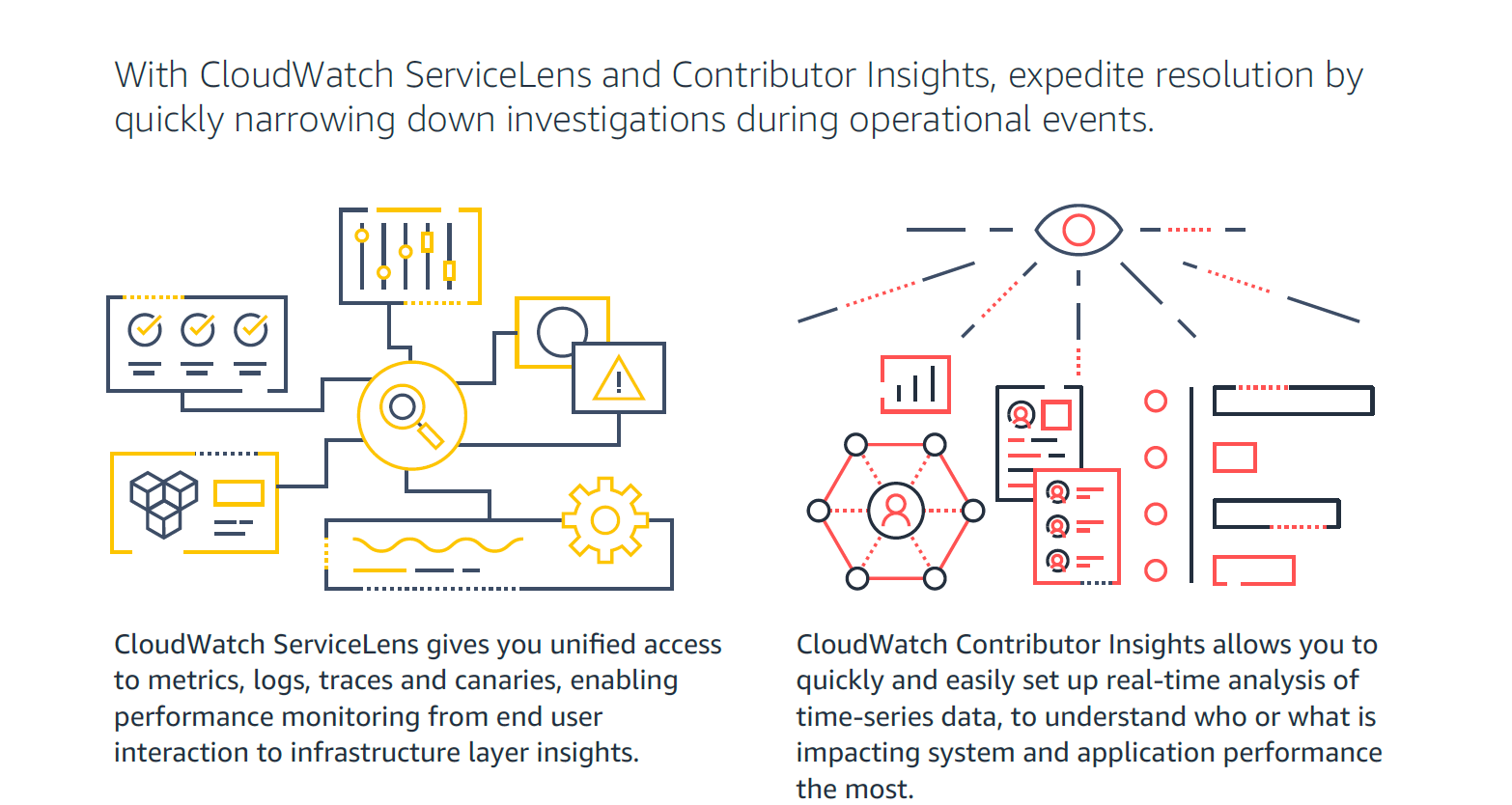
Amazon CloudWatch is a native AWS monitoring tool for AWS programs. It provides data collection and resource monitoring capabilities.
$0
per canary run
Oracle Observability and Management
Score6.3 out of 10
N/A
Oracle's Observability and Management solution provides visibility and machine learning-driven actionable insights to ease management across all layers of the stack deployed on any technology. To drive scale and predictable results, Oracle’s integrated functionality and automation for DevOps monitoring and IT operations management aims to make it 50% easier to prevent and solve IT problems.
N/A
Pricing
Amazon CloudWatch
Oracle Observability and Management
Editions & Modules
Canaries
$0.0012
per canary run
Logs - Analyze (Logs Insights queries)
$0.005
per GB of data scanned
Over 1,000,000 Metrics
$0.02
per month
Contributor Insights - Matched Log Events
$0.02
per month per one million log events that match the rule
Logs - Store (Archival)
$0.03
per GB
Next 750,000 Metrics
$0.05
per month
Next 240,000 Metrics
$0.10
per month
Alarm - Standard Resolution (60 Sec)
$0.10
per month per alarm metric
First 10,000 Metrics
$0.30
per month
Alarm - High Resolution (10 Sec)
$0.30
per month per alarm metric
Alarm - Composite
$0.50
per month per alarm
Logs - Collect (Data Ingestion)
$0.50
per GB
Contributor Insights
$0.50
per month per rule
Events - Custom
$1.00
per million events
Events - Cross-account
$1.00
per million events
CloudWatch RUM
$1
per 100k events
Dashboard
$3.00
per month per dashboard
CloudWatch Evidently - Events
$5
per 1 million events
CloudWatch Evidently - Analysis Units
$7.50
per 1 million analysis units
No answers on this topic
Offerings
Pricing Offerings
Amazon CloudWatch
Oracle Observability and Management
Free Trial
Yes
No
Free/Freemium Version
Yes
No
Premium Consulting/Integration Services
Yes
No
Entry-level Setup Fee
No setup fee
No setup fee
Additional Details
With Amazon CloudWatch, there is no up-front commitment or minimum fee; you simply pay for what you use. You will be charged at the end of the month for your usage.
For out business we find that AWS Cloudwatch is good at providing real-time metrics for monitoring and analysing the performance and usage of our platform by customers. It is possible to create custom metrics from log events, such people adding items to a basket, checking out or abandoning their orders.
A de minimis incentive was given to thank the reviewer for their time. The incentive was not used to bias or drive a particular response, nor was the incentive contingent on a positive endorsement. More Info
Ideal for a complex organization with requirements to build very complex reports. Especially useful for organizations that already have numerous Oracle products and need to pull information from them. This tool works best when plugged in with other Oracle tools and databases. If you're a larger company, and/or if you're managing a lot of data, Oracle IT Analytics Cloud Service is the perfect tool to manage your Oracle deployment. It provides a number of different options for intelligent analysis while not being too overwhelming to manage. Companies that want a robust tool to manage all data and present it in a visually appealing way to users will greatly benefit from this tool. The tool is very customizable and can be tailored to meet the needs of different users.
A de minimis incentive was given to thank the reviewer for their time. The incentive was not used to bias or drive a particular response, nor was the incentive contingent on a positive endorsement. More Info
It provides lot many out of the box dashboard to observe the health and usage of your cloud deployments. Few examples are CPU usage, Disk read/write, Network in/out etc.
It is possible to stream CloudWatch log data to Amazon Elasticsearch to process them almost real time.
If you have setup your code pipeline and wants to see the status, CloudWatch really helps. It can trigger lambda function when certain cloudWatch event happens and lambda can store the data to S3 or Athena which Quicksight can represent.
A de minimis incentive was given to thank the reviewer for their time. The incentive was not used to bias or drive a particular response, nor was the incentive contingent on a positive endorsement. More Info
A de minimis incentive was given to thank the reviewer for their time. The incentive was not used to bias or drive a particular response, nor was the incentive contingent on a positive endorsement. TR verified that a representative sample of customers was invited. More Info
Memory metrics on EC2 are not available on CloudWatch. Depending on workloads if we need visibility on memory metrics we use Solarwinds Orion with the agent installed. For scalable workloads, this involves customization of images being used.
Visualization out of the box. But this can easily be addressed with other solutions such as Grafana.
By design, this is only used for AWS workloads so depending on your environment cannot be used as an all in one solution for your monitoring.
A de minimis incentive was given to thank the reviewer for their time. The incentive was not used to bias or drive a particular response, nor was the incentive contingent on a positive endorsement. More Info
There's a pretty steep learning curve that needs to be overcome in order to properly deploy this tool. So, unless you're a seasoned IT administrator, you may have a fair amount of homework to do. Implementation and maintenance of this takes a bucket of consulting hours from outside consultants to come in and set up the tool and regularly maintain it, in the long run, this could be costly.
The dashboard is not as easy to set up as I would like, however, after setup it will serve your purpose in the best possible way. You may not be able to find out how some data related to another and you can create a report that you think has all the details you need, but it comes up blank because the data really is not connected.
There aren't enough self-learning materials available like tutorials and how-to videos. I would like to have access to more e-tutorials from inside the tool. A steep learning curve for most. It would be nice to have a robust learning portal within the application where users can access self-learning material directly from the application and step to spet guides on how to perform different tasks.
Does not provide the ease of adding additional data sources without lots of complications. Even though it can handle large data sets, rendering of reports can take a fairly long time if the parameter set is large. For some time it seems like processing takes a bit of time when large data sets are being used. This is not the case with other competing tools.
A de minimis incentive was given to thank the reviewer for their time. The incentive was not used to bias or drive a particular response, nor was the incentive contingent on a positive endorsement. More Info
It's excellent at collecting logs. It's easy to set up. The viewing & querying part could be much better, though. The query syntax takes some time to get used to, & the examples are not helpful. Also, while being great, Log Insights requires manual picking of log streams to query across every time.
A de minimis incentive was given to thank the reviewer for their time. The incentive was not used to bias or drive a particular response, nor was the incentive contingent on a positive endorsement. More Info
A de minimis incentive was given to thank the reviewer for their time. The incentive was not used to bias or drive a particular response, nor was the incentive contingent on a positive endorsement. More Info
Support is effective, and we were able to get any problems that we couldn't get solved through community discussion forums solved for us by the AWS support team. For example, we were assisted in one instance where we were not sure about the best metrics to use in order to optimize an auto-scaling group on EC2. The support team was able to look at our metrics and give a useful recommendation on which metrics to use.
A de minimis incentive was given to thank the reviewer for their time. The incentive was not used to bias or drive a particular response, nor was the incentive contingent on a positive endorsement. More Info
The product management team is very responsive. They are on LinkedIn and Twitter, responding to your questions and offering ideas. I have not opened an Oracle support ticket for this product yet
A de minimis incentive was given to thank the reviewer for their time. The incentive was not used to bias or drive a particular response, nor was the incentive contingent on a positive endorsement. More Info
Grafana is definitely a lot better and flexible in comparison with Amazon CloudWatch for visualisation, as it offers much more options and is versatile. VictoriaMetrics and Prometheus are time-series databases which can do almost everything cloudwatch can do in a better and cheaper way. Integrating Grafana with them will make it more capable Elasticsearch for log retention and querying will surpass cloudwatch log monitoring in both performance and speed
A de minimis incentive was given to thank the reviewer for their time. The incentive was not used to bias or drive a particular response, nor was the incentive contingent on a positive endorsement. More Info
Oracle Analytics Cloud is an enterprise solution and can't be compared apple-to-apple with a data visualization tool like Tableau. This is not the same use at all. Before selecting Oracle Analytics Cloud, it is most important to consider the data you are looking to collect and how you plan to visualize it. Other tools like Tableau and microstrategy feel smoother to work with, have better UI's and are quicker when processing data. It is also important to think through how you will use the data across your organizations. Can have a steep learning curve but once you are well trained on this tool, the possibilities are endless. The tool is highly customizable and will generate what you design it to generate. If you are having issues with reports and analytics, it is most likely due to data quality issues. Oracle Analytics Cloud also benefits by adding Essbase in it, to perform multi-dimensional analytics.
A de minimis incentive was given to thank the reviewer for their time. The incentive was not used to bias or drive a particular response, nor was the incentive contingent on a positive endorsement. More Info
A de minimis incentive was given to thank the reviewer for their time. The incentive was not used to bias or drive a particular response, nor was the incentive contingent on a positive endorsement. More Info
A de minimis incentive was given to thank the reviewer for their time. The incentive was not used to bias or drive a particular response, nor was the incentive contingent on a positive endorsement. TR verified that a representative sample of customers was invited. More Info