Anaconda is an enterprise Python platform that provides access to open-source Python and R packages used in AI, data science, and machine learning. These enterprise-grade solutions are used by corporate, research, and academic institutions for competitive advantage and research.
$0
per month
IBM Machine Learning for z/OS
Score 10.0 out of 10
N/A
IBM Machine Learning for z/OS® brings AI to transactional applications on IBM zSystems. It can embed machine learning and deep learning models to deliver real-time insight, or inference every transaction with minimal impact to operational SLAs.
N/A
Kortical
Score 10.0 out of 10
Enterprise companies (1,001+ employees)
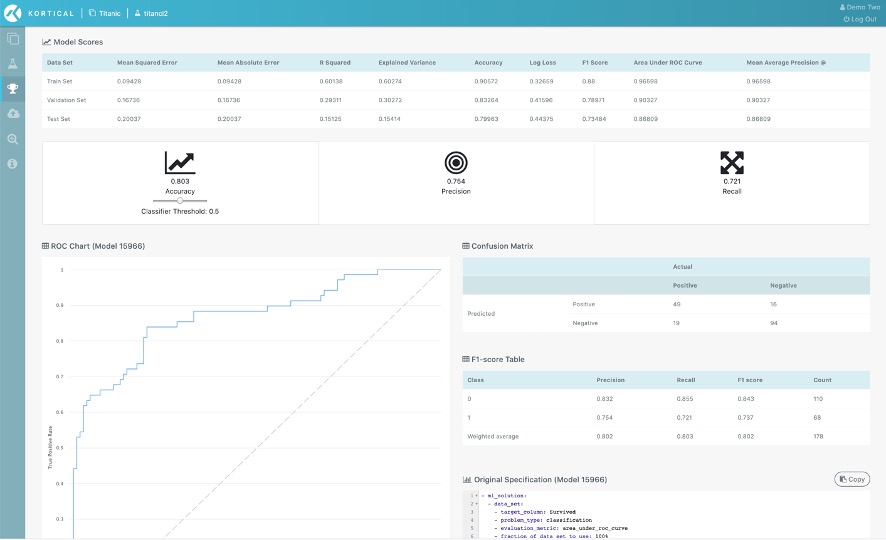
Kortical is an end to end AI as a Service (AIaaS) platform designed to accelerate the creation, iteration, explanation and deployment of world-class machine learning models. The vendor describes the key benefits of Kortical is AutoML that writes custom machine learning solutions from the ground up in code. Getting hands-on with the code is optional but being able to edit code it makes it easy to get the best of data scientists and AutoML, while also getting the benefits of full…
N/A
Pricing
Anaconda
IBM Machine Learning for z/OS
Kortical
Editions & Modules
Free Tier
$0
per month
Starter Tier
$15
per month per user
Business
$50
per month per user
Custom
Contact Sales
No answers on this topic
No answers on this topic
Offerings
Pricing Offerings
Anaconda
IBM Machine Learning for z/OS
Kortical
Free Trial
No
No
Yes
Free/Freemium Version
Yes
No
No
Premium Consulting/Integration Services
Yes
No
Yes
Entry-level Setup Fee
No setup fee
No setup fee
No setup fee
Additional Details
Users within organizations with 200+ employees/contractors (including Affiliates) require a paid Business license. Academic and non-profit research institutions may qualify for exemptions.
—
—
More Pricing Information
Community Pulse
Anaconda
IBM Machine Learning for z/OS
Kortical
Features
Anaconda
IBM Machine Learning for z/OS
Kortical
Platform Connectivity
Comparison of Platform Connectivity features of Product A and Product B
Anaconda
9.3
25 Ratings
11% above category average
IBM Machine Learning for z/OS
-
Ratings
Kortical
-
Ratings
Connect to Multiple Data Sources
9.822 Ratings
00 Ratings
00 Ratings
Extend Existing Data Sources
8.024 Ratings
00 Ratings
00 Ratings
Automatic Data Format Detection
9.721 Ratings
00 Ratings
00 Ratings
MDM Integration
9.614 Ratings
00 Ratings
00 Ratings
Data Exploration
Comparison of Data Exploration features of Product A and Product B
Anaconda
8.5
25 Ratings
1% above category average
IBM Machine Learning for z/OS
-
Ratings
Kortical
-
Ratings
Visualization
9.025 Ratings
00 Ratings
00 Ratings
Interactive Data Analysis
8.024 Ratings
00 Ratings
00 Ratings
Data Preparation
Comparison of Data Preparation features of Product A and Product B
Anaconda
9.0
26 Ratings
10% above category average
IBM Machine Learning for z/OS
-
Ratings
Kortical
-
Ratings
Interactive Data Cleaning and Enrichment
8.823 Ratings
00 Ratings
00 Ratings
Data Transformations
8.026 Ratings
00 Ratings
00 Ratings
Data Encryption
9.719 Ratings
00 Ratings
00 Ratings
Built-in Processors
9.620 Ratings
00 Ratings
00 Ratings
Platform Data Modeling
Comparison of Platform Data Modeling features of Product A and Product B
Anaconda
9.2
24 Ratings
9% above category average
IBM Machine Learning for z/OS
-
Ratings
Kortical
-
Ratings
Multiple Model Development Languages and Tools
9.023 Ratings
00 Ratings
00 Ratings
Automated Machine Learning
8.921 Ratings
00 Ratings
00 Ratings
Single platform for multiple model development
10.024 Ratings
00 Ratings
00 Ratings
Self-Service Model Delivery
9.019 Ratings
00 Ratings
00 Ratings
Model Deployment
Comparison of Model Deployment features of Product A and Product B
I have asked all my juniors to work with Anaconda and Pycharm only, as this is the best combination for now. Coming to use cases: 1. When you have multiple applications using multiple Python variants, it is a really good tool instead of Venv (I never like it). 2. If you have to work on multiple tools and you are someone who needs to work on data analytics, development, and machine learning, this is good. 3. If you have to work with both R and Python, then also this is a good tool, and it provides support for both.
IBM Watson Machine Learning is an AI-based scalable self-learning model for any type of business. It can be used to help any company automate repetitive tasks, predict future trends, and make data-driven decisions. I used it to predict stock prices based on certain variables. It works well, cost me nothing, and gives me the ability to create my own AI-based models that I can use for any purpose.
Kortical is really widely applicable to many use cases, although it doesn't handle images or video it is great to help you build really great ML models without needing to plan ahead what you are going to try, you let the platform build you the best model. It is suited to beginner and more advanced data scientists as you can edit the code to narrow the search space which makes model creation more you build it without AutoML. Hosting the model behind an API that is ready to go is great as it saves so much time vs doing that dev work from scratch
Anaconda is a one-stop destination for important data science and programming tools such as Jupyter, Spider, R etc.
Anaconda command prompt gave flexibility to use and install multiple libraries in Python easily.
Jupyter Notebook, a famous Anaconda product is still one of the best and easy to use product for students like me out there who want to practice coding without spending too much money.
I used R Studio for building Machine Learning models, Many times when I tried to run the entire code together the software would crash. It would lead to loss of data and changes I made.
It's really good at data processing, but needs to grow more in publishing in a way that a non-programmer can interact with. It also introduces confusion for programmers that are familiar with normal Python processes which are slightly different in Anaconda such as virtualenvs.
I am giving this rating because I have been using this tool since 2017, and I was in college at that time. Initially, I hesitated to use it as I was not very aware of the workings of Python and how difficult it is to manage its dependency from project to project. Anaconda really helped me with that. The first machine-learning model that I deployed on the Live server was with Anaconda only. It was so managed that I only installed libraries from the requirement.txt file, and it started working. There was no need to manually install cuda or tensor flow as it was a very difficult job at that time. Graphical data modeling also provides tools for it, and they can be easily saved to the system and used anywhere.
Anaconda provides fast support, and a large number of users moderate its online community. This enables any questions you may have to be answered in a timely fashion, regardless of the topic. The fact that it is based in a Python environment only adds to the size of the online community.
IBM had a hard time providing business level support. There were a lot of data scientists and technology experts but rarely a simple business person shows up. Also the way IBM operates IBM Consulting has competing priorities as compared to IBM Technology. This has resulted in a lot of confusion at the client's end.
Their support is great as we use Slack and we have our own channel and they always respond really quickly. Data Science support is available to help unblock you as well as dev support as we're setting up the data feeds. It would be great if there were more FAQ or self-help guides in the platform but the personal touch is also really appreciated and probably gets us there quicker anyway.
I have experience using RStudio oustide of Anaconda. RStudio can be installed via anaconda, but I like to use RStudio separate from Anaconda when I am worin in R. I tend to use Anaconda for python and RStudio for working in R. Although installing libraries and packages can sometimes be tricky with both RStudio and Anaconda, I like installing R packages via RStudio. However, for anything python-related, Anaconda is my go to!
We have been using Microsoft Azure as a machine learning tool. But the challenges remain the same. These are all tools that you need a robust analysis before a decision on the tool. Unfortunately, the technology company cannot make that determination due to lack of core business understanding. Without that the project is doomed.
It has helped our organization to work collectively faster by using Anaconda's collaborative capabilities and adding other collaboration tools over.
By having an easy access and immediate use of libraries, developing times has decreased more than 20 %
There's an enormous data scientist shortage. Since Anaconda is very easy to use, we have to be able to convert several professionals into the data scientist. This is especially true for an economist, and this my case. I convert myself to Data Scientist thanks to my econometrics knowledge applied with Anaconda.
ROI is great as what we would spend on compute we get the AutoML for essentially the same price so it is cost neutral as Kortical comes with compute built-in.
The results mean that we can automate so much more than our previous model so that is key to the positive ROI.
The platform auto trains new models and lets us know when there is a better model so it has saved a lot of time so we can focus on new business problems to solve with ML.