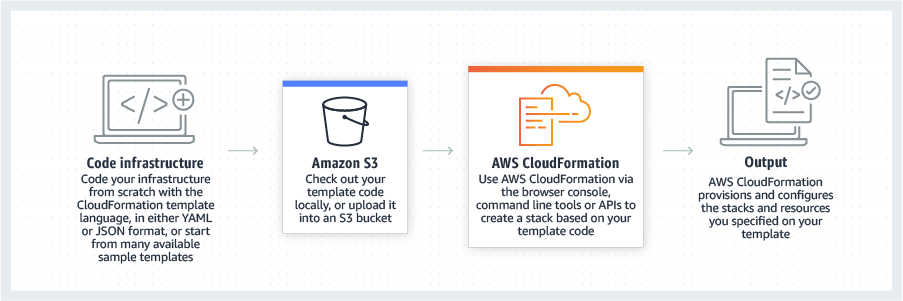
AWS CloudFormation gives developers and systems administrators a way to create and manage a collection of related AWS resources, provisioning and updating them in a predictable fashion. Use AWS CloudFormation’s sample templates or create templates to describe the AWS resources, and any associated dependencies or runtime parameters, required to run an application. Users don’t need to figure out the order for provisioning AWS services or the subtleties of making those dependencies work.…
$0
Google Cloud AI
Score 8.2 out of 10
N/A
Google Cloud AI provides modern machine learning services, with pre-trained models and a service to generate tailored models.
N/A
TensorFlow
Score 7.7 out of 10
N/A
TensorFlow is an open-source machine learning software library for numerical computation using data flow graphs. It was originally developed by Google.
N/A
Pricing
AWS CloudFormation
Google Cloud AI
TensorFlow
Editions & Modules
Free Tier - 1,000 Handler Operations per Month per Account
$0.00
Handler Operation
$0.0009
per handler operation
No answers on this topic
No answers on this topic
Offerings
Pricing Offerings
AWS CloudFormation
Google Cloud AI
TensorFlow
Free Trial
Yes
No
No
Free/Freemium Version
Yes
No
No
Premium Consulting/Integration Services
Yes
No
No
Entry-level Setup Fee
No setup fee
No setup fee
No setup fee
Additional Details
There is no additional charge for using AWS CloudFormation with resource providers in the following namespaces: AWS::*, Alexa::*, and Custom::*. In this case you pay for AWS resources (such as Amazon EC2 instances, Elastic Load Balancing load balancers, etc.) created using AWS CloudFormation as if you created them manually. You only pay for what you use, as you use it; there are no minimum fees and no required upfront commitments.
When you use resource providers with AWS CloudFormation outside the namespaces mentioned above, you incur charges per handler operation. Handler operations are create, update, delete, read, or list actions on a resource.
Google's documentation for their AI and Machine Learning products is a bit more straightforward and still much easier to onboard into compared to the Azure Machine Learning and other AI products. Additionally, Google's Cloud AI products provide more comprehensive specific …
I still give it an 8 because it's one of those tools that just quietly does the heavy lifting for you but it can really test your patience when it breaks esp with deep nested stacks. It's perfect for projects where we need clean consistent environments every time. It's less ideal for quick experimental setups like new EC2 configs or Lambda permission tweaks.
Google Cloud AI is a wonderful product for companies that are looking to offset AI and ML processing power to cloud APIs, and specific Machine Learning use cases to APIs as well. For companies that are looking for very specific, customized ML capabilities that require lots of fine-tuning, it may be better to do this sort of processing through open-source libraries locally, to offset the costs that your company might incur through this API usage.
TensorFlow is great for most deep learning purposes. This is especially true in two domains: 1. Computer vision: image classification, object detection and image generation via generative adversarial networks 2. Natural language processing: text classification and generation. The good community support often means that a lot of off-the-shelf models can be used to prove a concept or test an idea quickly. That, and Google's promotion of Colab means that ideas can be shared quite freely. Training, visualizing and debugging models is very easy in TensorFlow, compared to other platforms (especially the good old Caffe days). In terms of productionizing, it's a bit of a mixed bag. In our case, most of our feature building is performed via Apache Spark. This means having to convert Parquet (columnar optimized) files to a TensorFlow friendly format i.e., protobufs. The lack of good JVM bindings mean that our projects end up being a mix of Python and Scala. This makes it hard to reuse some of the tooling and support we wrote in Scala. This is where MXNet shines better (though its Scala API could do with more work).
Some of the build in/supported AI modules that can be deployed, for example Tensorflow, do not have up-to-date documentation so what is actually implemented in the latest rev is not what is mentioned in the documentation, resulting in a lot of debugging time.
Customization of existing modules and libraries is harder and it does need time and experience to learn.
Google Cloud AI can do a better job in providing better support for Python and other coding languages.
Theano is perhaps a bit faster and eats up less memory than TensorFlow on a given GPU, perhaps due to element-wise ops. Tensorflow wins for multi-GPU and “compilation” time.
We are extremely satisfied with the impact that this tool has made on our organization since we have practically moved from crawling to walking in the process of generating information for our main task to investigate in the field through interviews. With the audio to text translation tool there is a difference from heaven to earth in the time of feeding our internal data.
It's easy enough to get a shared template & apply it. You don't even have to download-then-upload or copy-and-paste, a publicly-accessible url works.
Diving deeper, it has enough powerful capabilities to make the life of a platform / DevOps engineer bearable.
However, you need equally deep knowledge to troubleshoot issues, when they inevitably pop up. This is the same for all IaC technologies, as they are additional abstraction layers on top of the native API provided by the cloud providers.
I give 8 because although it´s a tool I really enjoy working with, I think Google Cloud AI's impact is just starting, therefore I can visualize a lot/space of improvements in this tool. As an example the application of AI in international environments with different languages is a good example of that space/room to improve.
Every rep has been nice and helpful whenever I call for help. One of the systems froze and wouldn't start back up and with the help of our assigned rep we got everything back up in a timely manner. This helped us not lose customers and money.
Community support for TensorFlow is great. There's a huge community that truly loves the platform and there are many examples of development in TensorFlow. Often, when a new good technique is published, there will be a TensorFlow implementation not long after. This makes it quick to ally the latest techniques from academia straight to production-grade systems. Tooling around TensorFlow is also good. TensorBoard has been such a useful tool, I can't imagine how hard it would be to debug a deep neural network gone wrong without TensorBoard.
In fact, you only need the basic tech knowledge to do a Google search. You need to know if your organization requires it or not,. our organization required it. And that is why we acquired it and solved a need that we had been suffering from. This is part of the modernization of an organization and part of its growth as a company.
Cloning a virtual machine creates a virtual machine that is cloning a virtual machine creates a virtual machine that is a copy of the original. The new virtual machine is configured with the same virtual hardware, installed software, and other properties that were configured for the original virtual machine. For information about persistent memory and PMem storage, see the vSphere Cloning a virtual machine creates a virtual machine that is a copy of the original. The new virtual machine is configured with the same virtual hardware, installed software, and other properties that were configured for the original virtual machine. For information. Management guide.For information copy of the original. The new virtual Cloning virtual machine creates a virtual machine that is a copy of the original. The new virtual machine is configured with the same virtual hardware, installed software, and other properties that were configured for the original virtual machine. For information about persistent memory and PMem storage, see the vSphere Resource Management Guide. For information is configured with the same virtual hardware, installed software, and other properties that were configured for the original virtual machine. For information about persistent memory and PMem storage, see the vSphere Resource Management Guide. For information
These are basic tools although useful, you can't simply ignore them or say they are not good. These tools also have their own values. But, Yes, Google is an advanced one, A king in the field of offering a wide range of tools, quality, speed, easy to use, automation, prebuild, and cost-effective make them a leader and differentiate them from others.
Keras is built on top of TensorFlow, but it is much simpler to use and more Python style friendly, so if you don't want to focus on too many details or control and not focus on some advanced features, Keras is one of the best options, but as far as if you want to dig into more, for sure TensorFlow is the right choice
Artificial intelligence and automation seems 'free' and draws the organization in, without seeming to spend a lot of funds. A positive impact, but who is actually tracking the cost?
We want our employees to use it, but many resist technology or are scared of it, so we need a way to make them feel more comfortable with the AI.
The ROI seems positive since we are full in with Google, and the tools come along with the functionality.