Overview
ProductRatingMost Used ByProduct SummaryStarting Price
AWS CloudFormation
Score 8.6 out of 10
N/A
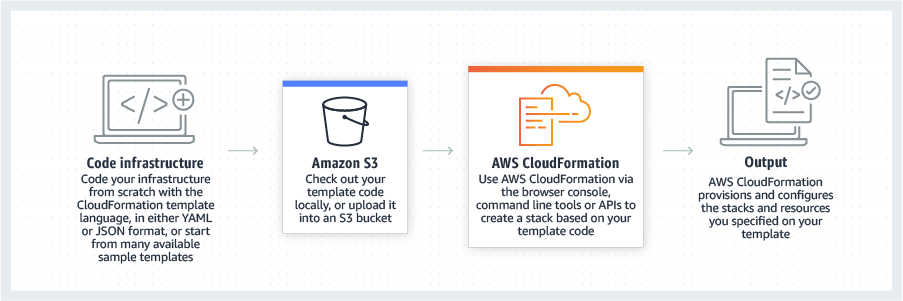
AWS CloudFormation gives developers and systems administrators a way to create and manage a collection of related AWS resources, provisioning and updating them in a predictable fashion. Use AWS CloudFormation’s sample templates or create templates to describe the AWS resources, and any associated dependencies or runtime parameters, required to run an application. Users don’t need to figure out the order for provisioning AWS services or the subtleties of making those dependencies work.…
$0
Perforce Puppet
Score 8.5 out of 10
N/A
Puppet Enteprise is an IT automation and configuration management solution that enables users to manage and automate infrastructure and complex workflows. The vendor states Puppet Enterprise combines both model‑based and task-based capabilities in a way that enables organizations to scale their multi-cloud infrastructure as their automation footprint grows, with more flexibility from both agent-based and agentless capabilities.N/A
Ansible
Score 9.0 out of 10
N/A
The Red Hat Ansible Automation Platform (acquired by Red Hat in 2015) is a foundation for building and operating automation across an organization. The platform includes tools needed to implement enterprise-wide automation, and can automate resource provisioning, and IT environments and configuration of systems and devices. It can be used in a CI/CD process to provision the target environment and to then deploy the application on it.
$5,000
per year
Pricing
AWS CloudFormationPerforce PuppetRed Hat Ansible Automation Platform
Editions & Modules
Free Tier - 1,000 Handler Operations per Month per Account
$0.00
Handler Operation
$0.0009
per handler operation
No answers on this topic
Basic Tower
5,000
per year
Enterprise Tower
10,000
per year
Premium Tower
14,000
per year
Offerings
Pricing Offerings
AWS CloudFormationPerforce PuppetAnsible
Free Trial
YesNoNo
Free/Freemium Version
YesNoNo
Premium Consulting/Integration Services
YesNoNo
Entry-level Setup FeeNo setup feeNo setup feeNo setup fee
Additional DetailsThere is no additional charge for using AWS CloudFormation with resource providers in the following namespaces: AWS::*, Alexa::*, and Custom::*. In this case you pay for AWS resources (such as Amazon EC2 instances, Elastic Load Balancing load balancers, etc.) created using AWS CloudFormation as if you created them manually. You only pay for what you use, as you use it; there are no minimum fees and no required upfront commitments. When you use resource providers with AWS CloudFormation outside the namespaces mentioned above, you incur charges per handler operation. Handler operations are create, update, delete, read, or list actions on a resource.
More Pricing Information
Community Pulse
AWS CloudFormationPerforce PuppetRed Hat Ansible Automation Platform
Considered Multiple Products
AWS CloudFormation
Chose AWS CloudFormation
The only real comparison would be to Terraform, which is another IaC technology at the infra level. Terraform is cloud-agnostic, which means most popular cloud providers are supported. While AWS CloudFormation is AWS-only. Although, if you consider CDK, CDK for Terraform …
Chose AWS CloudFormation
As we have our whole infrastructure on AWS, that is why we selected AWS CloudFormation. AWS CloudFormation is better integrated with AWS services than other available products and also provides visibility and tracking on AWS. AWS CloudFormation is free while Terraform
Perforce Puppet
Chose Perforce Puppet
As I mentioned before Ansible is a great tool. There is no question about it. It has very simple syntax (YAML), is very easy to learn, and is scalable as well. But the only thing that Ansible lacked at that time was the actual agent that have to go into each server. Ansible
Chose Perforce Puppet
[Both] products are comparable. There is a good open source community for each, but we found Puppet to be the most mature for our specific use case.
Chose Perforce Puppet
I have not used any other Configuration Management System since cfengine back in about 2007 so I have little current input on alternatives to Puppet having never used them, though Chef seems to have gained some traction as has Ansible.
Chose Perforce Puppet
We evaluated Chef and Ansible. Puppet Data Center Automation was cleaner and we were more familiar with the product.
Chose Perforce Puppet
Puppet has a very wide user base with many organizations tht support it as well as conferences and events. Puppet DSL is based in Ruby while the server is now in Clojure providing ease of configuration with the power of scale. Puppet is a great entry point into the world of …
Ansible
Chose Red Hat Ansible Automation Platform
One of these is already included in our license and the other is not. The agent based model makes access management to servers simpler. The agentless model makes things more flexible and secure for large organizations
Chose Red Hat Ansible Automation Platform
Puppet has Red Hat Ansible Automation Platform beat on metrics. This isn't a fair comparison due to the agent oriented nature of puppet. Ansible is much smoother to start using and appreciably faster to install, configure and role into small groups of systems. I no longer use …
Chose Red Hat Ansible Automation Platform
Puppet has more features, lower costs, and greater flexibility.
Chose Red Hat Ansible Automation Platform
AAP delivered a more complete solution at all steps of our process across different silos.
Chose Red Hat Ansible Automation Platform
AAP is much easier to use/configure/maintain.
Chose Red Hat Ansible Automation Platform
We were Puppet users. Red Hat Ansible Automation Platform made more sense to us because of the focus on Ansible content to support our AIX systems and RHEL systems. We have also seen that the learning curve for Red Hat Ansible Automation Platform is better than we experienced …
Chose Red Hat Ansible Automation Platform
Ansible is much easier to use and configure than Puppet.
Chose Red Hat Ansible Automation Platform
It was much simpler to deploy and use Red Hat Ansible Automation Platform in our enterprise environment. Red Hat has great training to get our users up to speed. YAML is easy to write (although watch out for spacing) and run playbooks. We can easily generate infrastructure …
Chose Red Hat Ansible Automation Platform
All three of these competitors are agent based. I did not want an additional service that needed to run absolutely everywhere. I also did not want to maintain a load balanced cluster of master servers that grows in resource requirements as your infrastructure scales.
Chose Red Hat Ansible Automation Platform
My experience with Puppet and Chef is limited, but as a total non-programmer Ansible was just worlds easier for me to implement.
Chose Red Hat Ansible Automation Platform
Ansible is much easier than Puppet, more enterprises are switching from Puppet to Ansible due to ease of use. Ansible has integration modules which allow you to transition from Puppet or Chef to Ansible. IT Automation space has a CAGR of 200%+ what are you doing to not get left …
Chose Red Hat Ansible Automation Platform
Ansible has unique features in terms of server managing and configuring. It is easy to use and fits the Red Hat Linux well since they are closely related. Our servers are mostly Red Hat, so it makes sense to use Ansible. But we are still exploring which is the best.
Chose Red Hat Ansible Automation Platform
Ansible is a great product, which we really love as it is compatible running along side and with other DevOps tool. The integration features allows other teams to participate in our shared objective. Ansible is easy to use as many programmers are familiar with Python and RHEL. …
Chose Red Hat Ansible Automation Platform
In the time of integration, we chose Ansible instead of Puppet because it was simpler to use, based on Python and didn't require additional server environments to run. Of course, there are a lot of different alternatives like Chef or Salt Stack.
Chose Red Hat Ansible Automation Platform
Ansible is sufficient for our purposes because our configurations are relatively simple. Chef and Puppet would work better for more complex configurations. Also, our applications are deployed using Docker which simplifies our configuration requirements. An organization with …
Chose Red Hat Ansible Automation Platform
I haven't used Puppet personally, but I believe Ansible is a robust solution which can serve many purposes. Puppet I'm sure is customizable in similar ways, I just don't have the experience to speak intelligently on the subject.
Chose Red Hat Ansible Automation Platform
I have used Puppet, Chef during my career and Ansible seems to be the most efficient tool by far, in terms of its implementation, configuration and ease of use.
Features
AWS CloudFormationPerforce PuppetRed Hat Ansible Automation Platform
Configuration Management
Comparison of Configuration Management features of Product A and Product B
AWS CloudFormation
8.2
2 Ratings
2% above category average
Perforce Puppet
-
Ratings
Red Hat Ansible Automation Platform
8.1
214 Ratings
1% above category average
Infrastructure Automation8.52 Ratings00 Ratings8.8204 Ratings
Automated Provisioning8.52 Ratings00 Ratings8.2204 Ratings
Parallel Execution8.02 Ratings00 Ratings8.5191 Ratings
Node Management7.52 Ratings00 Ratings8.3181 Ratings
Reporting & Logging7.52 Ratings00 Ratings7.3199 Ratings
Version Control9.02 Ratings00 Ratings7.3182 Ratings
Best Alternatives
AWS CloudFormationPerforce PuppetRed Hat Ansible Automation Platform
Small Businesses
HashiCorp Vagrant
HashiCorp Vagrant
Score 10.0 out of 10
HashiCorp Vagrant
HashiCorp Vagrant
Score 10.0 out of 10
HashiCorp Vagrant
HashiCorp Vagrant
Score 10.0 out of 10
Medium-sized Companies
Ansible
Ansible
Score 9.0 out of 10
Ansible
Ansible
Score 9.0 out of 10
Automox
Automox
Score 8.9 out of 10
Enterprises
Ansible
Ansible
Score 9.0 out of 10
Ansible
Ansible
Score 9.0 out of 10
Automox
Automox
Score 8.9 out of 10
All AlternativesView all alternativesView all alternativesView all alternatives
User Ratings
AWS CloudFormationPerforce PuppetRed Hat Ansible Automation Platform
Likelihood to Recommend
8.0
(7 ratings)
7.0
(12 ratings)
9.3
(169 ratings)
Likelihood to Renew
-
(0 ratings)
-
(0 ratings)
9.9
(5 ratings)
Usability
8.0
(2 ratings)
-
(0 ratings)
8.2
(57 ratings)
Performance
-
(0 ratings)
-
(0 ratings)
8.7
(5 ratings)
Support Rating
-
(0 ratings)
8.0
(1 ratings)
8.0
(5 ratings)
Implementation Rating
-
(0 ratings)
-
(0 ratings)
8.0
(2 ratings)
Ease of integration
-
(0 ratings)
-
(0 ratings)
8.6
(5 ratings)
User Testimonials
AWS CloudFormationPerforce PuppetRed Hat Ansible Automation Platform
Likelihood to Recommend
Amazon AWS
I still give it an 8 because it's one of those tools that just quietly does the heavy lifting for you but it can really test your patience when it breaks esp with deep nested stacks. It's perfect for projects where we need clean consistent environments every time. It's less ideal for quick experimental setups like new EC2 configs or Lambda permission tweaks.
Read full review
Perforce Software
Puppet is good enough to get the job done, you can use it to automate deployments and maintain files and configurations, if this is all you're looking for it's great. If you're looking for more control over your systems as a whole without having to write your own scripts or install multiple configuration management systems then Puppet is not what you're looking for.
Read full review
Red Hat
I think it's the best defacto orchestrator for automation because it's so easy to integrate in other tools to it (dynatrace, cyberark, terraform, etc). It is a lot for a new or smaller team to use so I wouldn't recommend it to a new team using Ansible, in that case using Ansible navigator is a better start to understanding playbooks/inventories before diving into the complexity of Red Hat Ansible Automation Platform. EDA also takes a lot of connectivity between Red Hat Ansible Automation Platform and target systems to get working which can be difficult in very locked down envs unless you have approval from many other teams like networking and security.
Read full review
Pros
Amazon AWS
  • All resources can segregated based on stacks which provides greater visibility
  • A complete audit trail of what went wrong while deploying a particular resource
  • Automatically rollbacks if any service as part of CloudFormation results in an error
  • The UI tool is useful
Read full review
Perforce Software
  • Provides a clear map of how a system is configured
  • Eases the creation of a system in a specific cluster as it is scripted in code
  • Simplifies configuration changes to a cluster or to every system such as rolling out vhost configurations, updating ldap roles, NFS mounts, etc
  • The syntax is very easy to read and carries a lot of fluidity once the language is learned.
Read full review
Red Hat
  • Standardize controls and visibility for automation.
  • Provide RBAC and Vault for improved automation security and support.
  • Job Scheduling is much more effective than Cron or other home-grown solutions.
  • The Red Hat Ansible Automation Platform API is one of the best features as it makes automation accessible from any other platform.
Read full review
Cons
Amazon AWS
  • Error Description upon Failure Needs to be Improved.
  • Slow to create, delete or update.
  • Need to delete resources manually. It can ask before starting deletion whether to skip those resources or delete them.
Read full review
Perforce Software
  • The setup of Puppet is a nightmare compared to ansible. Anyone watching a youtube video can easily set up ansible with minimal IT knowledge. All one needs is the source IP addresses and we are good to go. Setting up Puppet is a more hands-on task and pushing the puppet agents to all the boxes is another issue. If the installation and setup were simplified like ansible that would attract a lot of people to this platform
  • The syntax of the code for Puppet is not as easy as ansible. Ansible simply follows a YAML format and it's like typing in normal English. Even complicated tasks can be written by just understanding YAML syntax. Perhaps Puppet needs to revisit the lanugage used and try to come up with a much simpler lanugage for writing code. This will make day-to-day usage easier.
Read full review
Red Hat
  • Ansible is still not truly declarative like Terraform.
  • Simple automation is fine, but creating complex, scalable automation scripts is very difficult to learn.
  • For a higher number of nodes, Ansible consumes a lot of resources. It needs the paid version of AAP, which requires a cost.
Read full review
Likelihood to Renew
Amazon AWS
No answers on this topic
Perforce Software
No answers on this topic
Red Hat
We are extremely happy with the use of AAP. It's better than expected, There is almost no limit when thinking of automation. The only problem is that the day to day is consuming a big part of our time. Patching and checking vulnerabilities are virtually killing us. But we can only improve with AAP.
Read full review
Usability
Amazon AWS
It's easy enough to get a shared template & apply it. You don't even have to download-then-upload or copy-and-paste, a publicly-accessible url works.
Diving deeper, it has enough powerful capabilities to make the life of a platform / DevOps engineer bearable.
However, you need equally deep knowledge to troubleshoot issues, when they inevitably pop up. This is the same for all IaC technologies, as they are additional abstraction layers on top of the native API provided by the cloud providers.
Read full review
Perforce Software
No answers on this topic
Red Hat
Everything has room for improvement, but Ansible is the best tool out there for what it does and what it can do. There are plenty of features and capabilities that can be added, but it's just a matter of time before it happens.
Read full review
Performance
Amazon AWS
No answers on this topic
Perforce Software
No answers on this topic
Red Hat
Great in almost every way compared to any other configuration management software. The only thing I wish for is python3 support. Other than that, YAML is much improved compared to the Ruby of Chef. The agentless nature is incredibly convenient for managing systems quickly, and if a member of your term has no terminal experience whatsoever they can still use the UI.
Read full review
Support Rating
Amazon AWS
No answers on this topic
Perforce Software
Puppet has top class support. You can simply mail them with their query and they will respond to your query in a timely manner. We do have enterprise license for puppet. Also there is a vibrant community for puppet out there. So even if you dont purchase a premium support option you can simply google your queries and get answers
Read full review
Red Hat
There is a lot of good documentation that Ansible and Red Hat provide which should help get someone started with making Ansible useful. But once you get to more complicated scenarios, you will benefit from learning from others. I have not used Red Hat support for work with Ansible, but many of the online resources are helpful.
Read full review
Implementation Rating
Amazon AWS
No answers on this topic
Perforce Software
No answers on this topic
Red Hat
I spoke on this topic today!
Read full review
Alternatives Considered
Amazon AWS
Cloning a virtual machine creates a virtual machine that is cloning a virtual machine creates a virtual machine that is a copy of the original. The new virtual machine is configured with the same virtual hardware, installed software, and other properties that were configured for the original virtual machine. For information about persistent memory and PMem storage, see the vSphere Cloning a virtual machine creates a virtual machine that is a copy of the original. The new virtual machine is configured with the same virtual hardware, installed software, and other properties that were configured for the original virtual machine. For information. Management guide.For information copy of the original. The new virtual Cloning virtual machine creates a virtual machine that is a copy of the original. The new virtual machine is configured with the same virtual hardware, installed software, and other properties that were configured for the original virtual machine. For information about persistent memory and PMem storage, see the vSphere Resource Management Guide. For information is configured with the same virtual hardware, installed software, and other properties that were configured for the original virtual machine. For information about persistent memory and PMem storage, see the vSphere Resource Management Guide. For information
Read full review
Perforce Software
HPSA is a licensed product and incurs significant upfront investment costs due to COTS licensing. Puppet Data Center Automation has a significantly lower upfront investment and product documentation is more readily available. Chef is a very similar offering, however, at the time our decision was considered, the adoption of Chef vs. Puppet was significantly less in the community.
Read full review
Red Hat
AAP compares favorably with Terraform and Power Automate. I don't have much experience with Terraform, but I find AAP and Ansible easier to use as well as having more capabilities. Power Platform is also an excellent automation tool that is user friendly but I feel that Ansible has more compatibility with a variety of technologies.
Read full review
Return on Investment
Amazon AWS
  • + We can standup a VPC in minutes
  • - It took a lot of inital time to set up
  • + With logging/rollback, made testing much easier.
Read full review
Perforce Software
  • Cut deployment times down to around 1 hour from 4-5 hours.
  • Allows us to get a fully running system up from scratch in around 30 minutes.
  • Allows for a more clear view of what is required to get a host running.
Read full review
Red Hat
  • First, it keeps our entire server infrastructure aligned with our standards and reduces the time and effort needed to maintain our systems.
  • Automate routine IT tasks to save time, reduce errors, and ensure every server is configured and updated consistently.
  • Tasks that used to take our teams weeks to complete manually now run automatically and reliably, with full visibility, making our infrastructure management more effective and our compliance tracking much easier.
Read full review
ScreenShots

AWS CloudFormation Screenshots

Screenshot of CloudFormation - How it works overviewScreenshot of CloudFormation - High level how it worksScreenshot of CloudFormation - Template exampleScreenshot of CloudFormation - Template inputs overview