Azure DevOps (formerly VSTS, Microsoft Visual Studio Team System) is an agile development product that is an extension of the Microsoft Visual Studio architecture. Azure DevOps includes software development, collaboration, and reporting capabilities.
$2
per GB (first 2GB free)
Hatica
Score 9.4 out of 10
N/A
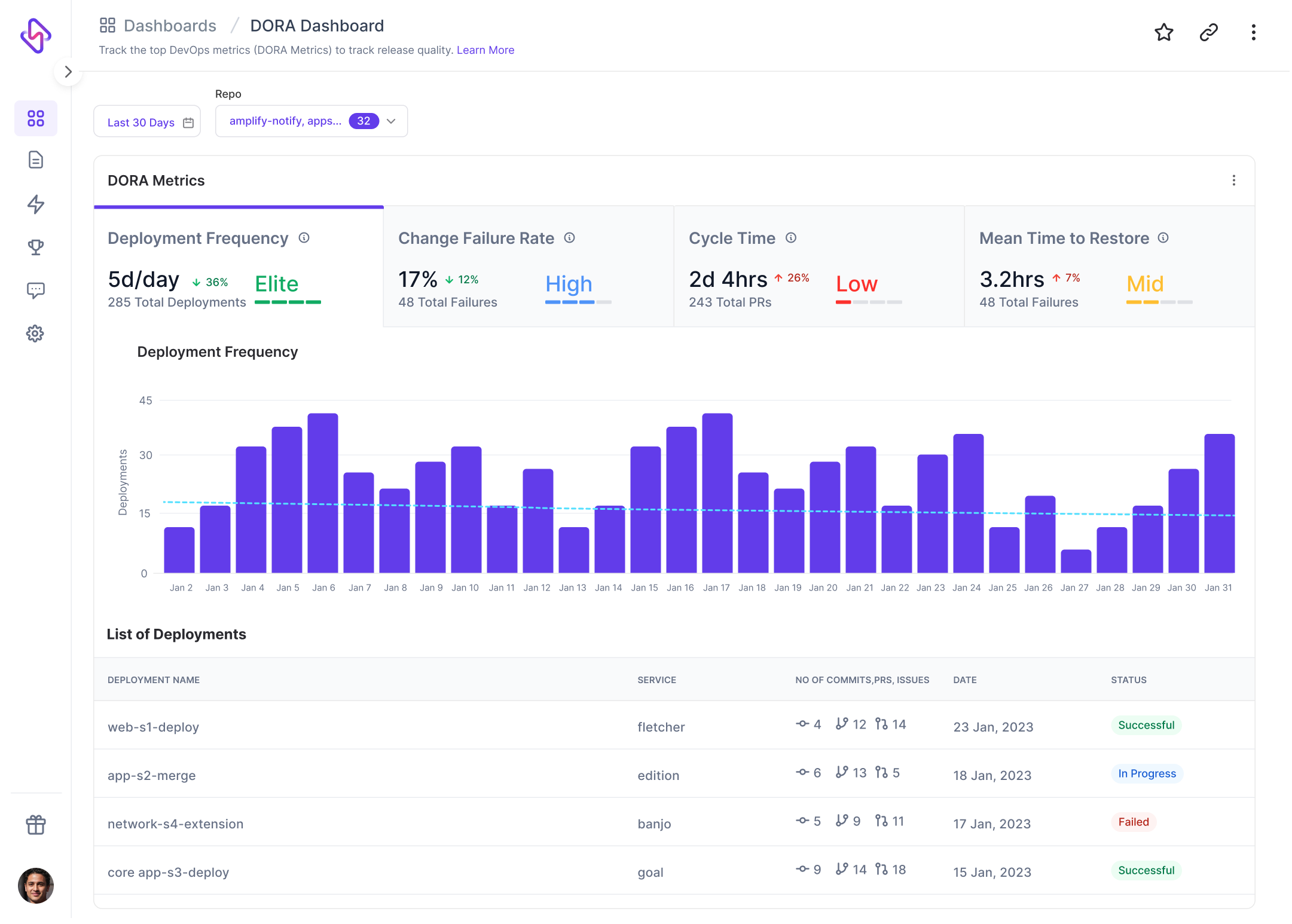
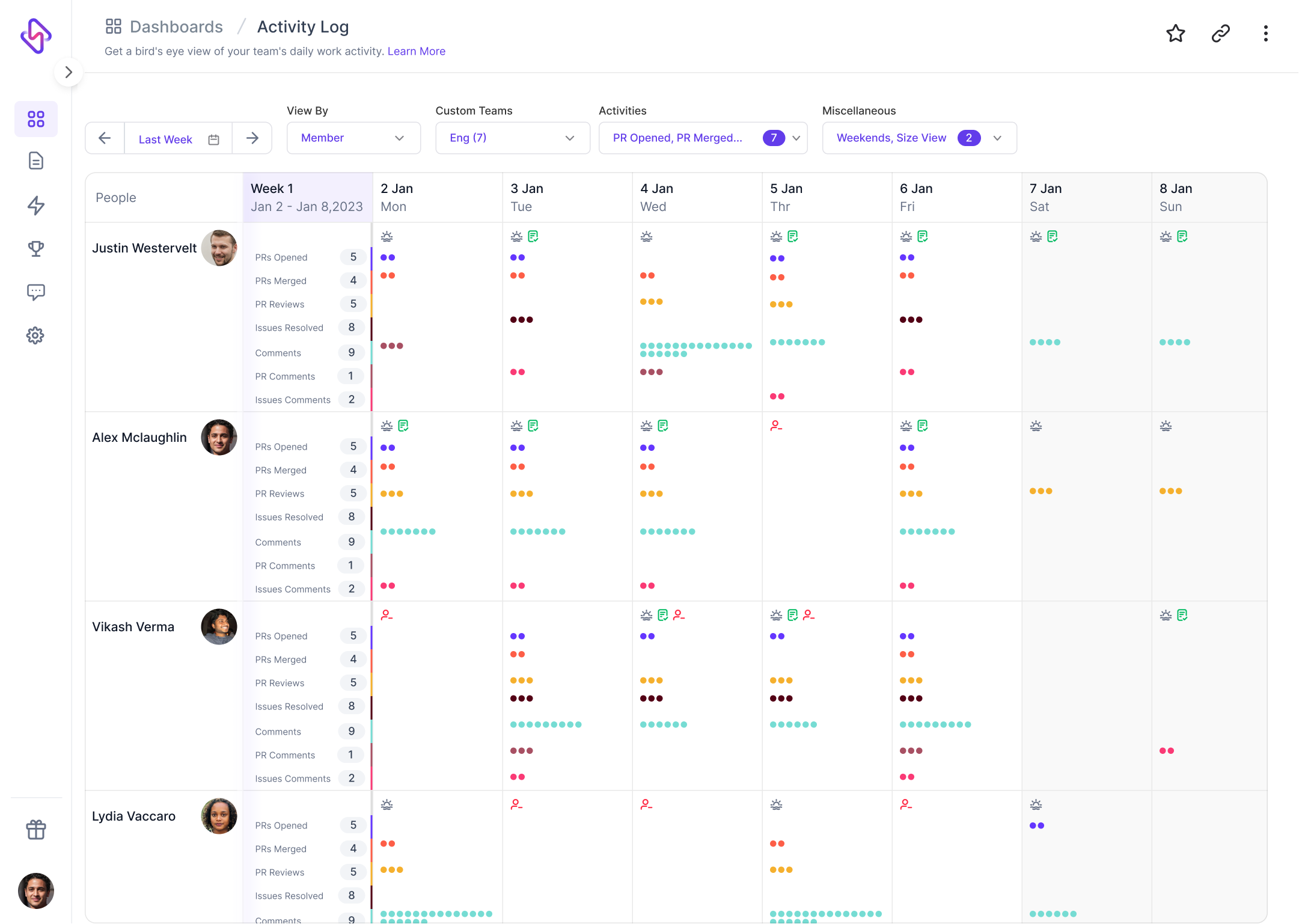
Hatica equips engineering teams with work visibility dashboards, actionable insights and workflows to drive team productivity and engagement in remote and in-office environments alike. The vendor offers a free forever plan to help get started. Features: Engineering metrics dashboards 100+ metrics from 20+ apps including Github, Jira, Slack, Zoom, Google Workplace Remote work insights Aggregated work overview, sprint and retro…
N/A
Pricing
Azure DevOps
Hatica
Editions & Modules
Azure Artifacts
$2
per GB (first 2GB free)
Basic Plan
$6
per user per month (first 5 users free)
Azure Pipelines - Self-Hosted
$15
per extra parallel job (1 free parallel job with unlimited minutes)
Azure Pipelines - Microsoft Hosted
$40
per parallel job (1,800 minutes free with 1 free parallel job)
Basic + Test Plan
$52
per user per month
No answers on this topic
Offerings
Pricing Offerings
Azure DevOps
Hatica
Free Trial
No
Yes
Free/Freemium Version
No
Yes
Premium Consulting/Integration Services
No
No
Entry-level Setup Fee
No setup fee
Optional
Additional Details
—
—
More Pricing Information
Community Pulse
Azure DevOps
Hatica
Considered Both Products
Azure DevOps
Verified User
Anonymous
Chose Azure DevOps
This is the first platform our dev team shared to us so I can't really compare but overall its such a great tool to have even if you are not from tech or dev team.
We would use App Center for distributing our app to testers, and we could implement the same functionality as was handled by App Center, and as far as I remember we even had some automatic conversion of our jobs from App Center. After the conversion, we could see that Azure …
We love the multi-tier hierarchy in Azure DevOps for tasks, with epics, features, stories, bugs and tasks all available in a nice nested hierarchy. It's not as pretty as Monday.com and doesn't work as well OOTB as ServiceNow SPM however.
It is a similar tools with its pros and cons but does not really a differential - I would say it does the same but its own way, sometimes better, other times worst. It is a matter of preference or demands that come from superior decisions, so you just have to take it.
Jira is fantastic for project management and customer facing portal. It is not good for pure development (no integration with Git, pipeline management, automated testing features). If DevOps were to integrate and adopt the project features of Jira as well as the customer facing …
The moment I have been working with this tool everything has benn operating efficiently. The software development process has borne positive results under scalable environment. The cost of running Azure DevOps Services us much lower as compared to other tools in the market. It …
ADO has better linking than Confluence and is adaptable for a specific need, whereas Confluence might be a bit more rigid, but it's also sort of along the same lines as to what can be done with both tools. ADO also had an ease of use to it and can do a bunch of stuff with it, …
Jira is super clunky and doesn't behave in a modern fashion. monday.com is too flexible and doesn't provide enough feature set. AWS is the most competitive, but it's hard to wrap your brain around all of the features and offerings provided by amazon. ADO does a better job of …
Azure DevOps has a drag and drop editor so that you can quickly drag build steps into a build or release pipeline. This is much faster than looking up the correct yaml syntax. Additionally, its support for Microsoft and Azure is great. If you're on the .net stack or you use …
Azure DevOps has more services and better integration with other tools. When it. Comes to the overall software development process management ecosystem.
Microsoft Planner is used by project managers and IT service managers across our organization for task tracking and running their team meetings. Azure DevOps works better than Planner for software development teams but might possibly be too complex for non-software teams or …
Trello is simple to use, but it's only for a Kanban board. Jira might be the same, but I don't really have enough experience with Jira to fully compare them. When I used it, it missed certain functionalities that I was used to in Azure DevOps. Visually it's a lot different too.
Azure DevOps Services have huge functionality and are well supported by Microsoft as well. You will get plenty of features in the marketplace and learning documentation.
Writing the Docker Images, Storing them in Azure Container Registry and then Deploying onto Azure Kubernetes Services is an Easier process which no other software/product is currently providing in the market. Best till date in terms of End to End deployment and maintaining …
Azure DevOps is widely used because of its collaboration and integration with various other tools. Here the assign of the sub task is quite easy compare to Jira. Also Azure Devops can we integrate easily with Git for better code representation and versioning. It reporting is …
Azure DevOps is a completed product and ecosystem. It offers a robust ecosystem that does everything that is needed. The above products do lack features like pipelines tasks, third-party integrations. Besides all cloud benefits, the main advantage of Azure DevOps Services …
Currently, we use both products, however, we use more the Atlassian suite. We have started recently using Azure DevOps for specific implementations and projects. We don't have any plan yet to migrate all our projects to Azure DevOps, we may in the next couple of years. …
We tested alternatives for Azure DevOps over time. We tested GitHub a while ago and back then lack of some features that now hast, like the project boards and private repositories. We will check GitHub next year.
We also tested AWS CodeCommit and found it very cryptic, …
Beside all cloud benefits, the main advantage Azure DevOps Services compared to Azure DevOps Server is the easier remote access for third party team members, and always up to date software. On the other hand, on prem deployment (Azure DevOps Server) makes complex access or …
The greatest strength of Azure DevOps Services (formerly VSTS) is that it's a one-stop solution for all agile project management instead of setting up bits of different software put together for each and every need. Azure DevOps Services (formerly VSTS) has a great ecosystem …
I prefer Azure Devops over all other code repository / ci/cd systems that I've used in the past. All features are integrated into a single service (back log, repo mgmt, deployment pipelines, artifacts, etc.). The tools are easy to use and super powerful.
Our company is already using a lot of Azure services and it makes more sense to start using Azure DevOps Services (formerly VSTS) when we needed a CI/CD tool. We tested different features of Azure DevOps Services (formerly VSTS) and found out that the build and release …
DevOps is much more user friendly than Git itself. There is a more GUI-centric interface, tighter integration with the Azure / Entra architecture. For those of use in the Microsoft-sphere, it really is excellent for code-centric project management. I rate this as an 8 because it does not seem quite as well suited for fully functional / non-code project aspects in implementation. Nor does it have customer / end-user portal / front end for easy reporting and insight.
Engineering team management can be done better if we use metrics and the SPACE metrics are the best in that aspect. This product follows that research to deliver great analytics for team management. We also really like that the support is very hands-on, integration happened without any glitches and works well with our stack
Flexible Requirements Hierarchy Management: AZDO makes it easy to track items such as features or epics as a flat list, or as a hierarchy in which you can track the parent-child relationship.
Fast Data Entry: AZDO was designed to facilitate quick data entry to capture work items quickly, while still enabling detailed capture of acceptance criteria and item properties.
Excel Integration: AZDO stands out for its integration with MS Excel, which enables quick updates for bulk items.
I did mention it has good visibility in terms of linking, but sometimes items do get lost, so if there was a better way to manage that, that would be great.
The wiki is not the prettiest thing to look at, so it could have refinements there.
There are so many metrics that you’re able to measure - it can get overwhelming at first
We had a walkthrough session with the founder that helped us approach the platform with more confidence so maybe they can include help documents for first-time users
I don't think our organization will stray from using VSTS/TFS as we are now looking to upgrade to the 2012 version. Since our business is software development and we want to meet the requirements of CMMI to deliver consistent and high quality software, this SDLC management tool is here to stay. In addition, our company uses a lot of Microsoft products, such as Office 365, Asp.net, etc, and since VSTS/TFS has proved itself invaluable to our own processes and is within the Microsoft family of products, we will continue to use VSTS/TFS for a long, long time.
It's a great help to get more information about new feature release and stay updated on what the dev team is working on. I like how easy it is to just login and read through the work items. Each work item has basic details: Title, Description, Assigned to, State, Area (what it belongs to), and iteration (when it’s worked on). See image above.They move through different states (New → Discovery → Ready for Prod → etc.).
When we've had issues, both Microsoft support and the user community have been very responsive. DevOps has an active developer community and frankly, you can find most of your questions already asked and answered there. Microsoft also does a better job than most software vendors I've worked with creating detailed and frequently updated documentation.
We love the multi-tier hierarchy in Azure DevOps for tasks, with epics, features, stories, bugs and tasks all available in a nice nested hierarchy. It's not as pretty as monday.com and doesn't work as well OOTB as ServiceNow SPM however.