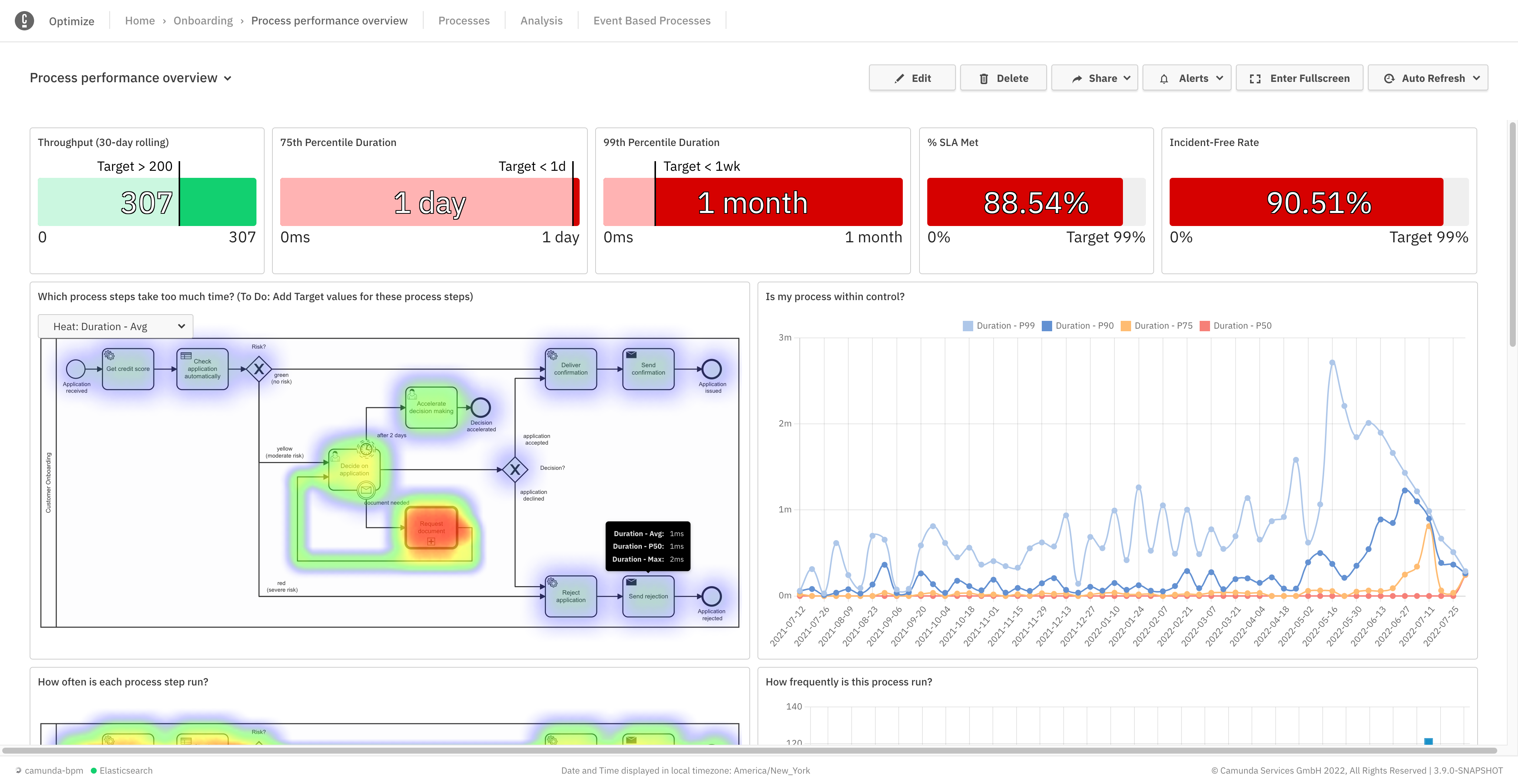
Camunda is a process orchestration tool designed to help organizations design, automate, and improve any process. Built for business and IT collaboration using BPMN and DMN standards, Camunda aims to enable seamless integration across endpoints to transform mission-critical processes.
N/A
IBM DevOps Code ClearCase
Score9.5 out of 10
N/A
An enterprise-grade configuration management system that provides controlled access to software assets.
N/A
Pricing
Camunda
IBM DevOps Code ClearCase
Editions & Modules
Self-Managed Enterprise
Contact Sales
per year
SaaS Enterprise
Contact Sales
per year
No answers on this topic
Offerings
Pricing Offerings
Camunda
IBM DevOps Code ClearCase
Free Trial
Yes
No
Free/Freemium Version
Yes
No
Premium Consulting/Integration Services
Yes
No
Entry-level Setup Fee
No setup fee
No setup fee
Additional Details
—
—
More Pricing Information
Features
Camunda
IBM DevOps Code ClearCase
Customization
Comparison of Customization features of Camunda and IBM DevOps Code ClearCase
Feature
Camunda
9.0
1 Ratings
21% above category average
IBM DevOps Code ClearCase
-
Ratings
API for custom integration
9.01 Ratings
00 Ratings
Reporting & Analytics
Comparison of Reporting & Analytics features of Camunda and IBM DevOps Code ClearCase
Feature
Camunda
8.0
1 Ratings
2% above category average
IBM DevOps Code ClearCase
-
Ratings
Dashboards
8.01 Ratings
00 Ratings
Standard reports
7.01 Ratings
00 Ratings
Custom reports
9.01 Ratings
00 Ratings
Process Engine
Comparison of Process Engine features of Camunda and IBM DevOps Code ClearCase
Feature
Camunda
8.5
2 Ratings
15% above category average
IBM DevOps Code ClearCase
-
Ratings
Process designer
9.02 Ratings
00 Ratings
Process simulation
9.01 Ratings
00 Ratings
Business rules engine
7.02 Ratings
00 Ratings
SOA support
9.02 Ratings
00 Ratings
Process player
9.02 Ratings
00 Ratings
Form builder
5.02 Ratings
00 Ratings
Model execution
10.02 Ratings
00 Ratings
Business Process Automation
Comparison of Business Process Automation features of Camunda and IBM DevOps Code ClearCase
Camunda Platform is well suited for scenarios where there are different stages in a business flow and the flow is driven by user action at each stage. For example placing of an order on an ecommerce platform. Depending on whether user was able to make the payment or not the workflow would go to dispatch or retry stage. Now the retry stage would trigger further actions like sending follow up emails etc. Likewise, dispatch stage would have a different set of actions. Since every order is important and we need to know where it stands, using Camunda Platform is imperative. Camunda Platform might not be a right choice where just a one off thing needs to be done. For example, uploading of product information by user or periodic processing of heavy images by a worker. These are all either one step processes or periodic automated processes where we can track the status without using a business modeler like Camunda Platform.
A de minimis incentive was given to thank the reviewer for their time. The incentive was not used to bias or drive a particular response, nor was the incentive contingent on a positive endorsement. More Info
IBM Rational ClearCase might be better suited for a smaller / simpler code base. Larger code bases really slow it down... but then again there are better alternatives out there for source control
A de minimis incentive was given to thank the reviewer for their time. The incentive was not used to bias or drive a particular response, nor was the incentive contingent on a positive endorsement. More Info
Rational ClearCase is excellent for handling versioning and branching. No other tool I've used has the depth that ClearCase has when it comes to handling complex branching scenarios and identifying where certain versions of particular files are within a particular configuration.
Rational ClearCase handles parallel development of many dependent applications really well.
The use of ClearCase Views to switch between projects and configurations is extremely convenient as opposed to the local workstation model of the competitors.
A de minimis incentive was given to thank the reviewer for their time. The incentive was not used to bias or drive a particular response, nor was the incentive contingent on a positive endorsement. More Info
A de minimis incentive was given to thank the reviewer for their time. The incentive was not used to bias or drive a particular response, nor was the incentive contingent on a positive endorsement. More Info
Lacks good documentation. Training and documentation is geared towards those who are already technically adept. Does not have as many data integrations as other full fledged products. Paid version of Camunda is not as fully fledged as other products.
A de minimis incentive was given to thank the reviewer for their time. The incentive was not used to bias or drive a particular response, nor was the incentive contingent on a positive endorsement. More Info
If development is centrallized to one location and your company releases hundreds of customized versions of your software per year, then ClearCase is the best tool for managing the complexity of multiple versions of customized software. If your company has globally distributed development, then I'd recommend Team Foundation Server over ClearCase. If your organization uses Agile Methodologies, then I'd recommend TFS with GIT.
A de minimis incentive was given to thank the reviewer for their time. The incentive was not used to bias or drive a particular response, nor was the incentive contingent on a positive endorsement. More Info
The positive impact is that we are able to ensure the business process is being followed and that results in orders getting processed successfully leading to customer satisfaction and revenue
Another positive impact is that we are able to track any anomalies and any errors in the order flow and retry them so that users don't have a negative experience.
A negative point is that it is an overhead to maintain so there is significant engineering effort getting invested there
A de minimis incentive was given to thank the reviewer for their time. The incentive was not used to bias or drive a particular response, nor was the incentive contingent on a positive endorsement. More Info
A de minimis incentive was given to thank the reviewer for their time. The incentive was not used to bias or drive a particular response, nor was the incentive contingent on a positive endorsement. More Info