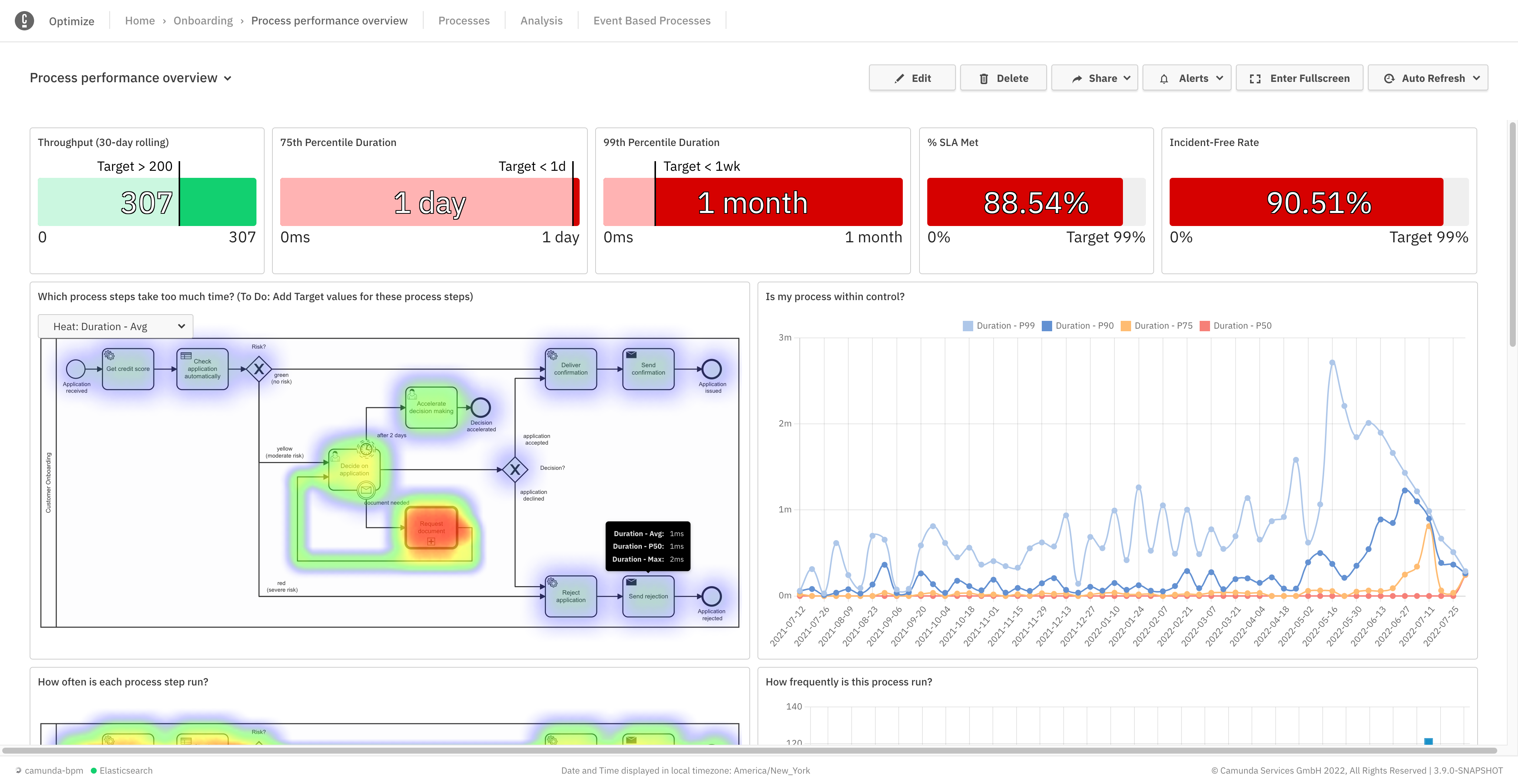
Camunda is a process orchestration tool designed to help organizations design, automate, and improve any process. Built for business and IT collaboration using BPMN and DMN standards, Camunda aims to enable seamless integration across endpoints to transform mission-critical processes.
N/A
Oracle SOA Suite
Score8 out of 10
N/A
The rapid adoption of cloud-based applications by the enterprise, combined with organizations’ desire to integrate applications with mobile technologies, is dramatically increasing application integration complexity. Oracle SOA Suite 12c, the latest version of the company's unified application integration and SOA solution, offers a simplified cloud, mobile, on-premises and Internet of Things (IoT) integration capabilities within a single platform.
N/A
Pricing
Camunda
Oracle SOA Suite
Editions & Modules
Self-Managed Enterprise
Contact Sales
per year
SaaS Enterprise
Contact Sales
per year
No answers on this topic
Offerings
Pricing Offerings
Camunda
Oracle SOA Suite
Free Trial
Yes
No
Free/Freemium Version
Yes
No
Premium Consulting/Integration Services
Yes
No
Entry-level Setup Fee
No setup fee
No setup fee
Additional Details
—
—
More Pricing Information
Features
Camunda
Oracle SOA Suite
Customization
Comparison of Customization features of Camunda and Oracle SOA Suite
Feature
Camunda
9.0
1 Ratings
21% above category average
Oracle SOA Suite
-
Ratings
API for custom integration
9.01 Ratings
00 Ratings
Reporting & Analytics
Comparison of Reporting & Analytics features of Camunda and Oracle SOA Suite
Feature
Camunda
8.0
1 Ratings
2% above category average
Oracle SOA Suite
-
Ratings
Dashboards
8.01 Ratings
00 Ratings
Standard reports
7.01 Ratings
00 Ratings
Custom reports
9.01 Ratings
00 Ratings
Process Engine
Comparison of Process Engine features of Camunda and Oracle SOA Suite
Feature
Camunda
8.5
2 Ratings
15% above category average
Oracle SOA Suite
-
Ratings
Process designer
9.02 Ratings
00 Ratings
Process simulation
9.01 Ratings
00 Ratings
Business rules engine
7.02 Ratings
00 Ratings
SOA support
9.02 Ratings
00 Ratings
Process player
9.02 Ratings
00 Ratings
Form builder
5.02 Ratings
00 Ratings
Model execution
10.02 Ratings
00 Ratings
Business Process Automation
Comparison of Business Process Automation features of Camunda and Oracle SOA Suite
Camunda Platform is well suited for scenarios where there are different stages in a business flow and the flow is driven by user action at each stage. For example placing of an order on an ecommerce platform. Depending on whether user was able to make the payment or not the workflow would go to dispatch or retry stage. Now the retry stage would trigger further actions like sending follow up emails etc. Likewise, dispatch stage would have a different set of actions. Since every order is important and we need to know where it stands, using Camunda Platform is imperative. Camunda Platform might not be a right choice where just a one off thing needs to be done. For example, uploading of product information by user or periodic processing of heavy images by a worker. These are all either one step processes or periodic automated processes where we can track the status without using a business modeler like Camunda Platform.
A de minimis incentive was given to thank the reviewer for their time. The incentive was not used to bias or drive a particular response, nor was the incentive contingent on a positive endorsement. More Info
Oracle service bus is great to quickly proxy any legacy services exposed as soap service. It's well suited for aggregating multiple services on a single endpoint. We can point to multiple endpoints on the business service and use a round-robin approach to access the endpoints. It's not well suited for data transformation and quick preview of mappings and transformations. It's not great on path to cloud transformation.
A de minimis incentive was given to thank the reviewer for their time. The incentive was not used to bias or drive a particular response, nor was the incentive contingent on a positive endorsement. More Info
The Oracle Service Bus makes the management of web services extremely easy. Through its point and click interface, the web service endpoints can be easily modified.
The administration console provides useful dashboards to diagnose any service issues.
A de minimis incentive was given to thank the reviewer for their time. The incentive was not used to bias or drive a particular response, nor was the incentive contingent on a positive endorsement. More Info
Message reporting tied to a database seems counter productive. Better options to eliminate that would not only minimize the maintenance hassle but also gives more ease to manage the product.
Polling feature isn't very efficient where the end point JMS queues may still have JMS connections despite not enabling the corresponding poller proxy services.
Unable to deploy multiple web services in one go from the OSB Web console.
A de minimis incentive was given to thank the reviewer for their time. The incentive was not used to bias or drive a particular response, nor was the incentive contingent on a positive endorsement. More Info
We have had not many issues with Oracle Service Bus and it's very stable for our requirements. It's highly available and helps us implement Tier1 applications on it.
A de minimis incentive was given to thank the reviewer for their time. The incentive was not used to bias or drive a particular response, nor was the incentive contingent on a positive endorsement. More Info
It's an excellent enterprise service bus and has very stable features. We have been using it since 2008. We did hit into some issues. But, recreating the service helped fix many issues. Also, deployment to various environments was easy. Also, the plugin on Eclipse helps to build proxy and business services quick and easy.
A de minimis incentive was given to thank the reviewer for their time. The incentive was not used to bias or drive a particular response, nor was the incentive contingent on a positive endorsement. More Info
We had some issues with MQ connectivity through OSB and our experience was poor with the support team. They do respond. But, it felt like we are ignored and we had bad support. We had to escalate and things used to get dragged for weeks before we get more quality questions on how to pursue investigation.
A de minimis incentive was given to thank the reviewer for their time. The incentive was not used to bias or drive a particular response, nor was the incentive contingent on a positive endorsement. More Info
Lacks good documentation. Training and documentation is geared towards those who are already technically adept. Does not have as many data integrations as other full fledged products. Paid version of Camunda is not as fully fledged as other products.
A de minimis incentive was given to thank the reviewer for their time. The incentive was not used to bias or drive a particular response, nor was the incentive contingent on a positive endorsement. More Info
A de minimis incentive was given to thank the reviewer for their time. The incentive was not used to bias or drive a particular response, nor was the incentive contingent on a positive endorsement. TR verified that a representative sample of customers was invited. More Info
The positive impact is that we are able to ensure the business process is being followed and that results in orders getting processed successfully leading to customer satisfaction and revenue
Another positive impact is that we are able to track any anomalies and any errors in the order flow and retry them so that users don't have a negative experience.
A negative point is that it is an overhead to maintain so there is significant engineering effort getting invested there
A de minimis incentive was given to thank the reviewer for their time. The incentive was not used to bias or drive a particular response, nor was the incentive contingent on a positive endorsement. More Info
A de minimis incentive was given to thank the reviewer for their time. The incentive was not used to bias or drive a particular response, nor was the incentive contingent on a positive endorsement. More Info