Cisco Application Centric Infrastructure (ACI) is network virtualization technology.
N/A
Cisco Identity Services Engine (ISE)
Score9 out of 10
N/A
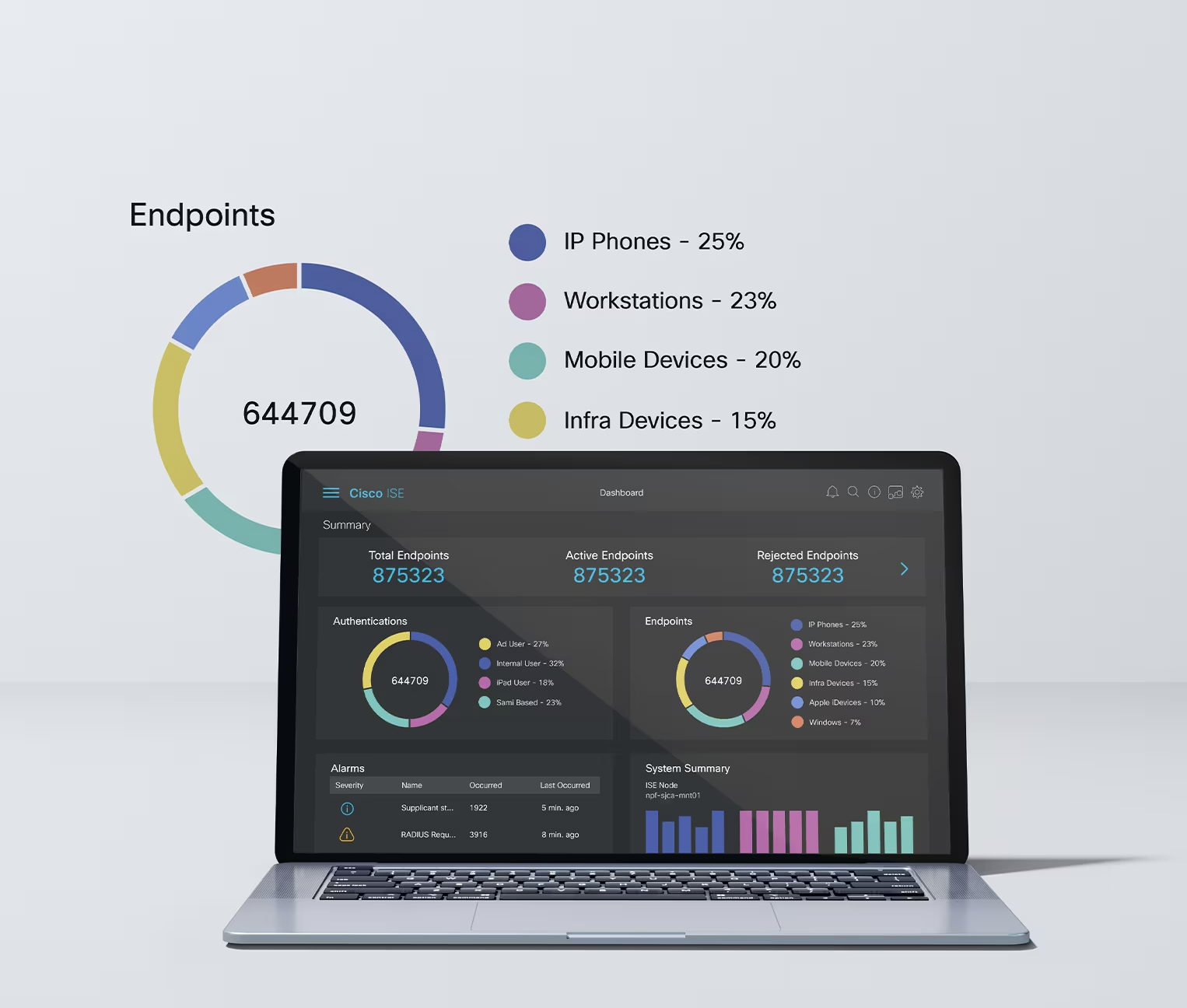
The Cisco Identity Services Engine (ISE) offers a network-based approach for adaptable, trusted access everywhere, based on context. It gives the user intelligent, integrated protection through intent-based policy and compliance solutions.
LAN, Storage network and compute were already Cisco so we moved from Nexus to Cisco Application Centric Infrastructure as natural alignment and simplified the dc operations.
A de minimis incentive was given to thank the reviewer for their time. The incentive was not used to bias or drive a particular response, nor was the incentive contingent on a positive endorsement. More Info
Verified User
Chose Cisco ACI
We haven't tried any thing else, it was the logical step forward from N7K.
A de minimis incentive was given to thank the reviewer for their time. The incentive was not used to bias or drive a particular response, nor was the incentive contingent on a positive endorsement. More Info
Verified User
Chose Cisco ACI
ACI is more mature compare to other cloud and fabric products. It's proven on the Cisco nxos and the engineers have the flexibility of knowing the system. Compared to the competition, TAC support is better for Cisco and the documentation covers good use cases. Power to extend …
A de minimis incentive was given to thank the reviewer for their time. The incentive was not used to bias or drive a particular response, nor was the incentive contingent on a positive endorsement. TR verified that a representative sample of customers was invited. More Info
Verified User
Chose Cisco ACI
Enable full automation of physical and virtual network. Legacy network devices can be physically connected to the fabric. Hardware routing is much more efficient than a software only network.
A de minimis incentive was given to thank the reviewer for their time. The incentive was not used to bias or drive a particular response, nor was the incentive contingent on a positive endorsement. More Info
A de minimis incentive was given to thank the reviewer for their time. The incentive was not used to bias or drive a particular response, nor was the incentive contingent on a positive endorsement. TR verified that a representative sample of customers was invited. More Info
Verified User
Chose Cisco Identity Services Engine (ISE)
We are using a lot of other Cisco solutions, so the integration between them became much better and easier and also gave us a relatively easy way of implementing network automation. We have planned to implement Software define network with the Cisco DNA Center, so Cisco …
A de minimis incentive was given to thank the reviewer for their time. The incentive was not used to bias or drive a particular response, nor was the incentive contingent on a positive endorsement. More Info
The ACI solution is perfectly fit for a large or multi-site data center environment. It permits simplifying deployment, management, automation, and security. ACI is especially valuable when strong scalability, automation, security, and segmentation are required. However, ACI is less suitable for a small environment due to its complexity and high cost.
A de minimis incentive was given to thank the reviewer for their time. The incentive was not used to bias or drive a particular response, nor was the incentive contingent on a positive endorsement. TR verified that a representative sample of customers was invited. More Info
Well suited... I've used it for both wired and wireless access, and it's perfect for that. In addition to enforcing security on the port, you can also lock down east-west traffic. When you get to the point where you're configuring secure group tags and things like that, you can keep people from getting to places they shouldn't. Basically, you could turn your entire network into a firewall if you wanted to. You can secure access based on the identity of any given user through role-based authentication. For example, if you have salespeople and you don't want them accessing your financial or PCI environment, they authenticate as a salesperson and you can completely stop them from getting to any of that. That's really important, especially for us. Our payment card infrastructure servers are heavily locked down. Granted, in our situation, we firewall all that off anyway, but you still don't want some random individual to be able to even attempt that sort of thing. That's what it's really good for. I'm trying to think of a weakness. I don't know. We don't really struggle with it. There's nothing that I use it for where I wish it were better, at least not that I can think of offhand. I'm sure there are things, I just can't think of anything off the top of my head.
A de minimis incentive was given to thank the reviewer for their time. The incentive was not used to bias or drive a particular response, nor was the incentive contingent on a positive endorsement. More Info
Cisco ACI, The object model is very complicated. It's something difficult to understand and also because there is a user interface, there's a web user interface, but it's not optimal to use it because if you want to deploy a large amount of VLAN or a large amount of tenants, it's quite difficult to do it or it's quite challenging. Maybe if you want to configure a large amount of ports using the web interface, it's not appropriate because it takes a lot of time. It also provides APIs to do that, but as I say, the object model is very difficult to understand and there is very little documentation about automation of the ACI and maybe there is but it's not so easy to find.
A de minimis incentive was given to thank the reviewer for their time. The incentive was not used to bias or drive a particular response, nor was the incentive contingent on a positive endorsement. TR verified that a representative sample of customers was invited. More Info
A de minimis incentive was given to thank the reviewer for their time. The incentive was not used to bias or drive a particular response, nor was the incentive contingent on a positive endorsement. TR verified that a representative sample of customers was invited. More Info
I think something I've just went to a session with hyper fabric and the ideas that hyper fabric has. Keep it really simple because Cisco ACI is a complex system and adopt some of the ideas behind hyper fabric, bring it to ACI that will be really beneficial. So as I said, automation is a great thing, but it's still, you need to have the background and the really complex stuff that happens behind the scenes to leverage the value of that solution. And by adding more simplicity to it, I think that will be a great thing. And also integrating with other applications in terms of the automation.
A de minimis incentive was given to thank the reviewer for their time. The incentive was not used to bias or drive a particular response, nor was the incentive contingent on a positive endorsement. TR verified that a representative sample of customers was invited. More Info
A de minimis incentive was given to thank the reviewer for their time. The incentive was not used to bias or drive a particular response, nor was the incentive contingent on a positive endorsement. More Info
Provided with the intensive fault isolation for the CISCO ACI, we are glad that we have this Data Center Solution in place and we will continue to renew as long as the future needed requirements are meet and more helpful features will be enabled in the future with the integration of security
A de minimis incentive was given to thank the reviewer for their time. The incentive was not used to bias or drive a particular response, nor was the incentive contingent on a positive endorsement. TR verified that a representative sample of customers was invited. More Info
A de minimis incentive was given to thank the reviewer for their time. The incentive was not used to bias or drive a particular response, nor was the incentive contingent on a positive endorsement. TR verified that a representative sample of customers was invited. More Info
You'll need a lot of training and hands on experience to get the most out of the product. There are a lot of very useful features in the ACI product. Often times there are a lot of ways to get to a solution for chalanges in the field. The solutions might be different eacht time. Knowing which one to implement is somtimes a challenge.
A de minimis incentive was given to thank the reviewer for their time. The incentive was not used to bias or drive a particular response, nor was the incentive contingent on a positive endorsement. More Info
For us the solution is very easily useable on its own. Perhaps that has to do because we started using ISE in the 1.2 days and have seen it grow during the years. Policy creation, etc. is all very visible and thus easy to use. Deployment of multiple nodes is also incredibly easy and flexible. You can easily add or remove nodes as you wish.
A de minimis incentive was given to thank the reviewer for their time. The incentive was not used to bias or drive a particular response, nor was the incentive contingent on a positive endorsement. More Info
It allways works. If there are problems with links going down by accident (say someone accidentally unpatches something they shouldn't have), we rarely miss more then one packet over the link. Also, using VPCs we are able to upgrade the software on the switches without the attached EPs ever noticing.
A de minimis incentive was given to thank the reviewer for their time. The incentive was not used to bias or drive a particular response, nor was the incentive contingent on a positive endorsement. More Info
We do have to occasionally reboot the servers when they get low on memory, but we're also a few versions behind. Availability has generally been pretty good though with no major outages in the time that we've had it implemented.
A de minimis incentive was given to thank the reviewer for their time. The incentive was not used to bias or drive a particular response, nor was the incentive contingent on a positive endorsement. TR verified that a representative sample of customers was invited. More Info
Day to day operations on Cisco ACI do not require much human intervention, the platform ticks over without any major faults. Being able to rapidly replicate the communication between two groups of machines across multiple sub networks speeds up new application delivery, and the integration into vmWare allows multiple teams within IT to work together to problem solve rapidly.
A de minimis incentive was given to thank the reviewer for their time. The incentive was not used to bias or drive a particular response, nor was the incentive contingent on a positive endorsement. More Info
A de minimis incentive was given to thank the reviewer for their time. The incentive was not used to bias or drive a particular response, nor was the incentive contingent on a positive endorsement. TR verified that a representative sample of customers was invited. More Info
Cisco provides users and partners with a multitude of data for you to consume. I think that the stuff in the public domain goes a long way to assisting you find any answers you may need, plus insights and information from areas such as DevNet provide you with access to more than just the traditional release notes and the like
A de minimis incentive was given to thank the reviewer for their time. The incentive was not used to bias or drive a particular response, nor was the incentive contingent on a positive endorsement. More Info
Cisco support is second to none, both in terms of how you access support but also the knowledge of the individual support teams. If you focus on one technology and provide "manufacturer support" then you can rest assured that you are accessing Cisco's top individuals. I feel like this is a USP for Cisco support.
A de minimis incentive was given to thank the reviewer for their time. The incentive was not used to bias or drive a particular response, nor was the incentive contingent on a positive endorsement. More Info
The Cisco ACI training provided by Cisco was in depth, covered all of our requirements, and allowed us to implement and maintain the platform without issues.
A de minimis incentive was given to thank the reviewer for their time. The incentive was not used to bias or drive a particular response, nor was the incentive contingent on a positive endorsement. More Info
A de minimis incentive was given to thank the reviewer for their time. The incentive was not used to bias or drive a particular response, nor was the incentive contingent on a positive endorsement. TR verified that a representative sample of customers was invited. More Info
Being involved in the implmentation gives you more overview on how things are supposed to be working and communicating, you can easily performce troubleshooting and understanding the troubleshooting scenario
A de minimis incentive was given to thank the reviewer for their time. The incentive was not used to bias or drive a particular response, nor was the incentive contingent on a positive endorsement. TR verified that a representative sample of customers was invited. More Info
I think our system integrators lacks some competencies and this has led to an implementation that is still perfectible. (i.e. dedicating an interface for intra-cluster communication)
A de minimis incentive was given to thank the reviewer for their time. The incentive was not used to bias or drive a particular response, nor was the incentive contingent on a positive endorsement. More Info
Actually we start our learning in networking career with Cisco. So it is very useful or easier to learn this product. And honestly speaking, I didn't work in any other data center solution other than Cisco. So I cannot compare what it gives us more than other popular stuff. But this is very nice product like from Cisco.
A de minimis incentive was given to thank the reviewer for their time. The incentive was not used to bias or drive a particular response, nor was the incentive contingent on a positive endorsement. TR verified that a representative sample of customers was invited. More Info
I think all give some visibility of device monitoring and management, but Cisco Identity Services Engine gives a good way to manage more details about the device in a centralized way that gives a wider range of monitoring and control than the other softwares individually. I don't think Cisco Identity Services Engine eliminates the need for these other software as of now, but there is potential for Cisco Identity Services Engine to be able to take over more of these roles.
A de minimis incentive was given to thank the reviewer for their time. The incentive was not used to bias or drive a particular response, nor was the incentive contingent on a positive endorsement. TR verified that a representative sample of customers was invited. More Info
A de minimis incentive was given to thank the reviewer for their time. The incentive was not used to bias or drive a particular response, nor was the incentive contingent on a positive endorsement. TR verified that a representative sample of customers was invited. More Info
Cisco ACI scales well and is suited in scenarios such as multi-cloud or large data centre implementations. It is not suited to smaller deployments as the efficiencies that it provides are not fully realised. It is well suited in large environments that contain both virtual and bare-metal machines allowing a great deal of flexibility. It is also perfect to support multi-tenancy platforms.
A de minimis incentive was given to thank the reviewer for their time. The incentive was not used to bias or drive a particular response, nor was the incentive contingent on a positive endorsement. More Info
It's fully customised and comprehensive. only thing is you need to know what you want. Proper research and planning would save lots of time and effort .
A de minimis incentive was given to thank the reviewer for their time. The incentive was not used to bias or drive a particular response, nor was the incentive contingent on a positive endorsement. TR verified that a representative sample of customers was invited. More Info
We've definitely spent quite a bit of time relearning how to do things in ACI, but I think the investment has been well worth while considering that we can now deploy tenants and leaves from the ground up in a matter of seconds.
We can if we choose to upgrade an entire datacenters worth of switches in a single night. (We've chosen to break it up for availability requirements, but if you didn't require 99.999% uptime like us you may be able to do it)
A de minimis incentive was given to thank the reviewer for their time. The incentive was not used to bias or drive a particular response, nor was the incentive contingent on a positive endorsement. More Info
I don't know about negatives because we haven't seen it right now, but positive impact is one is the roadmap we have. And now since we are going ahead with doing the deployment of Cisco ISE, we see that we are getting closure to, so at the end of the day, we have to make sure that operationally we stay excellent. So that's where operational excellence comes in. Cisco ISE is basically addressing that for us. Right now we are in a situation if there is a WIFI issue or if there is an authentication issue, it gets really difficult to isolate the problem. But with Cisco ISE , this functionality is going to come in. So we believe that it would be a good ROI.
A de minimis incentive was given to thank the reviewer for their time. The incentive was not used to bias or drive a particular response, nor was the incentive contingent on a positive endorsement. TR verified that a representative sample of customers was invited. More Info