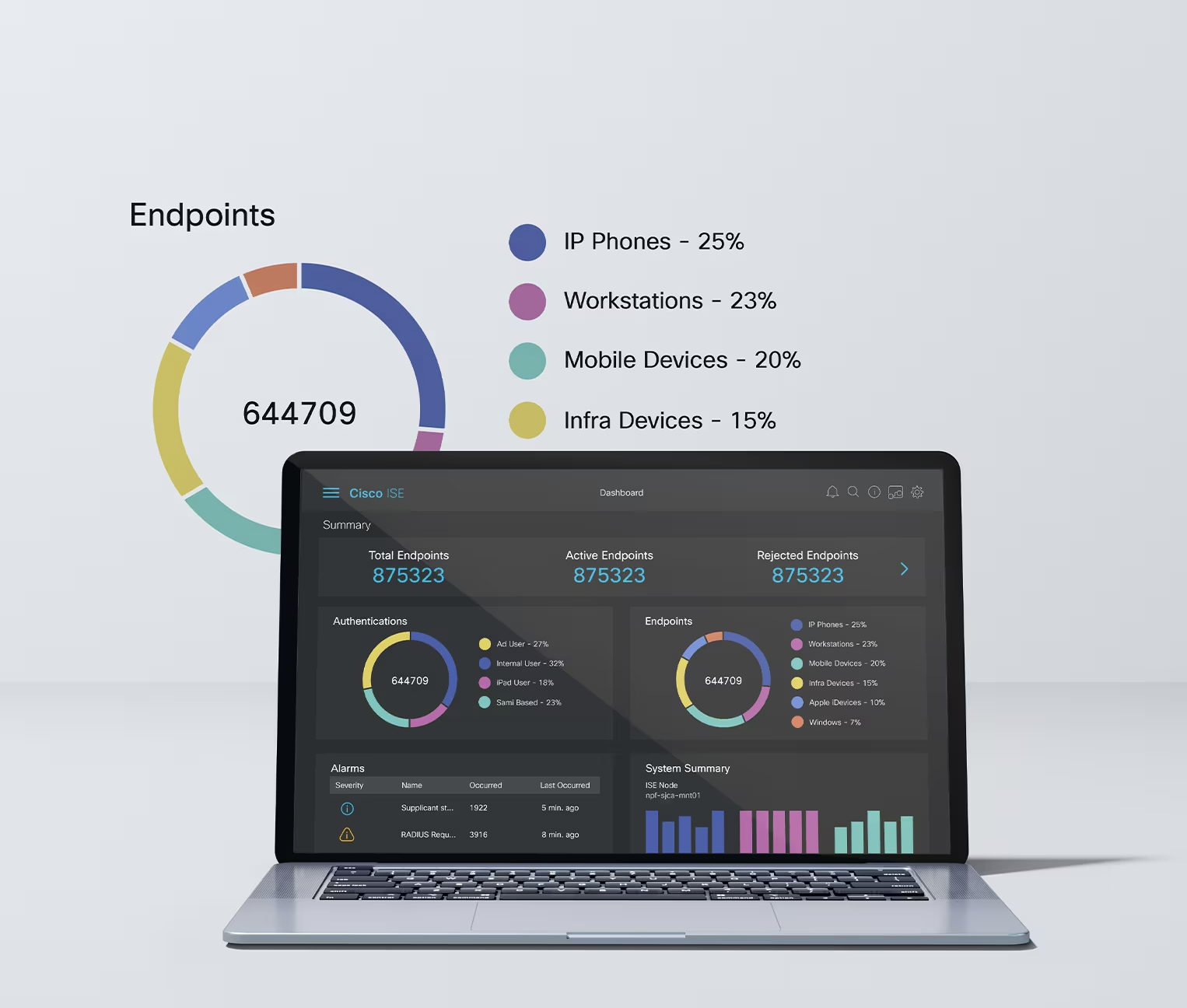
The Cisco Identity Services Engine (ISE) offers a network-based approach for adaptable, trusted access everywhere, based on context. It gives the user intelligent, integrated protection through intent-based policy and compliance solutions.
A de minimis incentive was given to thank the reviewer for their time. The incentive was not used to bias or drive a particular response, nor was the incentive contingent on a positive endorsement. More Info
Network Security Engineer in Information Technology at Woodforest National Bank (Banking, 5001-10,000 employees)
Chose Cisco Identity Services Engine (ISE)
The only other one I've ever used is ClearPass, which is the Aruba product. It's a decent RADIUS server. I don't know—it's more of a vanilla RADIUS server. It doesn't have nearly as many bells and whistles. It's a significantly easier product to use, that's for sure. It took me …
A de minimis incentive was given to thank the reviewer for their time. The incentive was not used to bias or drive a particular response, nor was the incentive contingent on a positive endorsement. More Info
cyber systems engineer in Engineering at Alaska (Airlines/Aviation, 201-500 employees)
Chose Cisco Identity Services Engine (ISE)
I think that Cisco ISE is way better and furthermore it integrates with splunk allowing for logs o be analyzed furthermore it can also integration with syslog easily allowing for multiple requirements to be met and then in the long term it allows for the usability to be …
A de minimis incentive was given to thank the reviewer for their time. The incentive was not used to bias or drive a particular response, nor was the incentive contingent on a positive endorsement. More Info
A de minimis incentive was given to thank the reviewer for their time. The incentive was not used to bias or drive a particular response, nor was the incentive contingent on a positive endorsement. More Info
Verified User
Chose Cisco Identity Services Engine (ISE)
We used Cisco Identity Services Engine (ISE) because we are a Full Cisco Vendor company so it fits perfect in our whole infrastruktrur. And also with the other Vendors Cisco Identity Services Engine (ISE) fits perfect because its open to standard Protocols.
A de minimis incentive was given to thank the reviewer for their time. The incentive was not used to bias or drive a particular response, nor was the incentive contingent on a positive endorsement. More Info
Verified User
Chose Cisco Identity Services Engine (ISE)
Main thing that Cisco Identity Services Engine (ISE) does better than ClearPass is the "personas" system implemented. Managing a cluster in ClearPass is not that easy, but, I think that ClearPass is still a better choice for small companies (HQ and a couple of branches)
A de minimis incentive was given to thank the reviewer for their time. The incentive was not used to bias or drive a particular response, nor was the incentive contingent on a positive endorsement. More Info
A de minimis incentive was given to thank the reviewer for their time. The incentive was not used to bias or drive a particular response, nor was the incentive contingent on a positive endorsement. More Info
Verified User
Chose Cisco Identity Services Engine (ISE)
It works, it's less expensive (incredible!), lower TCO.
A de minimis incentive was given to thank the reviewer for their time. The incentive was not used to bias or drive a particular response, nor was the incentive contingent on a positive endorsement. More Info
A de minimis incentive was given to thank the reviewer for their time. The incentive was not used to bias or drive a particular response, nor was the incentive contingent on a positive endorsement. More Info
A de minimis incentive was given to thank the reviewer for their time. The incentive was not used to bias or drive a particular response, nor was the incentive contingent on a positive endorsement. More Info
Verified User
Chose Cisco Identity Services Engine (ISE)
we have only try Cisco Identity Services Engine (ISE) as NAC (network access control) solution
A de minimis incentive was given to thank the reviewer for their time. The incentive was not used to bias or drive a particular response, nor was the incentive contingent on a positive endorsement. More Info
Verified User
Chose Cisco Identity Services Engine (ISE)
Cisco works great for policy enforcement and EAP authentication, but it is not so good for BYOD onboarding, and PSK from a portal. We use CloudPATH Ruckus, SecureW2, and Splash Access for those purposes.
A de minimis incentive was given to thank the reviewer for their time. The incentive was not used to bias or drive a particular response, nor was the incentive contingent on a positive endorsement. More Info
Verified User
Chose Cisco Identity Services Engine (ISE)
Since it mainly works best with the Cisco ecosystem, we prefer a single vendor if possible. It is more mature for example of FortiNAC. The support level of the vendor is better. The licenses are available in suites hence it can be included in a group of services so a richer …
A de minimis incentive was given to thank the reviewer for their time. The incentive was not used to bias or drive a particular response, nor was the incentive contingent on a positive endorsement. TR verified that a representative sample of customers was invited. More Info
Sr ICT Engineer in Engineering at ICAD (Information Technology & Services, 1001-5000 employees)
Chose Cisco Identity Services Engine (ISE)
Cisco ISE Leads in Certain Areas of integration with Cisco infrastructure (switches, firewalls, routers).Strong support for Zero Trust and regulatory compliance segmentation & dynamic access
A de minimis incentive was given to thank the reviewer for their time. The incentive was not used to bias or drive a particular response, nor was the incentive contingent on a positive endorsement. More Info
Verified User
Chose Cisco Identity Services Engine (ISE)
Cisco Identity Services Engine (ISE) is a tool that integrates well with other Cisco products but, in my opinion, does not play nicely with other vendors. That being said it the only product that can integrate with Cisco network devices to provide user access and privileges via …
A de minimis incentive was given to thank the reviewer for their time. The incentive was not used to bias or drive a particular response, nor was the incentive contingent on a positive endorsement. TR verified that a representative sample of customers was invited. More Info
Verified User
Chose Cisco Identity Services Engine (ISE)
Cisco Identity Services Engine (ISE) is great for integrating well with other Cisco products but Infoblox is more vendor agnostic and can provide ways to manage a variety of systems. However since Cisco Identity Services Engine (ISE) uses TACAS for cisco switches it is …
A de minimis incentive was given to thank the reviewer for their time. The incentive was not used to bias or drive a particular response, nor was the incentive contingent on a positive endorsement. TR verified that a representative sample of customers was invited. More Info
Verified User
Chose Cisco Identity Services Engine (ISE)
ISE has multiple cisco servers to provide redundancies to manage whenever a user logs into a cisco system. System administrators can conduct audits in the network to see who logged in and made what changes to the network. Users are granted different network privileges. which …
A de minimis incentive was given to thank the reviewer for their time. The incentive was not used to bias or drive a particular response, nor was the incentive contingent on a positive endorsement. More Info
Verified User
Chose Cisco Identity Services Engine (ISE)
We use Cisco Identity Services Engine to complement the products in our security architecture.
A de minimis incentive was given to thank the reviewer for their time. The incentive was not used to bias or drive a particular response, nor was the incentive contingent on a positive endorsement. TR verified that a representative sample of customers was invited. More Info
A de minimis incentive was given to thank the reviewer for their time. The incentive was not used to bias or drive a particular response, nor was the incentive contingent on a positive endorsement. More Info
Verified User
Chose Cisco Identity Services Engine (ISE)
In terms of ease of use, It's such a legacy application that it's pretty well known and well established and so in that sense it's easier to configure it.
A de minimis incentive was given to thank the reviewer for their time. The incentive was not used to bias or drive a particular response, nor was the incentive contingent on a positive endorsement. More Info
Well suited... I've used it for both wired and wireless access, and it's perfect for that. In addition to enforcing security on the port, you can also lock down east-west traffic. When you get to the point where you're configuring secure group tags and things like that, you can keep people from getting to places they shouldn't. Basically, you could turn your entire network into a firewall if you wanted to. You can secure access based on the identity of any given user through role-based authentication. For example, if you have salespeople and you don't want them accessing your financial or PCI environment, they authenticate as a salesperson and you can completely stop them from getting to any of that. That's really important, especially for us. Our payment card infrastructure servers are heavily locked down. Granted, in our situation, we firewall all that off anyway, but you still don't want some random individual to be able to even attempt that sort of thing. That's what it's really good for. I'm trying to think of a weakness. I don't know. We don't really struggle with it. There's nothing that I use it for where I wish it were better, at least not that I can think of offhand. I'm sure there are things, I just can't think of anything off the top of my head.
A de minimis incentive was given to thank the reviewer for their time. The incentive was not used to bias or drive a particular response, nor was the incentive contingent on a positive endorsement. More Info
A de minimis incentive was given to thank the reviewer for their time. The incentive was not used to bias or drive a particular response, nor was the incentive contingent on a positive endorsement. TR verified that a representative sample of customers was invited. More Info
A de minimis incentive was given to thank the reviewer for their time. The incentive was not used to bias or drive a particular response, nor was the incentive contingent on a positive endorsement. More Info
A de minimis incentive was given to thank the reviewer for their time. The incentive was not used to bias or drive a particular response, nor was the incentive contingent on a positive endorsement. TR verified that a representative sample of customers was invited. More Info
For us the solution is very easily useable on its own. Perhaps that has to do because we started using ISE in the 1.2 days and have seen it grow during the years. Policy creation, etc. is all very visible and thus easy to use. Deployment of multiple nodes is also incredibly easy and flexible. You can easily add or remove nodes as you wish.
A de minimis incentive was given to thank the reviewer for their time. The incentive was not used to bias or drive a particular response, nor was the incentive contingent on a positive endorsement. More Info
We do have to occasionally reboot the servers when they get low on memory, but we're also a few versions behind. Availability has generally been pretty good though with no major outages in the time that we've had it implemented.
A de minimis incentive was given to thank the reviewer for their time. The incentive was not used to bias or drive a particular response, nor was the incentive contingent on a positive endorsement. TR verified that a representative sample of customers was invited. More Info
A de minimis incentive was given to thank the reviewer for their time. The incentive was not used to bias or drive a particular response, nor was the incentive contingent on a positive endorsement. TR verified that a representative sample of customers was invited. More Info
Cisco support is second to none, both in terms of how you access support but also the knowledge of the individual support teams. If you focus on one technology and provide "manufacturer support" then you can rest assured that you are accessing Cisco's top individuals. I feel like this is a USP for Cisco support.
A de minimis incentive was given to thank the reviewer for their time. The incentive was not used to bias or drive a particular response, nor was the incentive contingent on a positive endorsement. More Info
A de minimis incentive was given to thank the reviewer for their time. The incentive was not used to bias or drive a particular response, nor was the incentive contingent on a positive endorsement. TR verified that a representative sample of customers was invited. More Info
I think our system integrators lacks some competencies and this has led to an implementation that is still perfectible. (i.e. dedicating an interface for intra-cluster communication)
A de minimis incentive was given to thank the reviewer for their time. The incentive was not used to bias or drive a particular response, nor was the incentive contingent on a positive endorsement. More Info
I think all give some visibility of device monitoring and management, but Cisco Identity Services Engine gives a good way to manage more details about the device in a centralized way that gives a wider range of monitoring and control than the other softwares individually. I don't think Cisco Identity Services Engine eliminates the need for these other software as of now, but there is potential for Cisco Identity Services Engine to be able to take over more of these roles.
A de minimis incentive was given to thank the reviewer for their time. The incentive was not used to bias or drive a particular response, nor was the incentive contingent on a positive endorsement. TR verified that a representative sample of customers was invited. More Info
A de minimis incentive was given to thank the reviewer for their time. The incentive was not used to bias or drive a particular response, nor was the incentive contingent on a positive endorsement. TR verified that a representative sample of customers was invited. More Info
It's fully customised and comprehensive. only thing is you need to know what you want. Proper research and planning would save lots of time and effort .
A de minimis incentive was given to thank the reviewer for their time. The incentive was not used to bias or drive a particular response, nor was the incentive contingent on a positive endorsement. TR verified that a representative sample of customers was invited. More Info
I don't know about negatives because we haven't seen it right now, but positive impact is one is the roadmap we have. And now since we are going ahead with doing the deployment of Cisco ISE, we see that we are getting closure to, so at the end of the day, we have to make sure that operationally we stay excellent. So that's where operational excellence comes in. Cisco ISE is basically addressing that for us. Right now we are in a situation if there is a WIFI issue or if there is an authentication issue, it gets really difficult to isolate the problem. But with Cisco ISE , this functionality is going to come in. So we believe that it would be a good ROI.
A de minimis incentive was given to thank the reviewer for their time. The incentive was not used to bias or drive a particular response, nor was the incentive contingent on a positive endorsement. TR verified that a representative sample of customers was invited. More Info