Cisco Catalyst Center provides an intent-based platform for managing enterprise networks across campus, branch, and edge environments. It combines automation, analytics, and assurance to streamline IT operations, improve security posture, and reduce manual tasks. With integratedAI/ML-driven insights, policy-based controls, and end-to-end visibility across wired and wireless infrastructures, Catalyst Center empowers IT teams toproactively detect issues, enforce compliance, and accelerate…
N/A
SolarWinds Network Configuration Manager (NCM)
Score8.3 out of 10
N/A
SolarWinds Network Configuration Manager is network diagnostics and troubleshooting technology, from Austin-based SolarWinds.
A de minimis incentive was given to thank the reviewer for their time. The incentive was not used to bias or drive a particular response, nor was the incentive contingent on a positive endorsement. TR verified that a representative sample of customers was invited. More Info
A de minimis incentive was given to thank the reviewer for their time. The incentive was not used to bias or drive a particular response, nor was the incentive contingent on a positive endorsement. TR verified that a representative sample of customers was invited. More Info
Verified User
Chose Cisco Catalyst Center
We evaluated SolarWinds but stopped the PoC after they got hacked. It wasn't stacking up well against DNAC anyway so it was inevitable that we were going to go with DNAC. DNAC has performed well so we made the right choice.
A de minimis incentive was given to thank the reviewer for their time. The incentive was not used to bias or drive a particular response, nor was the incentive contingent on a positive endorsement. TR verified that a representative sample of customers was invited. More Info
Network System Administrator in Information Technology at CentralSquare Technologies (Information Technology & Services, 1001-5000 employees)
Chose Cisco Catalyst Center
There are some other products that provide some of the benefits that Cisco DNA center offers, but I haven't found one solution that matches up against Cisco DNA Center. Our organization prefers Cisco products over others due to their resiliency. Since we have Cisco products, …
A de minimis incentive was given to thank the reviewer for their time. The incentive was not used to bias or drive a particular response, nor was the incentive contingent on a positive endorsement. More Info
Verified User
Chose Cisco Catalyst Center
DNA Center is best for Cisco environments and is a more complete management, automation, assurance, and deployment tool.
A de minimis incentive was given to thank the reviewer for their time. The incentive was not used to bias or drive a particular response, nor was the incentive contingent on a positive endorsement. TR verified that a representative sample of customers was invited. More Info
Would recommend Cisco Catalyst Center to medium to large scale organizations that have many cookie-cutter sites and the resources to properly provision all their devices. I would not recommend to teams that do not have a strong network engineering team that can navigate the various intricacies of the platform.
A de minimis incentive was given to thank the reviewer for their time. The incentive was not used to bias or drive a particular response, nor was the incentive contingent on a positive endorsement. TR verified that a representative sample of customers was invited. More Info
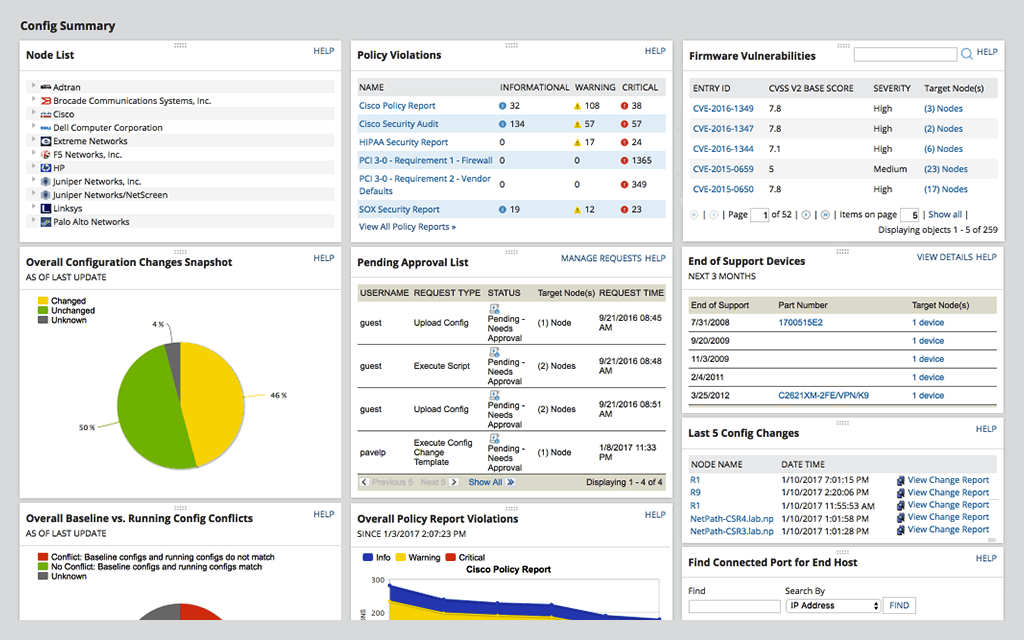
Network Configuration Manager is well suited for backing up configurations of all your devices. It also has a great comparison tool for seeing only the differences in config. Another great feature is it's ability to push a script to any number of devices. This is very handy for pushing changes to one, 10 or multiple devices. There are also some great reports that you can run against the devices in inventory
A de minimis incentive was given to thank the reviewer for their time. The incentive was not used to bias or drive a particular response, nor was the incentive contingent on a positive endorsement. More Info
Again, the ease of use of the APIs and the API Explorer provides the tools needed to write these custom workflows that allow us to do a lot of the automation we’re doing now, saving hundreds of hours by using those tools.
The product is very intuitive, and there is a lot of support out there in the DevNet community to help with that.
A de minimis incentive was given to thank the reviewer for their time. The incentive was not used to bias or drive a particular response, nor was the incentive contingent on a positive endorsement. More Info
A de minimis incentive was given to thank the reviewer for their time. The incentive was not used to bias or drive a particular response, nor was the incentive contingent on a positive endorsement. TR verified that a representative sample of customers was invited. More Info
Within its Tasks - Audit, it can sometimes allow plaintext data, including passwords, to be seen. There should be functionality to detect password usage and appropriately obfuscate the data.
Occasionally, Catalyst Center does not sync changes properly within templates, which requires deleting and reconfiguring the template version. Better processes here would be beneficial.
A de minimis incentive was given to thank the reviewer for their time. The incentive was not used to bias or drive a particular response, nor was the incentive contingent on a positive endorsement. More Info
For our use case, it does everything great and some of the features we underutilize but I would like to be able to set a configuration baseline when initially adding a node instead of after the configuration is pulled but it's not a particularly big deal to let it pull the configuration then set it as the baseline.
A de minimis incentive was given to thank the reviewer for their time. The incentive was not used to bias or drive a particular response, nor was the incentive contingent on a positive endorsement. TR verified that a representative sample of customers was invited. More Info
I think new products are often "half-baked" or over hyped when they release, as was the case with DNAC. We were well ahead of the curve in acquiring it. But as it has matured it is now a fantastic addition to our infrastructure. I think we are easing into a stage where it is hard to envision a large organization NOT having Catalyst Center in place. If for nothing outside of the mapping and troubleshooting aspects; using it as a "source of truth".
A de minimis incentive was given to thank the reviewer for their time. The incentive was not used to bias or drive a particular response, nor was the incentive contingent on a positive endorsement. TR verified that a representative sample of customers was invited. More Info
Medium complexity to set up in the beginning if using any non-standard devices or configurations, else fairly easy (e.g. Cisco Nexus or IOS-based devices). Reports are fairly straightforward to set up. Updates to the platform are fairly straightforward and don't take a major effort. Easy to add or remove devices.
A de minimis incentive was given to thank the reviewer for their time. The incentive was not used to bias or drive a particular response, nor was the incentive contingent on a positive endorsement. TR verified that a representative sample of customers was invited. More Info
Cisco DNA Center is going to help us in security, simplicity and ease of administration. Cisco DNA Center is complete management and control platform that simplifies and streamlines network operations. Cisco DNA Center offers a single dashboard for every core function in your network. With this platform, IT can become more nimble and respond to changes and challenges faster and more intelligently.
The user interface is lacking. It is difficult to navigate at times and things can be done multiple ways. Quite often I am confused by how their notification structure works. It is not very intuitive. They do offer a free Academy. They also offer a community of other technical folks. I have enjoyed both.
A de minimis incentive was given to thank the reviewer for their time. The incentive was not used to bias or drive a particular response, nor was the incentive contingent on a positive endorsement. More Info
El soporte de CISCO DNA Center es muy bueno, responden a mis dudas pero no he tenido oportunidad de reportar un incidente o determinar un tiempo de respuesta critico. The support of CISCO DNA Center is very good, they answer my questions, but I have not had the opportunity to report an incident or determine a critical response time.
A de minimis incentive was given to thank the reviewer for their time. The incentive was not used to bias or drive a particular response, nor was the incentive contingent on a positive endorsement. More Info
To be fair, I have not had to involve Support in a number of years, but when I did, I was greeted with enthusiastic engineers who wanted to understand and solve the issue. It was a fairly complex scenario and I have discovered in my most recent implementation that engineering included that option as a standard now.
A de minimis incentive was given to thank the reviewer for their time. The incentive was not used to bias or drive a particular response, nor was the incentive contingent on a positive endorsement. More Info
It was informative, but the labs were not available long enough for us to get intimately familiar with CCNA before it was closed. The course instructor was well informed and got us as close to ready as she could.
A de minimis incentive was given to thank the reviewer for their time. The incentive was not used to bias or drive a particular response, nor was the incentive contingent on a positive endorsement. TR verified that a representative sample of customers was invited. More Info
Solarwinds has actually produced new training since I last used it that is available on their site at any time. Their previous training was more than enough to get us started but now there is significantly more content. Since I'm comfortable with the Orion platform and the products we use I haven't checked the new training out yet but we have new staff go through portions of that training and they always come away with an understanding of the platform and ready to use it
A de minimis incentive was given to thank the reviewer for their time. The incentive was not used to bias or drive a particular response, nor was the incentive contingent on a positive endorsement. TR verified that a representative sample of customers was invited. More Info
it was a fairly easy implementation and everything was pretty straightforward. only challenge we had was getting all the snmp communities updated on the networking equipment
A de minimis incentive was given to thank the reviewer for their time. The incentive was not used to bias or drive a particular response, nor was the incentive contingent on a positive endorsement. More Info
Cisco Catalyst Centeris basic zero-touch provisioning out of the box. You just rack and stack the switches, patch 'em in, and the controller pushes the config automatically. No need to console into every single box or spend hours script-running over CLI.The AI-driven assurance and telemetry are top-tier. Instead of getting flooded with useless syslog alerts when a link drops, it correlates the telemetry data to give you proactive health checks. It literally pinpoints wireless anomalies and bandwidth chokepoints before the users even start opening tickets.It handles fabric microsegmentation like a boss through SD-Access and TrustSec. You can easily enforce group-based policies right at the hardware level. It drops IoT gear, guests, and corporate traffic into their own secure buckets dynamically, without you having to manage a trillion messy VLANs and ACLs.
A de minimis incentive was given to thank the reviewer for their time. The incentive was not used to bias or drive a particular response, nor was the incentive contingent on a positive endorsement. TR verified that a representative sample of customers was invited. More Info
At the time SolarWinds was the biggest player in the space and their whole portfolio was very comprehensive. As time progressed and newer technologies came about (i.e. SDWAN) their products couldn't keep up with the consumer demands and changing market. Security became such a big focus that once Solarwinds got hacked we had to remove all their products from our environment
A de minimis incentive was given to thank the reviewer for their time. The incentive was not used to bias or drive a particular response, nor was the incentive contingent on a positive endorsement. More Info
I have used it for upgrading devices, and it's does a great job at that, however out operations team for whatever reason has not adopted the feature.
Overall it feels like Cisco Catalyst Center has been huge waste of time. I feel like my time would be better spent on other projects and looking at other products and tools
A de minimis incentive was given to thank the reviewer for their time. The incentive was not used to bias or drive a particular response, nor was the incentive contingent on a positive endorsement. TR verified that a representative sample of customers was invited. More Info
Saves 100s of hours a year in man hours over manual configuration.
Saved easily 50k in lost revenue when a switch rebooted with months old unsaved configuration. NCM let us quickly restore a snapshot of the running config from the previous day.
Saves us several man hours per week of config auditing by reducing all changes to a summary email.
A de minimis incentive was given to thank the reviewer for their time. The incentive was not used to bias or drive a particular response, nor was the incentive contingent on a positive endorsement. TR verified that a representative sample of customers was invited. More Info