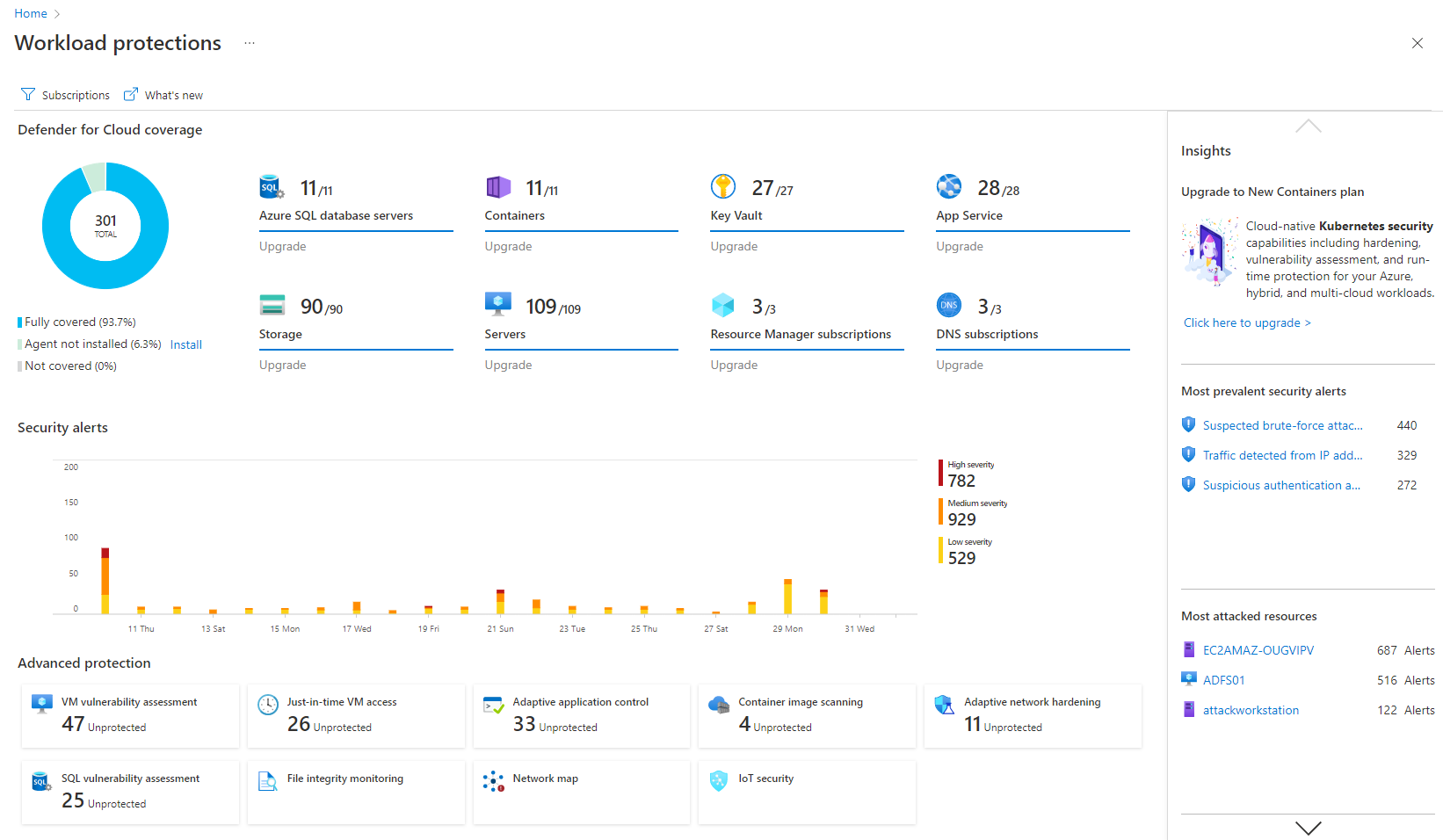
Microsoft Defender for Cloud is a Cloud Security Posture Management (CSPM) and Cloud Workload Protection Platform (CWPP) for Azure, on-premises, and multicloud (Amazon AWS and Google GCP) resources.
N/A
Microsoft Sentinel
Score 8.6 out of 10
N/A
Microsoft Sentinel (formerly Azure Sentinel) is designed as a birds-eye view across the enterprise. It is presented as a security information and event management (SIEM) solution for proactive threat detection, investigation, and response.
Evaluated between cost. I just think it integrates better with the Microsoft stack and I mean, I think just cost from just that perspective and being the one pane of glass, I think that's enough.
Elastic seems to have a much better interface for log search and is able to filter out noise. Microsoft Sentinel also appears to generate a lot of false positives.
ArcSight is an on-prem solution that has a different approach than Sentinel.
In a basis this product is more complex to maintain and deploy. The query functionality in Sentinel is more powerful and easier to maintain. ArcSight has a much slower performance and an interface that …
Control access to critical enterprise resources by business role, device type, and location, so policy changes can be made without redesigning the network.
Easily manage access control and segmentation while maintaining compliance.
Create and manage policies in an easy-to-use matrix.
Reduce the need for costly network re-architecture by automating firewall rules and access control list (ACL) administration.
Microsoft is well-suited with its definitive cloud, and I also like its Microsoft Intune ID. The conditional policies are great with that, and they're really good and well situated, so you can't beat them at that conditional policy level. Less appropriate, as I said, some of these low-hanging fruit features, like being good in phishing campaigns, and then I feel like maybe doing better at their seam products. So we'll see how that goes.
It's certainly well-suited in environments that rely heavily on Microsoft products, and it's well-suited for environments where you have other business drivers to go to the E5 license. If I were to say where I would not and why, I only gave it a seven on the recommendation, that answer would probably vary if you already owned E5 or not. It's extremely expensive. And if there are other alternatives, if you don't have any other driving reason to go to E5, I would coach you not to go to Microsoft Sentinel. But if you're there, it's a fantastic property. It's certainly part of the cost argument for moving to E5, but it's only a part. It can't by itself justify the move to E5.
It's the scale. Having built-in detections and vulnerabilities and the ability to see into the traffic flows is absolutely key. Look at it from my perspective as network security. We want to see what's going on east, west, between all the kinds of subscriptions and the tenants. We don't have that. We don't have that with any other product. Microsoft Sentinel gives us that kind of visibility.
Granular permissions and role-based access management could improve security. This would enable organizations to control who has access to and can set specific features.
While it offers integration with various Microsoft services, expanding support for third-party cloud platforms and applications would enhance its versatility. Many organizations use multiple cloud providers, and broader compatibility would be advantageous.
The cost structure could be more transparent, especially for larger organizations with extensive cloud resources. Clearer cost breakdowns and predictions would help organizations budget more effectively.
An area for improvement is how case management is surfaced within the Microsoft Sentinel experience, as clearer integration into Sentinel workflows would reduce context switching and improve incident handling.
There is an opportunity to further expand agentic, autonomous investigation and response capabilities.
It is a great product that integrates nicely when running an Azure platform and even multi-cloud environment. Not looking for point-solutions but a suite that answers most requirements. It is very comfortable being able to use KQL, workbooks and automation that is native to the azure platform
My visibility is limited because I'm only doing very small pieces of what the overall org does. And also, we have limitations on what we're allowed to use. It's not like we get a new product as users or leadership level users, and everything is on, and we can just do whatever we want. We're very restricted in what we can use any tooling within the org because of the different levels of regulatory constraints we have, because of just the nature of who we are inherently. So that's why. I don't think it's necessarily the product. I think it's more or less of what we're able to do with the product.
Because, as I said, it still lacks a lot of things, like many playbooks outside the Copilot integrations and the actual remediation. For example, for Microsoft Sentinel and SAP, I would want to see Copilot doing a lot of remediations in Microsoft Sentinel at SAPN, like executing the transaction code, maybe creating certain increases, or remediating stuff like that, which is all customized.
Microsoft support is one of the highest rated on the market. It has global and multilingual support. Calls can be made over the phone and the solution is virtually instantaneous with the help of Microsoft engineers. It's great!
Microsoft Defender for Cloud is definitely the choice with the latest market trend and attacks that are currently happening. Microsoft has been able to safe guard a lot after the recent serious attacks happening globally in the digital world. There is a trust in this software and with the latest updates and machine learning capabilities, Microsoft Defender for Cloud should be the choice.
Microsoft Sentinel excels in cloud-native scalability, Microsoft ecosystem integration, and AI-driven threat detection with UEBA and Fusion rules, offering faster deployment and lower costs (48% cheaper per Forrester) than Splunk, QRadar, Exabeam, SentinelOne, Securonix, and Wazuh. It lags in third-party integrations and syslog parsing. Organizations choose Microsoft Sentinel for its cost-effectiveness, automation, and Microsoft synergy, especially in Azure-heavy environments, though Splunk and Exabeam lead in flexibility and UEBA, respectively.
It simplifies security management and saves time. I'm not sure, but I'm very confident it saved me a couple of paychecks by centralizing the data I need to secure the cloud environment.
I also utilize the inventory overview to monitor my team's activities and verify they are following internal regulations, as well as cost overruns.
The recommendations can be utilized as a valuable instructional tool. I have the team explain why they are receiving them, why they are not following them, and what they are doing differently.
As any cybersecurity product, this has to be more with risk to avoid loss in case of a ransomware that more than relate to a productivity increase. Maybe the impact could be that instead of having people that are checking 24/7 the dashboard, you could implement Sentinel and have less people checking that or people with less expertise. So the saving will be a minor but will be a saving in the cost of your team.