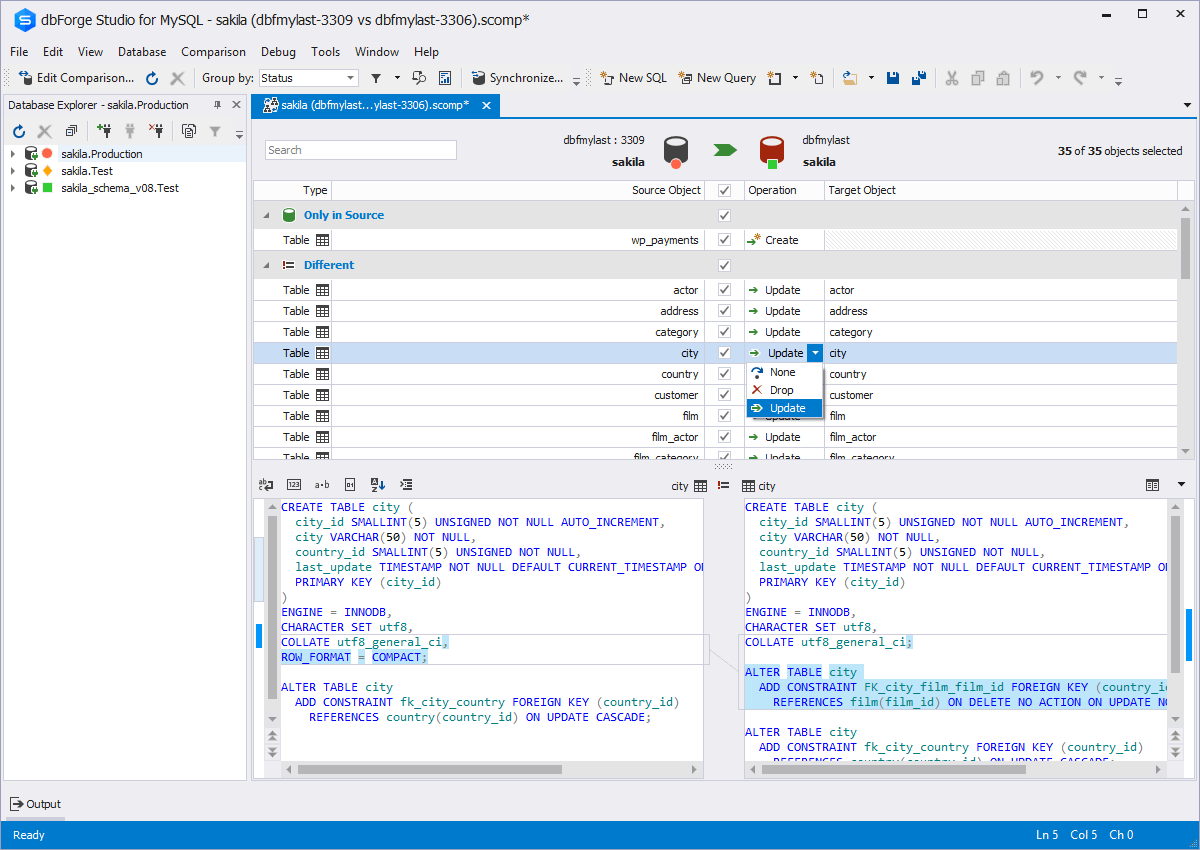
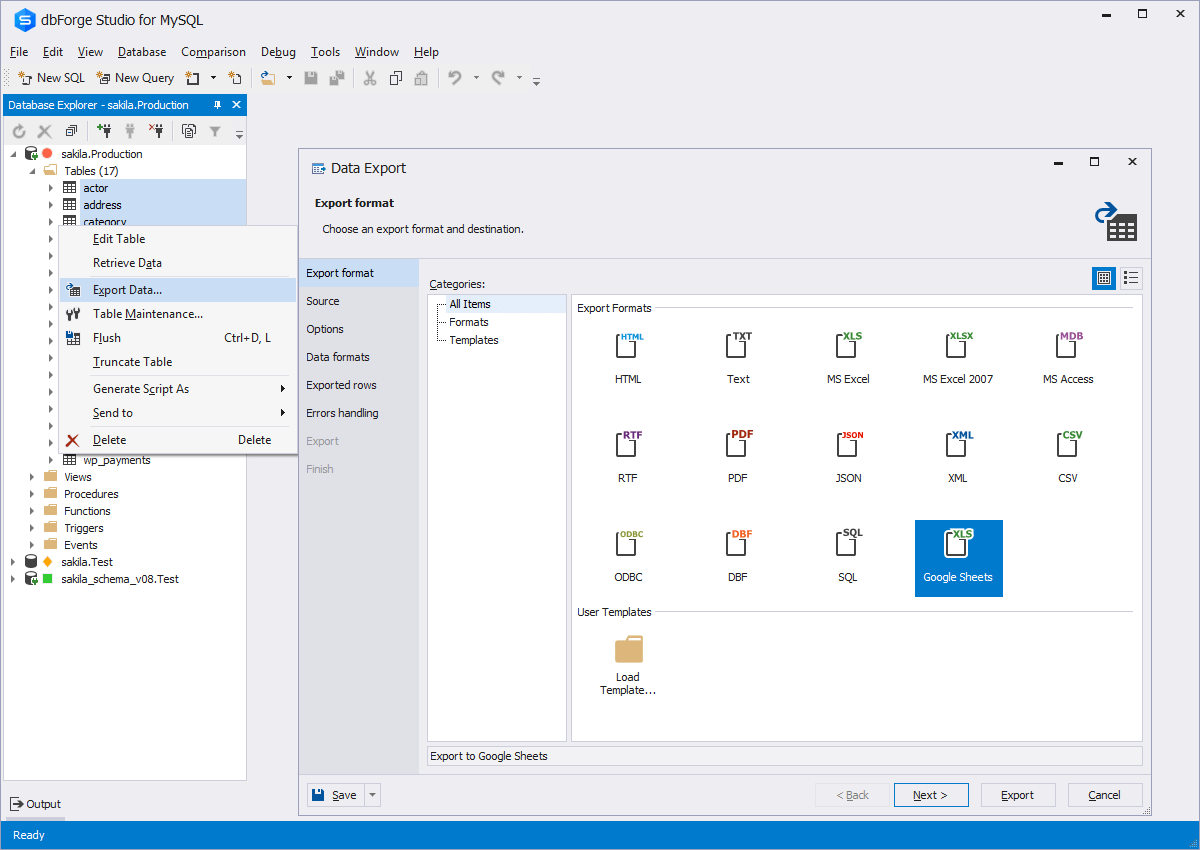
dbForge Studio is provided by
Devart and is a universal front-end client for database
management, administration and development. Devart's GUI tool provides
utilities to compare, synchronize, and back up databases (e.g. MySQL, Oracle, SQL Server, PostgreSQL, etc.) with scheduling,
and includes the possibility to analyze and report MySQL tables data. For example, dbForge
Studio for MySQL works with any MariaDB database servers, and supports all
MariaDB objects types. This solution enables users…
$9.95
per month
Apache Derby
Score 7.0 out of 10
N/A
Apache Derby is an embedded relational database management system, originally developed by IBM and called IBM Cloudscape.
N/A
RaimaDB
Score 10.0 out of 10
N/A
The Raima Database Manager (RDM) from Raima Inc in Seattle, Washington is a relational database management system.
N/A
Pricing
dbForge Studio (Edge)
Apache Derby
RaimaDB
Editions & Modules
Standard (subcription)
$9.95
per month
Professional (subscription)
$19.95
per month
Enterprise (subscription)
$29.95
per month
Standard (subcription)
$99.95
per year
Professional (subscription)
$179.95
per year
Standard
$199.95
Enterprise (subscription)
$229.95
per year
Professional
$349.95
Enterprise
$449.95
No answers on this topic
No answers on this topic
Offerings
Pricing Offerings
dbForge Studio (Edge)
Apache Derby
RaimaDB
Free Trial
Yes
No
No
Free/Freemium Version
Yes
No
No
Premium Consulting/Integration Services
Yes
No
No
Entry-level Setup Fee
No setup fee
No setup fee
No setup fee
Additional Details
—
—
—
More Pricing Information
Community Pulse
dbForge Studio (Edge)
Apache Derby
RaimaDB
Features
dbForge Studio (Edge)
Apache Derby
RaimaDB
Database Development
Comparison of Database Development features of Product A and Product B
dbForge Studio (Edge)
8.4
2 Ratings
1% below category average
Apache Derby
-
Ratings
RaimaDB
-
Ratings
Version control tools
8.01 Ratings
00 Ratings
00 Ratings
Test data generation
7.01 Ratings
00 Ratings
00 Ratings
Performance optimization tools
9.01 Ratings
00 Ratings
00 Ratings
Schema maintenance
9.01 Ratings
00 Ratings
00 Ratings
Database change management
9.02 Ratings
00 Ratings
00 Ratings
Database Administration
Comparison of Database Administration features of Product A and Product B
This tool is useful for small and large IT departments and associated data analysts that perform direct database functions such as DBA tasks or extracting/importing data. Non-technical staff members would not benefit from this tool as much as the functions are detailed and technical. However, automation engineers will find this tool very open for automation, and can generate the scripting code for any of its functions.
If you need a SQL-capable database-like solution that is file-based and embeddable in your existing Java Virtual Machine processes, Apache Derby is an open-source, zero cost, robust and performant option. You can use it to store structured relational data but in small files that can be deployed right alongside with your solution, such as storing a set of relational master data or configuration settings inside your binary package that is deployed/installed on servers or client machines.
Apache Derby is SMALL. Compared to an enterprise scale system such as MSSQL, it's footprint is very tiny, and it works well as a local database.
The SPEED. I have found that Apache Derby is very fast, given the environment I was developing in.
Based in JAVA (I know that's an obvious thing to say), but Java allows you to write some elegant Object Oriented structures, thus allowing for fast, Agile test cases against the database.
Derby is EASY to implement and can be accessed from a console with little difficulty. Making it appropriate for everything from small embedded systems (i.e. just a bash shell and a little bit of supporting libraries) to massive workstations.
First of all the performance of RDM was superior compared to SQLite in my multi-user environment (about 200 users). The pricing was surprisingly good compared to other high-performance databases.
Decreased time to market, a faster and more performant application overall and lower maintenance costs.
They run on most RTOS and can be used in a cross-platform environment.
The ability to parameterize searches more would be advantageous. For example, being able to specify to only look for certain columns, certain data type changes, etc.
The output reports from dbForge are very plain and could contain more detail, and perhaps be structured more like a pivot table form Excel
dbForge Studio (Edge) has a great UI and it's versatile, but it still has some glitches. Its multiple database support makes it possible to stick with only one UI to handle different RDBM systems, even though you have to redefine user credentials for each new connection (no copying/cloning feature for database connections). The Edit View and diagramming features also could be improved.
Although experience here is limited, as only one question has been asked and answered promptly, the registration and licensing process was very smooth and professional. There are forums online that discuss dbForge issues, as well as a Facts and Questions section on dbForge's website, so product support does seem to exist if needed.
Before choosing dbForge Studio I evaluated at least a dozen tools, especially on the Visual Query Builder function. For now, I have identified only one product that has a better Visual Query Builder than dbForge Studio. This other product also manages UNIONs, while dbStudio still doesn't do it visually. However, the better alternative product is enormously slower in operations and less feature-rich than DbForge Studio
SQLite is another open-source zero-cost file-based SQL-capable database solution and is a good alternative to Apache Derby, especially for non-Java-based solutions. We chose Apache Derby as it is Java-based, and so is the solution we embedded it in. However, SQLite has a similar feature set and is widely used in the industry to serve the same purposes for native solutions such as C or C++-based products.
Being Open source, the resources spent on the purchase of the product are ZERO.
Contrary to popular belief, open source software CAN provide support, provided that the developers/contributors are willing to answer your emails.
Overall, the ROI was positive: being able to experiment with an open source technology that could perform on par with the corporate products was promising, and gave us much information about how to proceed in the future.