F5 Distributed Cloud App Connect vs. NGINX

Overview
ProductRatingMost Used ByProduct SummaryStarting Price
F5 Distributed Cloud App Connect
Score 8.1 out of 10
N/A
Securely connects distributed apps and services across public cloud, on-premises, and edge environments. Utilizing Infrastructure as Code, App Connect provisions resources and maintain uniform policies across multiple sites.N/A
NGINX
Score 9.8 out of 10
Mid-Size Companies (51-1,000 employees)
NGINX, a business unit of F5 Networks, powers over 65% of the world's busiest websites and web applications. NGINX started out as an open source web server and reverse proxy, built to be faster and more efficient than Apache. Over the years, NGINX has built a suite of infrastructure software products o tackle some of the biggest challenges in managing high-transaction applications. NGINX offers a suite of products to form the core of what organizations need to create…N/A
Pricing
F5 Distributed Cloud App ConnectNGINX
Editions & Modules
No answers on this topic
Offerings
Pricing Offerings
F5 Distributed Cloud App ConnectNGINX
Free Trial
YesYes
Free/Freemium Version
NoYes
Premium Consulting/Integration Services
NoYes
Entry-level Setup FeeNo setup feeOptional
Additional Details
More Pricing Information
Community Pulse
F5 Distributed Cloud App ConnectNGINX
Features
F5 Distributed Cloud App ConnectNGINX
Application Servers
Comparison of Application Servers features of Product A and Product B
F5 Distributed Cloud App Connect
-
Ratings
NGINX
7.9
24 Ratings
0% below category average
IDE support00 Ratings7.612 Ratings
Security management00 Ratings7.920 Ratings
Administration and management00 Ratings7.120 Ratings
Application server performance00 Ratings8.020 Ratings
Installation00 Ratings9.921 Ratings
Open-source standards compliance00 Ratings7.118 Ratings
Best Alternatives
F5 Distributed Cloud App ConnectNGINX
Small Businesses
NGINX
NGINX
Score 9.8 out of 10
Apache HTTP Server
Apache HTTP Server
Score 9.0 out of 10
Medium-sized Companies
NGINX
NGINX
Score 9.8 out of 10
Apache Tomcat
Apache Tomcat
Score 8.2 out of 10
Enterprises
NGINX
NGINX
Score 9.8 out of 10
Apache Tomcat
Apache Tomcat
Score 8.2 out of 10
All AlternativesView all alternativesView all alternatives
User Ratings
F5 Distributed Cloud App ConnectNGINX
Likelihood to Recommend
8.0
(10 ratings)
8.7
(50 ratings)
Likelihood to Renew
9.1
(1 ratings)
9.1
(1 ratings)
Usability
-
(0 ratings)
7.7
(3 ratings)
Performance
7.9
(10 ratings)
-
(0 ratings)
Support Rating
-
(0 ratings)
8.1
(4 ratings)
Ease of integration
8.5
(3 ratings)
-
(0 ratings)
User Testimonials
F5 Distributed Cloud App ConnectNGINX
Likelihood to Recommend
F5
My advice is if your firm build multi-cloud, high availability SaaS products or you just run polyglot workloads across kubernetes and VMs, then F5 Distributed Cloud App Connect is your guy. Coming from an expert, just start with a few core services or else you will be overwhelmed.
Read full review
F5
[NGINX] is very well suited for high performance. I have seen it used on servers with 1k current connections with no issues. Despite seeing it used in many environments I've never seen software developers use it over apache, express, IIS in local dev environments so it may be more difficult to setup. I've also seen it used to load balance again without issues.
Read full review
Pros
F5
  • Ease of use - standing up a new site took very little time, less then an hour.
  • Connecting the dots - the ease at standing up a load balancer and advertising it on CEs was simple and straight forward. Once you get familiar with the field layout it's very comparable to BIG-IP
Read full review
F5
  • Very low memory usage. Can handle many more connections than alternatives (like Apache HTTPD) due to low overhead. (event-based architecture).
  • Great at serving static content.
  • Scales very well. Easy to host multiple Nginx servers to promote high availability.
  • Open-Source (no cost)!
Read full review
Cons
F5
  • User access roles should be more granular what we currently have
  • user interface should be user friendly
  • Setup process and guided workflows could add a user friendly process for first time users
  • log export from SIEM tool still require a manual intervention
Read full review
F5
  • Customer support can be strangely condescending, perhaps it's a language issue?
  • I find it a little weird how the release versions used for Nginx+ aren't the same as for open source version. It can be very confusing to determine the cross-compatibility of modules, etc., because of this.
  • It seems like some (most?) modules on their own site are ancient and no longer supported, so their documentation in this area needs work.
  • It's difficult to navigate between nginx.com commercial site and customer support. They need to be integrated together.
  • I'd love to see more work done on nginx+ monitoring without requiring logging every request. I understand that many statistics can only be derived from logs, but plenty should work without that. Logging is not an option in many environments.
Read full review
Likelihood to Renew
F5
At this point it has become too focal to our operations. An entire department could collapse if we dropped it now or in the near future. My experiences as mentioned in the previous questions tell of its gravity
Read full review
F5
Great value for the product
Read full review
Usability
F5
No answers on this topic
F5
Front end proxy and reverse proxy of Nginx is always useful. I always prefer to Nginx in overall usability when you have application server and database or multiple application servers and single database i.e. clustered application. Nginx provides really good features and flexibility which helps the system administrator in case of troubleshooting and also from the administration perspective. Also, Nginx doesn't delay any request because of internal performance issues.
Read full review
Performance
F5
From what we have been able to test load/responsiveness is quick and when we've tested out reporting and troubleshooting modules they have pulled the correct information in quick timeframes. We haven't been able to test out any software integration with Splunk of other software on our system since we are still in early POC stages but from what we've been told we should be able to implement that in our environment
Read full review
F5
No answers on this topic
Support Rating
F5
No answers on this topic
F5
Community support is great, and they've also had a presence at conferences. Overall, there is no shortage of documentation and community support. We're currently using it to serve up some WordPress sites, and configuring NGINX for this purpose is well documented.
Read full review
Alternatives Considered
F5
-F5 Distributed Cloud App Connect provides more granular security policies with features like DOS, WAF etc and others lack -F5 Distributed Cloud App Connect provides high performance global network and other rely on public internet and impact is latency and it gives F5 Distributed Cloud App Connect a better user experience
Read full review
F5
We have used Traffic, Apache, Google Cloud Load Balancing and other managed cloud-based load balancers. When it comes to scale and customization nothing beats Nginx. We selected Nginx over the others because
  • we have a large number of services and we can manage a single Nginx instance for all of them
  • we have high impact services and Nginx never breaks a sweat under load
  • individual services have special considerations and Nginx lets us configure each one uniquely
Read full review
Return on Investment
F5
  • Inconsistent policies and procedures and now its all seem to be sorted and now requires less support
  • Deployment cycle time was reduced and achieves a faster adoption of newly added contents
  • Saved migration cost and more gave durability to the existing setup
Read full review
F5
  • Nginx has decreased the burden of web server administration and maintenance, and we are spending less time on server issues than when we were using Apache.
  • Nginx has allowed more people in our company to get involved with configuring things on the web server, so there's no longer a single point of failure ("the Apache guy").
  • Nginx has given us the ability to handle a larger number of requests without scaling up in hardware quite so quickly.
Read full review
ScreenShots

F5 Distributed Cloud App Connect Screenshots

Screenshot of Screenshot of Screenshot of

NGINX Screenshots

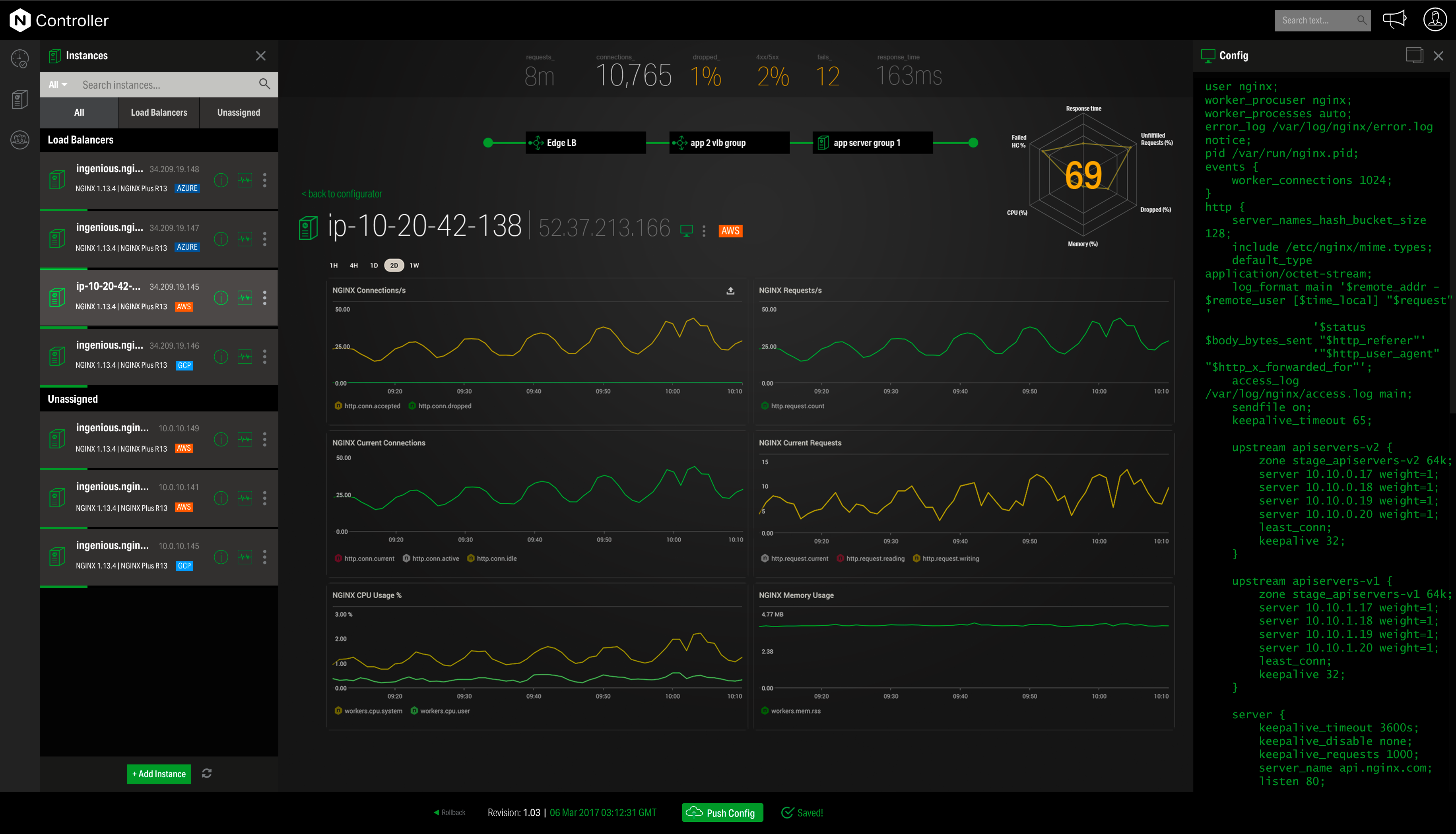
Screenshot of Overview of the NGINX Application PlatformScreenshot of NGINX Controller - MonitoringScreenshot of NGINX Controller - Configuration