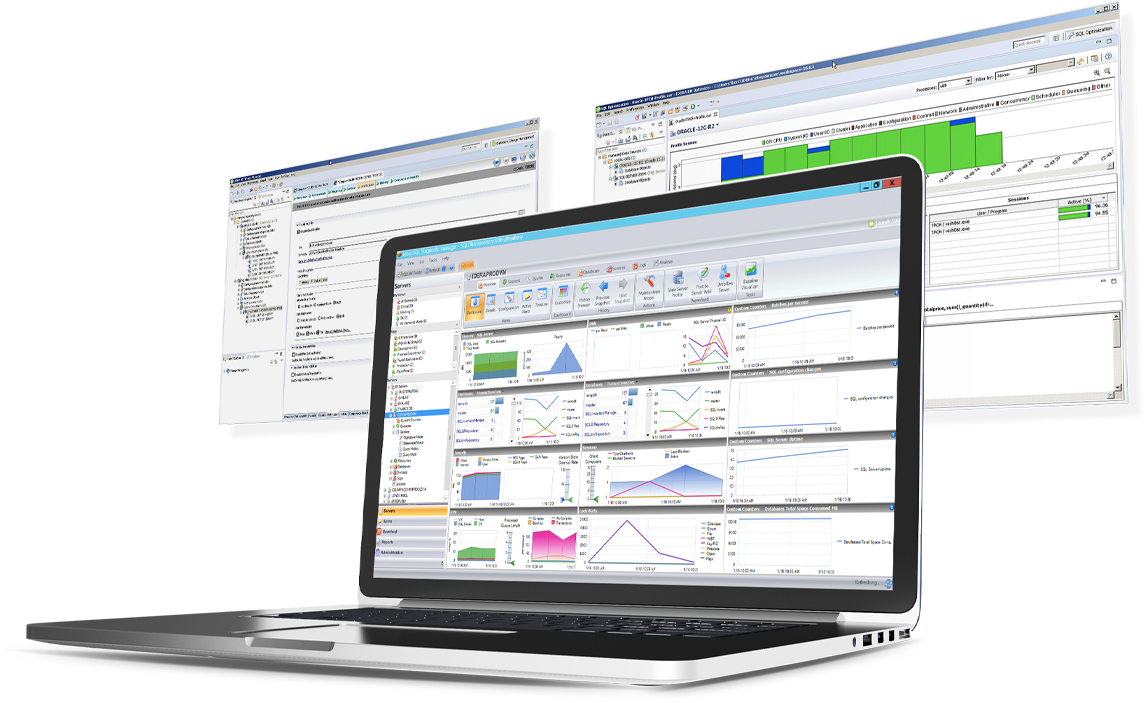
SQL Diagnostic Manager for Microsoft SQL Server helps database administrators to find and fix Microsoft SQL Server performance problems in physical, virtual, and cloud environments. Unlike its competition, it provides effective scalability, advanced SQL query analysis and optimization, prescriptive analysis with corrective SQL scripts, powerful automated alert responses, broad PowerShell integration, complete customization, and extensive support for current and legacy Microsoft SQL Server and…
$1,996
per instance with first year maintenance included
Splunk Enterprise Security
Score8.3 out of 10
N/A
Splunk Enterprise Security is an analytics-driven SIEM that helps to combat threats with actionable intelligence and advanced analytics at scale.
SQL Server [Business Intelligence] Manager is useful for tracking performance across SSIS, SSRS and SSA and have the data represented in dashboards. It helps improve performance and helps end users. However, several features are redundant for smaller organization that can use the tools that comes with existing Microsoft products. These features also takes time to learn and use.
A de minimis incentive was given to thank the reviewer for their time. The incentive was not used to bias or drive a particular response, nor was the incentive contingent on a positive endorsement. More Info
Based on my experience, Splunk is a strong git for some environments and a poor match for others. The distinction is primarily based on infrastructure complexity and budget. It's perfect for large enterprises with a mix of on-prem/cloud infrastructure. It's not a perfect match for small teams with restricted resources.
A de minimis incentive was given to thank the reviewer for their time. The incentive was not used to bias or drive a particular response, nor was the incentive contingent on a positive endorsement. More Info
SQLdm does a good job of providing information at a high level, but also allows me to drill down to specific queries and events if needed. I don't always need to sift through tons of details to get the information I need. It also gives a very wide range of information from SQL specific metrics, to OS metrics, to VM metrics, all the way up to host server metrics.
I like how the alert and notification system can be customized. For example, if you know a certain server regularly has long-running queries, you can adjust the alert to not fire unless a query has been running for 30 minutes while the rest of the servers fire after 30 seconds. That is very helpful in not being bombarded at dinner with alerts from a server similar to, "I've been at 90% cpu for 26 milliseconds!!!!!!!...and now it's back down to 30%" Good information to know, but not something you need to literally lose sleep over.
I like how you can configure different servers to be monitored differently. For example, you can have a group of servers called DEVELOPMENT that you can turn on heavier monitoring on so you can test how changes in applications might affect the SQL environment, but in the PRODUCTION group, you may only want to enable the heavier analysis and logging when performance issues are actively being reported.
A de minimis incentive was given to thank the reviewer for their time. The incentive was not used to bias or drive a particular response, nor was the incentive contingent on a positive endorsement. More Info
Writes Powerful Queries: The queries that can be written using the Splunk Query Language are very powerful and highly customizable to meet every need. Ex: Writing queries to search the intersection of two different sources like Network and Endpoint Logs.
Offers Dashboard Abilities: Helps build complex panels for Dashboards in addition to providing several out-of-the-box panels. Ex: creating panels to calculate the performance of analysts in a given timezone.
Helpful Search Aids: It helps to set up complex custom alerts very easily. The interesting fields section is very helpful while threat hunting. Ex: It shows all the users and the frequency of each in a failed login event. The user list on the interesting fields is useful to look for suspicious logins.
A de minimis incentive was given to thank the reviewer for their time. The incentive was not used to bias or drive a particular response, nor was the incentive contingent on a positive endorsement. More Info
Windows client has some issues. When you have small time intervals for your data collection, it can cause the client to become unresponsive and require you to restart it.
It takes more time to get the web client running than it does to get the windows client running.
The visualizations have been the same for the last eight years--could use a little bit of a refresh.
A de minimis incentive was given to thank the reviewer for their time. The incentive was not used to bias or drive a particular response, nor was the incentive contingent on a positive endorsement. More Info
Improved User Interface Customization: While the interface is generally intuitive, providing more options for users to customize their dashboards and views would enhance the overall user experience. Tailoring the interface to specific roles or use cases could be a valuable addition.
Simplified Alert Management: Streamlining the process of managing alerts, such as grouping or categorizing them based on severity or type, would make it easier for security teams to prioritize and respond to incidents effectively.
Expanded Threat Intelligence Feeds: Increasing the variety and sources of threat intelligence feeds available within ES would provide a broader context for identifying and mitigating emerging threats, ensuring a more comprehensive defense against evolving attack vectors.
A de minimis incentive was given to thank the reviewer for their time. The incentive was not used to bias or drive a particular response, nor was the incentive contingent on a positive endorsement. More Info
A de minimis incentive was given to thank the reviewer for their time. The incentive was not used to bias or drive a particular response, nor was the incentive contingent on a positive endorsement. More Info
Maintaining hundreds or even 1000+ SOC use cases is really difficult, considering that the Data sources may not always send the data. A module that detects data freshness issues and detect data format changes would be a great help. the main challenge today using Splunk Enterprise Security is making sure that the detection rules are still working properly given all the changes that occur in data source applications. Also, maintaining the data collects on tens of thousands of servers and more than 100k workstations is a real company IT challenge: the splunkbase forwarder may not support old OS anymore, while these are the most important to monitor. Moving to the Open Telemetry collector has become essential so that only 1 agent is required for both SIEM and application observability.
A de minimis incentive was given to thank the reviewer for their time. The incentive was not used to bias or drive a particular response, nor was the incentive contingent on a positive endorsement. More Info
A de minimis incentive was given to thank the reviewer for their time. The incentive was not used to bias or drive a particular response, nor was the incentive contingent on a positive endorsement. More Info
It takes a long time for items to load if you are just generally searching through logs. It is best to use the data models which load faster but can be strange in terms of what is coming from which logs where. Yes, you can look it up, but this also requires familiarity with where things are and how to look them up.
A de minimis incentive was given to thank the reviewer for their time. The incentive was not used to bias or drive a particular response, nor was the incentive contingent on a positive endorsement. More Info
It's good when it's responsive, but I've had times where I had to wait quite a while for a response. But these are typically the exceptions rather than the rule. When you do get a response it is always well-informed and appropriate. I would say they've been trending better over time with this.
A de minimis incentive was given to thank the reviewer for their time. The incentive was not used to bias or drive a particular response, nor was the incentive contingent on a positive endorsement. More Info
I experienced only on-line training, but the trainers were very professional and competent. Maybe it could be more useful if they also have an experience in projects because sometimes they didn't have a real project experience to communicate to the students. Anyway, it was very interesting and I learned many thing that's very difficoult (or maybe impossible!) to have by myself, aven if I have more than 10 years of Splunk activity experience.
A de minimis incentive was given to thank the reviewer for their time. The incentive was not used to bias or drive a particular response, nor was the incentive contingent on a positive endorsement. More Info
It was very interesting and I learned many thing that's very difficoult (or maybe impossible!) to have by myself. The only problem was that, when I worked with the Splunk Professional Services, I found some difference between the training contents and the information from PS. In addition is required a long experience on Splunk Enterprise for the data ingestion part, in other words I'm able to work with ES because I'm worling on Splunk since 11 years, otherwise I'd some problem.
A de minimis incentive was given to thank the reviewer for their time. The incentive was not used to bias or drive a particular response, nor was the incentive contingent on a positive endorsement. More Info
A de minimis incentive was given to thank the reviewer for their time. The incentive was not used to bias or drive a particular response, nor was the incentive contingent on a positive endorsement. More Info
IDERA SQL Diagnostic Manager for SQL, Redgate SQL, and MonitorLogicMonitor are similar products to each other. We decided on IDERA SQL Diagnostic Manager for SQL because our experience with locating heavy queries has been very good and it provides real-time monitoring of all servers and databases. It also allows you to have a large volume of historical data which allows you to analyze trends in the databases.
A de minimis incentive was given to thank the reviewer for their time. The incentive was not used to bias or drive a particular response, nor was the incentive contingent on a positive endorsement. More Info
Splunk enterprise is the only solution that we’ve been able to identify that provides risk based alerting, which allows our SOC to reduce analyst fatigue which would be a huge problem without it. Before RBA, there were thousands of alerts a day and it was impossible to review all of them
A de minimis incentive was given to thank the reviewer for their time. The incentive was not used to bias or drive a particular response, nor was the incentive contingent on a positive endorsement. More Info
for my exterience, unit pricing and billing frequency are correct. As I already said, I hint to have more discount flexibility, expecially with new customers, because there are competitors less expensive and very aggressive that are dangerous. In addition the possibility to don't pay the license for the development period could be a very interesting feature for the final customers.
A de minimis incentive was given to thank the reviewer for their time. The incentive was not used to bias or drive a particular response, nor was the incentive contingent on a positive endorsement. More Info
- 8 out of 10 and took 2 for the data pipeline and administration part. Even if you'd like to improve yourself or your team, you have to pay a lot of money and it could be more than GIAC education + cert. - Normalization for Data models and CPU-based searches can be a problem sometimes.
A de minimis incentive was given to thank the reviewer for their time. The incentive was not used to bias or drive a particular response, nor was the incentive contingent on a positive endorsement. More Info
I had a fantastic experience with Splunk Professional Services: they worked with us in our last SON project (a SOC migration for a very large customer) and helped to build a multi tenent environment even if ES isn't a multi tenant platform. Th Splunk PS was a very professional and competent people, he is italian and was able to speak with our italian customers.
A de minimis incentive was given to thank the reviewer for their time. The incentive was not used to bias or drive a particular response, nor was the incentive contingent on a positive endorsement. More Info
A de minimis incentive was given to thank the reviewer for their time. The incentive was not used to bias or drive a particular response, nor was the incentive contingent on a positive endorsement. More Info
We have a 100% success rate on all our ES implementations due to the amazing documentation and Splunk enablement on the subject.
Our Splunk ES business has grown 100% YoY for the last 3 years.
In terms of long term management and maintenance, ES has been highly stable and predictable, reducing our overhead on costly services team for ad hoc maintenance work.