Informatica PowerCenter was data integration technology designed to form the foundation for data integration initiatives, application migration, or analytics. It is a legacy product.
N/A
SAS Visual Analytics
Score7.8 out of 10
Enterprise companies (1,001+ employees)
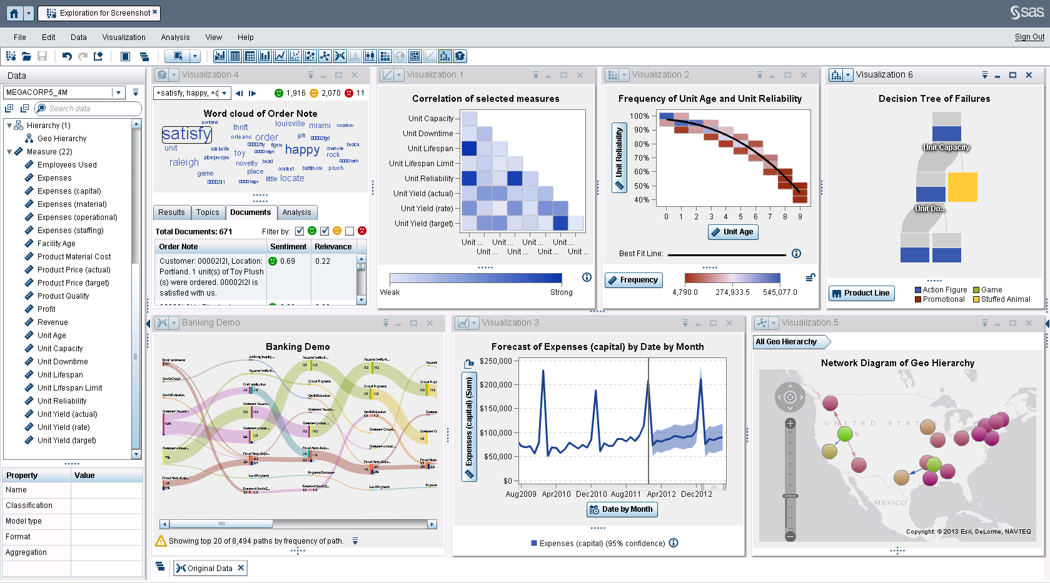
SAS Visual Analytics provides a complete platform for analytics visualization, enabling users to identify patterns and relationships in data that weren't initially evident. Interactive, self-service BI and reporting capabilities are combined with out-of-the-box advanced analytics so everyone can discover insights from any size and type of data, including text.
N/A
Pricing
Informatica PowerCenter (legacy)
SAS Visual Analytics
Editions & Modules
No answers on this topic
SAS Visual Analytics for SAS Cloud
$0
Annual By Users: 5, 10, 20
Offerings
Pricing Offerings
Informatica PowerCenter (legacy)
SAS Visual Analytics
Free Trial
No
Yes
Free/Freemium Version
No
No
Premium Consulting/Integration Services
No
Yes
Entry-level Setup Fee
No setup fee
No setup fee
Additional Details
—
SAS Visual Statistics and SAS Office Analytics are also available as add-ons.
More Pricing Information
Features
Informatica PowerCenter (legacy)
SAS Visual Analytics
Data Source Connection
Comparison of Data Source Connection features of Informatica PowerCenter (legacy) and SAS Visual Analytics
Feature
Informatica PowerCenter (legacy)
8.5
18 Ratings
1% above category average
SAS Visual Analytics
-
Ratings
Connect to traditional data sources
9.018 Ratings
00 Ratings
Connecto to Big Data and NoSQL
8.014 Ratings
00 Ratings
Data Transformations
Comparison of Data Transformations features of Informatica PowerCenter (legacy) and SAS Visual Analytics
Feature
Informatica PowerCenter (legacy)
7.5
18 Ratings
8% below category average
SAS Visual Analytics
-
Ratings
Simple transformations
8.018 Ratings
00 Ratings
Complex transformations
7.018 Ratings
00 Ratings
Data Modeling
Comparison of Data Modeling features of Informatica PowerCenter (legacy) and SAS Visual Analytics
Feature
Informatica PowerCenter (legacy)
8.2
18 Ratings
3% above category average
SAS Visual Analytics
-
Ratings
Data model creation
9.015 Ratings
00 Ratings
Metadata management
8.016 Ratings
00 Ratings
Business rules and workflow
9.018 Ratings
00 Ratings
Collaboration
6.116 Ratings
00 Ratings
Testing and debugging
9.017 Ratings
00 Ratings
Data Governance
Comparison of Data Governance features of Informatica PowerCenter (legacy) and SAS Visual Analytics
Feature
Informatica PowerCenter (legacy)
9.0
15 Ratings
11% above category average
SAS Visual Analytics
-
Ratings
Integration with data quality tools
9.015 Ratings
00 Ratings
Integration with MDM tools
9.013 Ratings
00 Ratings
BI Standard Reporting
Comparison of BI Standard Reporting features of Informatica PowerCenter (legacy) and SAS Visual Analytics
Feature
Informatica PowerCenter (legacy)
-
Ratings
SAS Visual Analytics
8.3
11 Ratings
2% above category average
Pixel Perfect reports
00 Ratings
8.011 Ratings
Customizable dashboards
00 Ratings
8.011 Ratings
Report Formatting Templates
00 Ratings
9.010 Ratings
Ad-hoc Reporting
Comparison of Ad-hoc Reporting features of Informatica PowerCenter (legacy) and SAS Visual Analytics
Feature
Informatica PowerCenter (legacy)
-
Ratings
SAS Visual Analytics
8.8
12 Ratings
9% above category average
Drill-down analysis
00 Ratings
9.012 Ratings
Formatting capabilities
00 Ratings
8.012 Ratings
Integration with R or other statistical packages
00 Ratings
8.010 Ratings
Report sharing and collaboration
00 Ratings
10.011 Ratings
Report Output and Scheduling
Comparison of Report Output and Scheduling features of Informatica PowerCenter (legacy) and SAS Visual Analytics
Feature
Informatica PowerCenter (legacy)
-
Ratings
SAS Visual Analytics
9.2
12 Ratings
11% above category average
Publish to Web
00 Ratings
9.011 Ratings
Publish to PDF
00 Ratings
9.012 Ratings
Report Versioning
00 Ratings
9.09 Ratings
Report Delivery Scheduling
00 Ratings
10.011 Ratings
Delivery to Remote Servers
00 Ratings
9.06 Ratings
Data Discovery and Visualization
Comparison of Data Discovery and Visualization features of Informatica PowerCenter (legacy) and SAS Visual Analytics
1.- Scenaries with poor sources of data is not recomended (Very bad ROI). The solution is for medium-big enterprises with a lot of sources of data and users. 2.- Bank and finance enviroment to integrate differente data form trading, Regulatory reports, decisions makers, fraud and financial crimes because in this kind of scenary the quality of data is the base of the business. 3.- Departments of development and test of applications in enterprises because you can design enviroments, out of the production systems, to development and test the new API's or updateds made.
A de minimis incentive was given to thank the reviewer for their time. The incentive was not used to bias or drive a particular response, nor was the incentive contingent on a positive endorsement. More Info
I was in a meeting with the client and there I have to show them some analytic data to them. But I was confused about how I will manage to show big data to clients with accuracy. But then the SAS Visual Analytics software helps me in presenting accurate data at the moment and it was very presentable and through that, I got the deal for that business.
A de minimis incentive was given to thank the reviewer for their time. The incentive was not used to bias or drive a particular response, nor was the incentive contingent on a positive endorsement. More Info
Informatica Powercenter is an innovative software that works with ETL-type data integration. Connectivity to almost all the database systems.
Great documentation and customer support.
It has a various solution to address data quality issues. data masking, data virtualization. It has various supporting tools or MDM, IDQ, Analyst, BigData which can be used to analyze data and correct it.
A de minimis incentive was given to thank the reviewer for their time. The incentive was not used to bias or drive a particular response, nor was the incentive contingent on a positive endorsement. More Info
Provides the flexibility to the end user to slice and dice the data.
Anyone can make predictive models with the help of in-built algorithms without the need to write a single line of code or knowledge of what's under the hood of algorithms.
The feature to simply ask a question related to data and getting a response in form of text, chart or graph is amazing.
A de minimis incentive was given to thank the reviewer for their time. The incentive was not used to bias or drive a particular response, nor was the incentive contingent on a positive endorsement. More Info
There are too many ways to perform the same or similar functions which in turn makes it challenging to trace what a workflow is doing and at which point (ex. sessions can be designed as static or re-usable and the override can occur at the session or workflow, or both which can be counter productive and confusing when troubleshooting).
The power in structured design is a double edged sword. Simple tasks for a POC can become cumbersome. Ex. if you want to move some data to test a process, you first have to create your sources by importing them which means an ODBC connection or similar will need to be configured, you in turn have to develop your targets and all of the essential building blocks before being able to begin actual development. While I am on sources and targets, I think of a table definition as just that and find it counter intuitive to have to design a table as both a source and target and manage them as different objects. It would be more intuitive to have a table definition and its source/target properties defined by where you drag and drop it in the mapping.
There are no checkpoints or data viewer type functions without designing an entire mapping and workflow. If you would like to simply run a job up to a point and check the throughput, an entire mapping needs to be completed and you would workaround this by creating a flat file target.
A de minimis incentive was given to thank the reviewer for their time. The incentive was not used to bias or drive a particular response, nor was the incentive contingent on a positive endorsement. More Info
SAS is relatively expensive when compared to other BI tools and requires a large amount of upfront fee which becomes an issue for smaller organizations.
UI for the dashboards looks a little date in comparison to competitors like Tableau and Microstrategy.
Integration with other open source software like Python needs to be built in.
A de minimis incentive was given to thank the reviewer for their time. The incentive was not used to bias or drive a particular response, nor was the incentive contingent on a positive endorsement. More Info
SAS really is the cutting edge in Business Intelligence. That is all they do! They are constantly coming out with new products, product upgrades, and their tech support is second to none. In addition, their support of Education has made our ability to acquire their product possible.
Positives; - Multi User Development Environment - Speed of transformation - Seamless integration between other Informatica products. Negatives; - There should be less windows to maintain developers' focus while using. You probably need 2 big monitors when you start development with Informatica Power Center. - Oracle Analytical functions should be natively used. - E-LT support as well as ETL support.
A de minimis incentive was given to thank the reviewer for their time. The incentive was not used to bias or drive a particular response, nor was the incentive contingent on a positive endorsement. More Info
SAS BI is good for creating reports and dashboards and then sharing it with the users. It also has ability to manage access to the reports and dashboards but somehow with most of the world moving to open source languages R, Python and Julia, SAS BI feels to be archaic in terms of feature set and integrations it allow[s]. Also, comparing it with other Business Intelligence tools like Tableau and Microsoft BI, the functionality of SAS BI is very limited and doesn't justify the pricing.
A de minimis incentive was given to thank the reviewer for their time. The incentive was not used to bias or drive a particular response, nor was the incentive contingent on a positive endorsement. More Info
PowerCenter is robust and fast, and it does a great job meeting all the needs, not just the most commercially vocal needs. In the hands of an expert power user, you can accomplish almost anything with your data. It is not for new users or intermittent users-- for that the Cloud version is a better fit. Be prepared for costly connectors (priced differently for each source or destination you are working with), and just be planful of your projects so you are not paying for connectors you no longer need or want
A de minimis incentive was given to thank the reviewer for their time. The incentive was not used to bias or drive a particular response, nor was the incentive contingent on a positive endorsement. More Info
Informatica power center is a leader of the pack of ETL tools and has some great abilities that make it stand out from other ETL tools. It has been a great partner to its clients over a long time so it's definitely dependable. With all the great things about Informatica, it has a bit of tech burden that should be addressed to make it more nimble, reduce the learning curve for new developers, provide better connectivity with visualization tools.
A de minimis incentive was given to thank the reviewer for their time. The incentive was not used to bias or drive a particular response, nor was the incentive contingent on a positive endorsement. More Info
When you call tech support, you are immediately routed to a person who can answer your question. Often they can answer on the spot. However, if they cannot, you are given a track number and then followed up with. There have been times when I have had multiple track numbers open and they will actually TRACK YOU DOWN to ensure that your problem has been resolved. Issues do not fall into black holes with SAS. They are also willing to do a WebEx with you to diagnose the problem by seeing your environment, which is always helpful.
While Talend offers a much more comfortable interface to work with, Informatica's forte is performance. And on that front, Informatica Enterprise Data Integration certainly leaves Talend in the dust. For a more back-end-centric use case, Informatica is certainly the ETL tool of choice. On the other hand, if business users would be using the tool, then Talend would be the preferred tool.
A de minimis incentive was given to thank the reviewer for their time. The incentive was not used to bias or drive a particular response, nor was the incentive contingent on a positive endorsement. More Info
I have used Crystal Reports, Jaspersoft and SQL Server Reporting Services (SSRS). I would recommended Business Intelligence over SSRS and Crystal Reports. SSRS is very SQL-centric and Crystal Reports is more of an end-user tool. I would recommend Jaspersoft over Business Intelligence for developing a seamless web-based reporting interface but I highly recommend Business Intelligence for end-user ad-hoc reporting.
A de minimis incentive was given to thank the reviewer for their time. The incentive was not used to bias or drive a particular response, nor was the incentive contingent on a positive endorsement. More Info
The data pipeline automation capability of Informatica means that few resources are needed to pre-process the data that ultimately resides in a Data Warehouse. Once a workflow is implemented, manual intervention is not needed.
PowerCenter did require more resources and time for installation and configuration than was expected/planned for.
The lack of or minimal support of unstructured data means that newer sources of dynamic/changing data cannot be easily processed/transformed through PowerCenter workflows.
A de minimis incentive was given to thank the reviewer for their time. The incentive was not used to bias or drive a particular response, nor was the incentive contingent on a positive endorsement. More Info
A de minimis incentive was given to thank the reviewer for their time. The incentive was not used to bias or drive a particular response, nor was the incentive contingent on a positive endorsement. More Info