Ingeniux is a provider of web content management and
digital experience software. The vendor states their solutions are built to enable organizations to orchestrate
the entire customer experience – from acquisition through to support and
service – on any device, application, or website. Ingeniux CMS is designed to
manage and deliver modern websites, customer support portals, online
communities, and other customer touchpoints.
The vendor further states Ingeniux builds content…
N/A
Joomla
Score 8.3 out of 10
N/A
Joomla! is a free and open source content management system used to publish web content. Included features are page caching, RSS feeds, printable versions of pages, news flashes, blogs, polls, a search function, and support for language internationalization.
Such a pathetic tool Joomla was and I still can't understand why we chose Joomla and instead of making our work easy and facilitating it had made it harder to manage for us. The dashboard of it was very perplexing and we were not even able to find features of our needs. Well …
We found the DITA capabilities to give the Ingeniux CMS an upper hand when compared with the other alternatives we evaluated in the discover phase. Though there are a plethora of CMS products and Ingeniux CMS doesn't have a free version either. But their vision for the future …
Ingeniux CMS is intended for large sites, which WordPress and Drupal can sometimes struggle with. Also, it offers far more freedom in development than Cascade Server, as you can use C# and Razor templating to build the pages, and this gives you access to advanced functionality …
IGX has came a long way and is going even further. Once they integrate more self-support for developers, integrate with other languages and provide more detailed specific training, they will stack up to the leaders, Drupal and Joomla. IGX is on their way, I know product …
Joomla! fits me better because it is flexible and simple enough to understand. WordPress is straightforward, but it can't handle bigger websites as efficiently. Drupal is powerful, but it can be more challenging to learn. Joomla! Offers a suitable mix of options that meet my …
Joomla is a very stable and secure CMS platform that ranks about in the middle of the pack with the other 'modern day' CMS systems out there. It's not as complex and frustrating as Magento, but it's also not as easy or robust to work on as Wordpress. Thankfully when we do …
At the starting of my career, I got Joomla! to work on, SO I learned about Joomla!. Initially, it was tough to learn component development but after [learning] something, I like to do it.
All the reviews I read are lazy. They all say the same old, WP is easy, Joomla! harder but good and Drupal security. But that's so old, as they were measuring a decade ago. Joomla! has moved ahead. Its got over 70 languages and has been multi-language from the start. [It] was …
Simpler and easy to visually understand elements and tools. We don't need to do any fancy coding or use too many plugins. çompared with Wordpress and Webflow, we believe Joomla! has a more accurate and easy interface that allows the user to finish tasks in less time than the …
We tested other platforms like Wordpress, Magento and some local CMS.
But Joomla offered us better resources for generating content.
Joomla is a CMS suitable for many types of projects, especially if you have several people editing content at the same time.
As a user, it is more than OK for those standard daily operations like publishing and editing or comment management. As a developer, I have a very different perspective. Joomla! is not my favorite platform. Only ready-to-use tools like Wix can be less friendly than having to …
There are many themes and other design assets for Joomla! we can use from paid and free libraries throughout the internet. WordPress on the other hand is also very good and useful, comparatively Joomla! offered more features and at a better price.
I like Joomla! a lot more than Wordpress, as I find this constrictive in the way that they have made it a one size fits all CMS. I also find that their vulnerabilities are far bigger than Joomla's.
Part of Joomla core, which is what comes with Joomla when you install it, is it's Access Control Lists. It allows you to not only control which users can access what, but allows you to create custom groups and have unique access per group. WordPress can't do that without a …
Wordpress is designed in a way to make it fairly fool-proof for the admin, but in this approach, it handcuffs the user from having control or making it easy to do, in many cases, what are basic things (changing the title, URL segment, etc...). With the exception of the …
Wordpress is probably the most popular CMS, followed by Joomla! For me, I find Joomla! much more intuitive. Both use themes and can provide excellent results, however I prefer Joomla!
We chose Joomla! over Drupal or Wordpress because it's in the middle ground between those two systems. We needed something that can be extended down the road if we need it, but at the same time, it can't be too complex. We felt Drupal is too complex and Wordpress seems to be …
Joomla! is the #2 Open Source CMS behind WordPress, which we also use, and ahead of Drupal, which we have evaluated but decided not to pursue. Joomla! generally performs better than WP for clients that need more complexity to their websites, including flexibility in templating, …
I think Joomla is on-par with Drupal and Umbraco and similar platforms, but WordPress does seem to be above it. WordPress has become so common that there are more and more features becoming available to it that exceed the Joomla platform and make it hard to compete with. …
I have selected Joomla when I needed an easy content management platform for a team of beginners. It's not as easy to customize or optimize like WordPress or Wix sites, but it's a great introduction until you are ready for the more advanced features offered by these alternative …
Joomla has a more general and wide use, more documentation, forums and community that develops many templates and extensions for almost all purposes. It has a great web-based administration environment and, with the correct permissions setting, it can be prepared for a regular …
This tool is dextrous in managing content and it is a profoundly specialized tool for the management of websites, portals and also assists in the delivery of the content and most amazingly on the time. At a reasonable price, we are enjoying many features. A few of its features need to be improved like customization and templates it provides for the mobile.
It seems with the release of Joomla! 4 that the weak areas have all been covered. Its always been good for the mid-level small to large business, the blogging was WP, and the large-scale enterprise was probably bespoke. But the new interface is so simple it seems pointless using WP when Joomla! is as easy and can then grow as big as you like. The Workflows feature which allows you to set up work pipelines easily is going to be a boom to any larger enterprise sites. Couples with the new API which I got to see at one of their user groups, is amazing. They were creating articles on one site then another site was taking the feed directly for just certain categories. Really blows your mind what you could do with that and the new workflows.
We use Joomla to build our websites and web applications because of its incredible intuitiveness and tools to make everything more manageable.
Its working environment is quite comfortable for my development team, and its web design resources significantly speed up our work when carrying out web development projects.
It allows you to use blocks to create and visually manage websites and divide them into different categories without programming knowledge.
Everything you will need for your website will likely need to be built from scratch. There are little to no out-of-the-box modules that come with the CMS.
There is a total absence of a user community for Ingeniux, so obtaining support from anyone other than Ingeniux themselves is non-existent.
Ingeniux is getting better at this but the documentation of their product and feature set is somewhat limited, and generally only available through in-person training sessions, which can be costly.
Updating was never as seamless/easy as it seems to be with Wordpress. Obviously we accounted for this with our own workflow/methods, but I remember whenever we did WordPress updates it always seemed a breeze compared to the time/energy involved with a Joomla update/upgrade.
For a while (I think this has changed some) Joomla left itself open to attacks when administrators were not as well versed as they should be. There were developer additions that did security checks/audits for you, but the CMS was the subject of a lot of attacks when left in the hands of our clients for a long time (who had changed permissions to make editing easier/convenient). Ideally the CMS would have been more restrictive on some of these things to prevent easy abuse. Obviously this is more the fault of the misinformed/human then the CMS, but it could have been more dummy-proof.
No native versioning. There are some community extensions that add this functionality, but they pale in comparison to the versioning plugins of other CMS's (WordPress specifically). Again this was some time ago and in our experience, it could have changed by now.
I gave it a rating of 10 because I just love how Joomla! works, how it is set up and how it handles many users. Also it is very fast, and there is no overload on the MySQL database or servers ever.
The user experience and interface are good, but sometimes it is down. Delayed in the loading speed. Workflows can be simplified, and understanding templates needs much time. It is user-friendly and with multi-language support. Users can be added to the groups, which is easier. User controls can also be created based on role-based permission.
Today's Modern Joomla performs very well and is robust and durable. The pages load faster than they ever did in the past and Modern Joomla's integration into other software or systems has become seamless. Modern Joomla sites will last long and will stay running forever.
Between the core Joomla developers who are excellent at answering questions and providing support, you have a whole community of developers who work with Joomla and are happy to help fellow developers out answering questions and supporting the Joomla project. Out of the many communities I am involved in for open-source software, Joomla's community is by far the best.
Make sure that PHP.ini is set to at least 60 ms for computer priority, 60MB for maximum downloads and 128MB for uploads. This is the minimum. It is best to run Joomla on a business host if you are using a shared hosting environment so that there are fewer accounts on the server. Make sure you have access to the root on CPanel. Be sure to point the DNS to the host and set up all zones prior to implementation and run your new version in a sub-domain hidden from the live version until you are ready to cut over.
IGX has came a long way and is going even further. Once they integrate more self-support for developers, integrate with other languages and provide more detailed specific training, they will stack up to the leaders, Drupal and Joomla. IGX is on their way, I know product integrity is their main focus and as long as they keep that notion, their success will continue
Joomla is a very stable and secure CMS platform that ranks about in the middle of the pack with the other 'modern day' CMS systems out there. It's not as complex and frustrating as Magento, but it's also not as easy or robust to work on as WordPress. Thankfully when we do utilize it, there's still an online community our we can bounce issues and ideas off of.
It has been liked really well by the customers and our inhouse CMS development team could do with lesser head count because of the tool's self driven features.
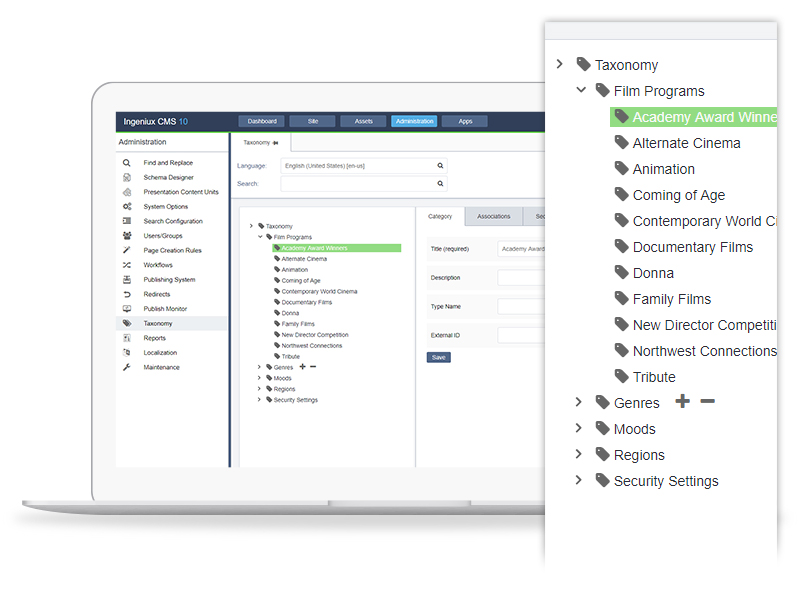
Taxonomy features are not that robust and thus could be made more rich for users looking to categorize their content.
Deploying Joomla! for clients has helped them discover the benefits of using Open Source software while helping them appreciate our expertise.
Because the Joomla! community is smaller than the WP community, we are able to reach a wide range of clients looking for experts in the software, boosting our bottom line.
Occasionally a client will find Joomla! too complicated and wish to move to a proprietary DIY CMS, which we do not support, so we have lost clients looking for that level of flexibility.