Jahia is a Java-based enterprise content management system. It features an integrated user portal, web publishing and content management, document management, collaboration, and multi-channel publishing.
N/A
Prismic
Score 10.0 out of 10
N/A
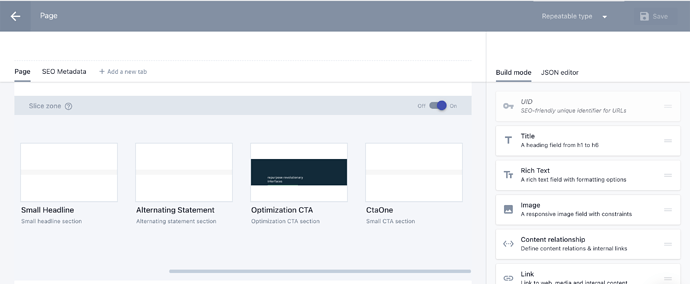
Prismic (prismic.io) is a headless API-driven content management system (CMS). The Page Builder lets marketers create and update pages, launch campaigns, and manage content without breaking design or relying on developers.
$15
per month
Pricing
Jahia Digital Experience Platform
Prismic
Editions & Modules
No answers on this topic
Starter
$15
per month
Small
$30
per month
Medium
$180
per month
Platinum
$750
per month
Enterprise
Custom Pricing
Offerings
Pricing Offerings
Jahia Digital Experience Platform
Prismic
Free Trial
Yes
Yes
Free/Freemium Version
Yes
Yes
Premium Consulting/Integration Services
No
No
Entry-level Setup Fee
No setup fee
No setup fee
Additional Details
—
—
More Pricing Information
Community Pulse
Jahia Digital Experience Platform
Prismic
Considered Both Products
Jahia Digital Experience Platform
Verified User
Anonymous
Chose Jahia Digital Experience Platform
Jahia is a high level platform from a functional and technical point of view. Its technical architecture best met our expectations of flexibility and performance and future contributors easily grasped the concepts and interface of the solution.
I would say that the Jahia Digital Experience Platform is definitely easiest when it comes to content management. The ease of use when everything is properly implemented is very high. Other platforms have significantly higher effort to make content from scratch in my opinion. …
Jahia provides a similar user experience to other CMS I have used in the past - it features a simple interface that makes navigating and learning how to use the platform easy and the ability to copy and paste content saves time and effort when building new pages. The ease in …
A lot of these technologies are very close when it comes to the technology capabilities, but Jahia came across as the best company to work with in terms of understanding our needs and collaborating with us to deliver the results that the business wanted to see. Finding a …
Jahia is better with multi-site management capabilities. Jahia is suitable for organization like ours which has strict security requirement.Jahia offers developer friendly environment with robust APIs.
Liferay was our previous CMS, and while it had some perks it was old and slow (we lived with an outdated version). Jahia Digital Experience Platform and Liferay are very similar from an architecture standpoint and that's why we switched to Jahia Digital Experience Platform. …
Jahia goes head-to-head with other leading DXP platforms. We found it had the features our customers prioritized without overcomplicated interfaces and implementations. We work with clients who have built out other DXPs in ways that are cumbersome and even painful to maintain …
Jahia Digital Experience Platform is a good alternative to other CMS especially on the performance side. It is as easy to use as more common CMS. The installation is easier than an equivalent Wordpress environment.
Compared with its free competitors, which are developed by developers all over the world, Jahia has complete control over its DX product, which makes it extremely stable. Bugs are under control and the few that do occur are quickly corrected. The same goes for the modules. They …
Jahia is more cost effective and catered to our inhouse development skills. The multi-site support is also very enterprise and organized which allows for us to manage our client relationships with ease when it comes to the web and content. The main driver for our selection was …
Sales and engagement swayed us to purchase Jahia Digital Experience Platform. Personally, I would have gone with Sitecore Experience Platform due to the tech stack. Sitecore Experience Platform never provided anything but a canned demo. Jahia Digital Experience Platform …
It was already used when I arrived at this job, so I can't say I [picked] this software. However, I used it 10 years ago, and I can see that they really improved the solution, and the interface is much more enjoyable now.
Jahia is more ergonomic and easier to use. Integration with other applications is facilitated by its modular design and its development in the java language.
Jahia relies on the Java technology. WordPress is based on PHP. The communities are quite different. The WordPress community is bigger but more for web designers as Jahia is more for developers.
As we wanted more customization capability, we chose Jahia because it appeared to fit better in this aspect with its capacity for personalization. The intuitive interface of Jahia also caught our attention since it would be easier for other users in the company to adapt to the …
Jahia provides a more user-friendly and easy interface. Content contribution, editing and specific role-based security on contents can be easily implemented.
These are the four we traditionally see still. Jahia ranks high when we have a client not needing the brand awareness of Adobe. Not wanting the .Net of Sitecore, and not wanting the PHP of Acquia.
Jahia compares favorably against products like Acquia and Sitecore. Each has their pros and cons. Jahia tends to outperform the competitors in the areas such as ease of integration, contextual content edit experience, and price. Jahia is also very well suited for Java-centric …
Liferay is a good product with a broad community and a strong integration capability but a weak contribution interface and no website management easiness.Drupal is good for simple website needs, with a very large community and modules. But it's architecture is too unstable, …
Jahia is flexible and customizable so it allows its users to develop different of pages. However, such work requires additional resources and expertise of third party professionals. Other products I used have been more self sufficient by providing a high range of tools, …
Jahis is much more powerful than other CMSs that I have used in the past. It is more customizable and more user friendly than WordPress and I think that is a great accomplishment.
We have a large volume of digital content to manage and distribute across various channels, Jahia DX is an excellent choice. Its robust CMS allows for efficient content creation, editing, and management, while its flexible delivery options ensure a consistent user experience across all platforms. While Jahia DX is designed to be user-friendly, some technical knowledge is still required to set up and fully utilize the platform. Businesses with limited IT resources might find it challenging to get the most out of Jahia DX.
It lacks the ability to manage multiple versions of a page or content in general.
The back office interface sometimes encounters bugs or display problems.
It's difficult to keep pre-production sites up to date in terms of content compared to production, because the time required to import/export sites is very long once the site is rich in content.
I would not use Jahia as it proved too complex for our needs and didn't help our over goal of customer satisfaction. Along with the man hours to build and execute, it wasn't worth the hassle
The interface and ergonomics are designed to facilitate the use of the product. The creation of template is easy which allows to minimize the actions necessary for the provision of content.
[I give it this rating because it] was up most of the time. There are so many scheduled reboots that I don't think it would be a good choice for a 95% SLA.
As I was saying, the support makes sure to be available for any question, or any technical point that we may need to discuss about. Moreover, whenever we have an issue with the platform they get alerted and also send us an email so that we are aware. We had multiple complex topics to work on in the past, but they always have been answering our question
I would say that the Jahia Digital Experience Platform is definitely easiest when it comes to content management. The ease of use when everything is properly implemented is very high. Other platforms have significantly higher effort to make content from scratch in my opinion. Expandability via custom development also appears to be easier. This expandability also seems to support more complex functionality than other platforms, possibly due to the ease of modifications.