Google Threat Intelligence (Mandiant) vs. Microsoft Sentinel

Overview
ProductRatingMost Used ByProduct SummaryStarting Price
Google Threat Intelligence (Mandiant)
Score 8.8 out of 10
Enterprise companies (1,001+ employees)
Google Threat Intelligence, based on the expertise and service of Mandiant, aims to accelerate security and risk decision making – operational as well as strategic – and to enable security teams to focus on threats that matter to them.N/A
Microsoft Sentinel
Score 8.6 out of 10
N/A
Microsoft Sentinel (formerly Azure Sentinel) is designed as a birds-eye view across the enterprise. It is presented as a security information and event management (SIEM) solution for proactive threat detection, investigation, and response.
$2.46
per GB ingested
Pricing
Google Threat Intelligence (Mandiant)Microsoft Sentinel
Editions & Modules
No answers on this topic
Azure Sentinel
$2.46
per GB ingested
100 GB per day
$123.00
per day
200 GB per day
$221.40
per day
300 GB per day
$319.80
per day
400 GB per day
$410.00
per day
500 GB per day
$492.00
per day
More than 500 GB per day
$492.00 + $98.40
per day/plus each additional 100 GB increment
Offerings
Pricing Offerings
Google Threat Intelligence (Mandiant)Microsoft Sentinel
Free Trial
YesYes
Free/Freemium Version
YesNo
Premium Consulting/Integration Services
YesNo
Entry-level Setup FeeOptionalNo setup fee
Additional DetailsPriced by company size
More Pricing Information
Community Pulse
Google Threat Intelligence (Mandiant)Microsoft Sentinel
Features
Google Threat Intelligence (Mandiant)Microsoft Sentinel
Endpoint Security
Comparison of Endpoint Security features of Product A and Product B
Google Threat Intelligence (Mandiant)
7.2
6 Ratings
0% below category average
Microsoft Sentinel
-
Ratings
Infection Remediation7.26 Ratings00 Ratings
Threat Intelligence
Comparison of Threat Intelligence features of Product A and Product B
Google Threat Intelligence (Mandiant)
7.8
10 Ratings
8% above category average
Microsoft Sentinel
-
Ratings
Network Analytics7.79 Ratings00 Ratings
Threat Recognition7.89 Ratings00 Ratings
Vulnerability Classification7.510 Ratings00 Ratings
Automated Alerts and Reporting8.09 Ratings00 Ratings
Threat Analysis7.510 Ratings00 Ratings
Threat Intelligence Reporting8.210 Ratings00 Ratings
Automated Threat Identification7.99 Ratings00 Ratings
Security Information and Event Management (SIEM)
Comparison of Security Information and Event Management (SIEM) features of Product A and Product B
Google Threat Intelligence (Mandiant)
-
Ratings
Microsoft Sentinel
8.0
31 Ratings
2% above category average
Centralized event and log data collection00 Ratings8.630 Ratings
Correlation00 Ratings8.431 Ratings
Event and log normalization/management00 Ratings8.031 Ratings
Deployment flexibility00 Ratings6.929 Ratings
Integration with Identity and Access Management Tools00 Ratings8.329 Ratings
Custom dashboards and workspaces00 Ratings8.031 Ratings
Host and network-based intrusion detection00 Ratings8.126 Ratings
Data integration/API management00 Ratings7.829 Ratings
Behavioral analytics and baselining00 Ratings8.027 Ratings
Rules-based and algorithmic detection thresholds00 Ratings8.429 Ratings
Response orchestration and automation00 Ratings8.428 Ratings
Reporting and compliance management00 Ratings7.35 Ratings
Incident indexing/searching00 Ratings8.429 Ratings
Best Alternatives
Google Threat Intelligence (Mandiant)Microsoft Sentinel
Small Businesses
OpenText Core Endpoint Protection
Score 7.9 out of 10
LevelBlue USM Anywhere
Score 7.7 out of 10
Medium-sized Companies
CrowdStrike Falcon
CrowdStrike Falcon
Score 9.1 out of 10
Sumo Logic
Sumo Logic
Score 8.8 out of 10
Enterprises
CrowdStrike Falcon
CrowdStrike Falcon
Score 9.1 out of 10
Sumo Logic
Sumo Logic
Score 8.8 out of 10
All AlternativesView all alternativesView all alternatives
User Ratings
Google Threat Intelligence (Mandiant)Microsoft Sentinel
Likelihood to Recommend
7.8
(18 ratings)
8.7
(53 ratings)
Likelihood to Renew
-
(0 ratings)
6.8
(2 ratings)
Usability
7.6
(18 ratings)
6.5
(7 ratings)
Support Rating
-
(0 ratings)
8.0
(3 ratings)
Professional Services
-
(0 ratings)
5.0
(1 ratings)
User Testimonials
Google Threat Intelligence (Mandiant)Microsoft Sentinel
Likelihood to Recommend
Google
Usually SOC leverages Intel from mutiple sources. The scenarios are: 1.Suitable: In large scale SOC where more than 5000 devices are being monitored and the tech stack is wide, Mandiant will play an excellent role in that scenario. 2.Not Suitable: In small scale SOCs wherein limited devices belonging to the same tech stack is being used then the analysts can rely on OSINT and it is not useful to buy the solution.
Read full review
Microsoft
It's certainly well-suited in environments that rely heavily on Microsoft products, and it's well-suited for environments where you have other business drivers to go to the E5 license. If I were to say where I would not and why, I only gave it a seven on the recommendation, that answer would probably vary if you already owned E5 or not. It's extremely expensive. And if there are other alternatives, if you don't have any other driving reason to go to E5, I would coach you not to go to Microsoft Sentinel. But if you're there, it's a fantastic property. It's certainly part of the cost argument for moving to E5, but it's only a part. It can't by itself justify the move to E5.
Read full review
Pros
Google
  • accelerated threat response feature, prioritizing threats according to requirement.
  • Optimization of the threat intelligence , and can be integrated with 3rd party tools.
  • Features like - Breach ,Adversary, Machine and Operational Intelligence.
  • Mandiant dynamic host and the malware views along with indicators.
Read full review
Microsoft
  • It's the scale. Having built-in detections and vulnerabilities and the ability to see into the traffic flows is absolutely key. Look at it from my perspective as network security. We want to see what's going on east, west, between all the kinds of subscriptions and the tenants. We don't have that. We don't have that with any other product. Microsoft Sentinel gives us that kind of visibility.
Read full review
Cons
Google
  • Paywalls exist throughout the data set and can halt an investigation without the right model
  • Some data was incomplete or broken up between pay tiers
  • Navigation through the data lacked a definitive trail or breadcrumbs to retrace steps during investigations
Read full review
Microsoft
  • An area for improvement is how case management is surfaced within the Microsoft Sentinel experience, as clearer integration into Sentinel workflows would reduce context switching and improve incident handling.
  • There is an opportunity to further expand agentic, autonomous investigation and response capabilities.
Read full review
Likelihood to Renew
Google
No answers on this topic
Microsoft
it does the job reasonably well
Read full review
Usability
Google
Mandiant Advantage Threat Intelligence has a very usable platform, with well-differentiated sections for the analyst, as well as the possibility of cross-searching to obtain the desired results. All this is presented with an interface that is easy on the eye and not very messy, which increases productivity and the speed with which work is done.
Read full review
Microsoft
Because, as I said, it still lacks a lot of things, like many playbooks outside the Copilot integrations and the actual remediation. For example, for Microsoft Sentinel and SAP, I would want to see Copilot doing a lot of remediations in Microsoft Sentinel at SAPN, like executing the transaction code, maybe creating certain increases, or remediating stuff like that, which is all customized.
Read full review
Support Rating
Google
No answers on this topic
Microsoft
Microsoft support is one of the highest rated on the market. It has global and multilingual support. Calls can be made over the phone and the solution is virtually instantaneous with the help of Microsoft engineers. It's great!
Read full review
Alternatives Considered
Google
It gives more ways to analyze threats and options to fixed it. This device gives more visibility on vulnerability detection and its analysis. It provides detailed reports to have more information of all malwares which help us to increase overall security of our current organization
Read full review
Microsoft
Microsoft Sentinel excels in cloud-native scalability, Microsoft ecosystem integration, and AI-driven threat detection with UEBA and Fusion rules, offering faster deployment and lower costs (48% cheaper per Forrester) than Splunk, QRadar, Exabeam, SentinelOne, Securonix, and Wazuh. It lags in third-party integrations and syslog parsing. Organizations choose Microsoft Sentinel for its cost-effectiveness, automation, and Microsoft synergy, especially in Azure-heavy environments, though Splunk and Exabeam lead in flexibility and UEBA, respectively.
Read full review
Professional Services
Google
No answers on this topic
Microsoft
Did not use professional services
Read full review
Return on Investment
Google
  • Improved incident response time
  • Specific investigations that have reduced the attack surface
  • Technical reports on threats not controlled by the bank's local team
Read full review
Microsoft
  • As any cybersecurity product, this has to be more with risk to avoid loss in case of a ransomware that more than relate to a productivity increase. Maybe the impact could be that instead of having people that are checking 24/7 the dashboard, you could implement Sentinel and have less people checking that or people with less expertise. So the saving will be a minor but will be a saving in the cost of your team.
Read full review
ScreenShots

Google Threat Intelligence (Mandiant) Screenshots

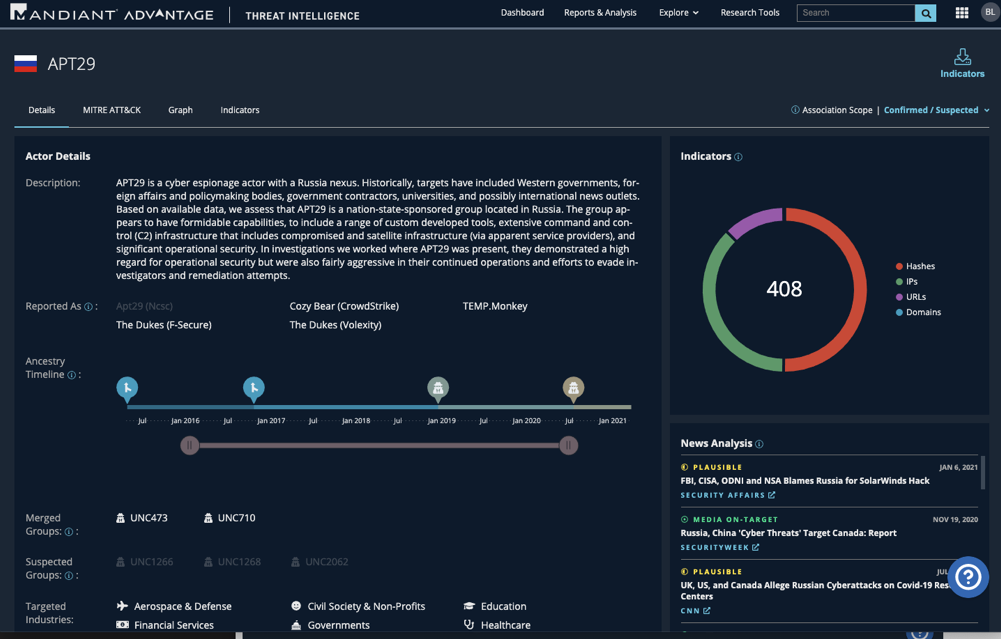
Screenshot of Mandiant Advantage DashboardScreenshot of Mandiant Advantage Actor DetailsScreenshot of Mandiant Advantage Actor Graph

Microsoft Sentinel Screenshots

Screenshot of Screenshot of Screenshot of Microsoft Sentinel Capabilities